Multiplication practice Arrays Worksheets for Ages 4-8
4 filtered results
-
From - To
Help your child master multiplication with our "Multiplication Practice Arrays Worksheets" designed for ages 4-8! These engaging, printable worksheets use visual arrays to simplify the learning process, making it easy for young learners to grasp basic multiplication concepts. Colorful and fun, they encourage children to solve problems by counting rows and columns, enhancing their number sense and foundational math skills. Ideal for classroom or home use, these worksheets foster confidence in math, setting your child on the path to success. Download now and turn multiplication practice into an enjoyable learning adventure!
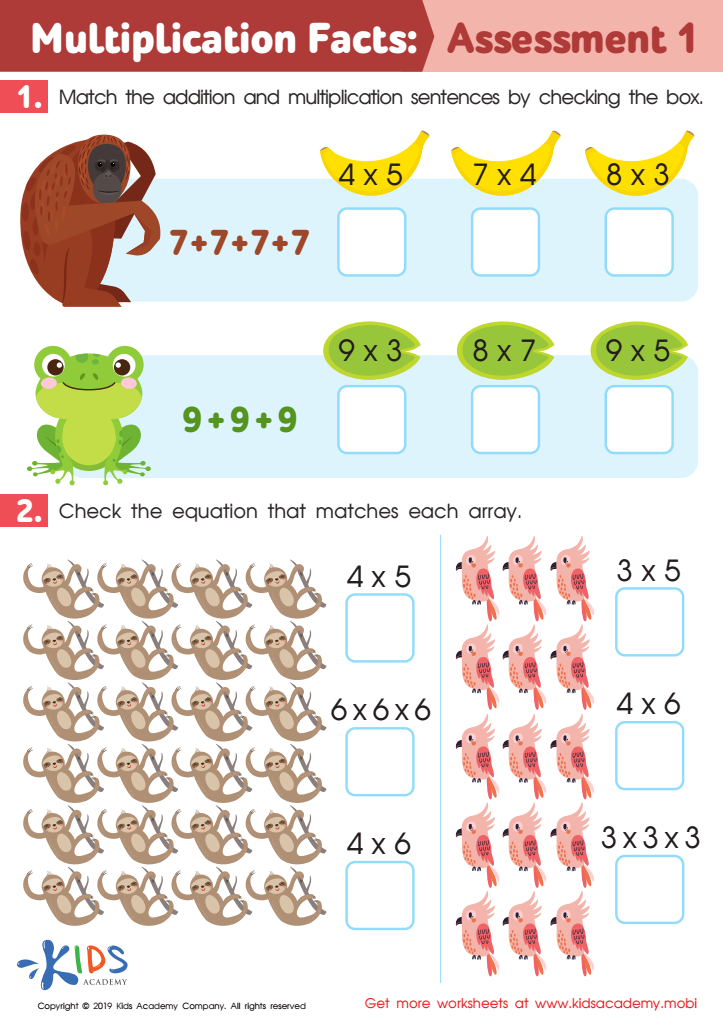
Multiplication Facts: Assessment 1 Worksheet
 Assign to My Students
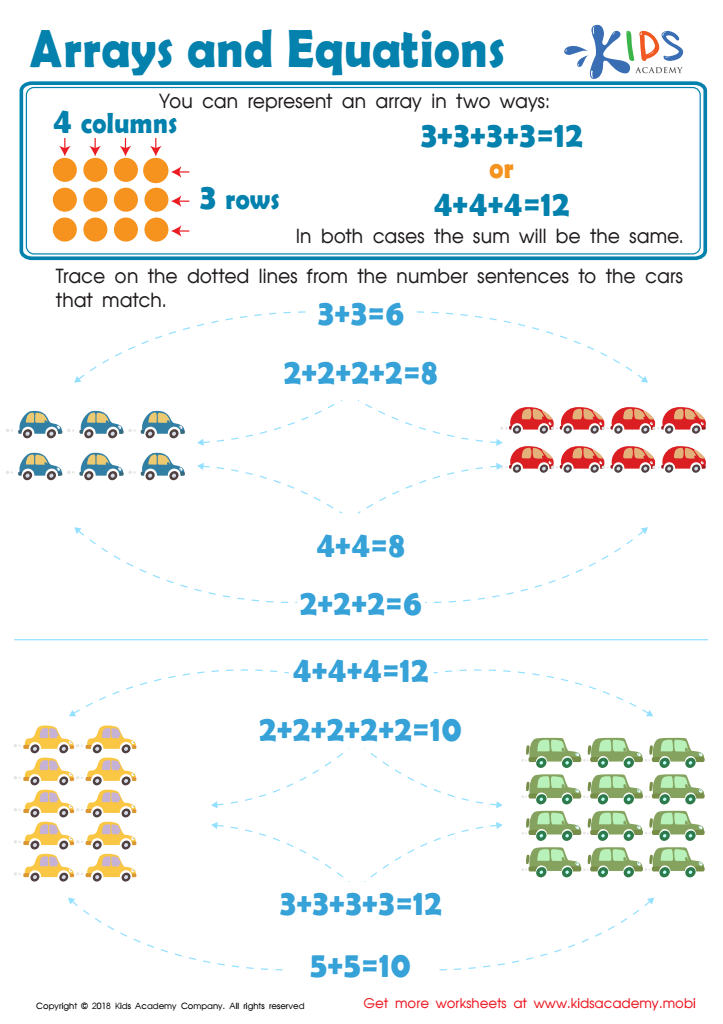
Arrays and Equations Worksheet
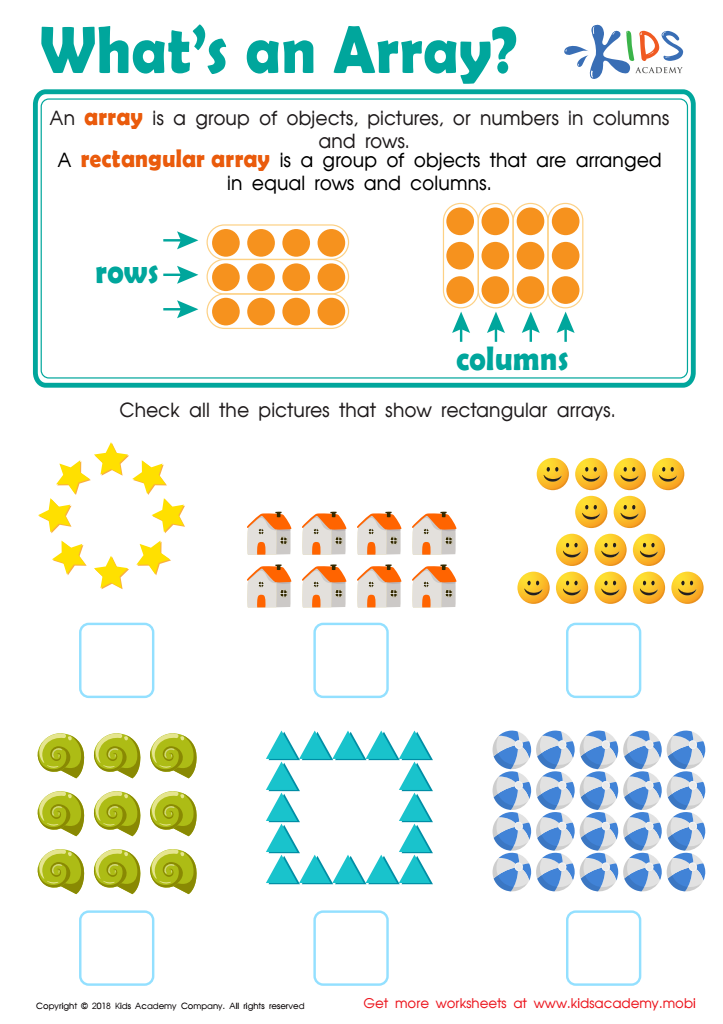
What's an Array? Worksheet
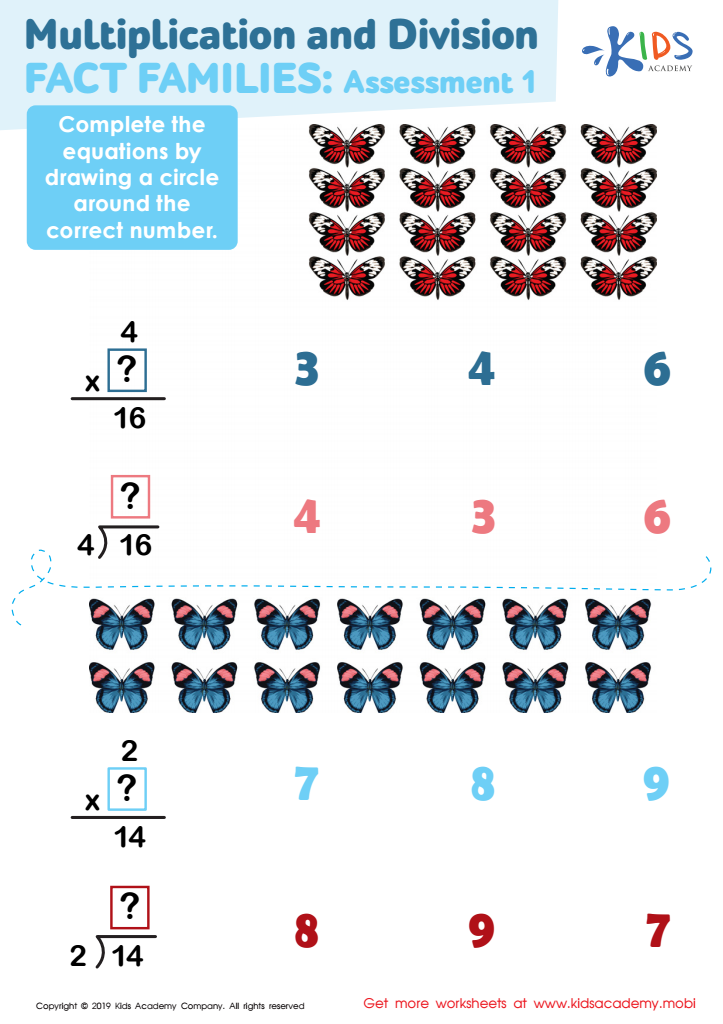
Multiplication and Division Fact Families Assessment 1 Worksheet








Multiplication practice arrays are vital learning tools for children ages 4-8 as they lay the foundation for understanding multiplication, an essential mathematical skill. Arrays help young learners visualize multiplication concepts by organizing objects into rows and columns, making abstract ideas more concrete and easier to grasp. For instance, a 3x4 array, where objects are arranged in 3 rows and 4 columns, visually represents the multiplication fact 3x4=12.
By using arrays, children can see the relationship between repeated addition and multiplication, which deepens their comprehension. This method also supports the development of problem-solving skills and pattern recognition. Additionally, working with arrays aligns with various learning styles, especially for visual and kinesthetic learners who benefit from seeing and manipulating objects.
Introducing arrays at an early age ensures children build a strong mathematical foundation, crucial for later academic success. It prepares them for more advanced topics such as area, algebra, and higher-order arithmetic operations. Thus, parents and teachers should prioritize multiplication practice arrays to foster confident, proficient mathematicians, reinforcing essential life skills like logical thinking, attention to detail, and perseverance in problem-solving. Arrays transform multiplication from a daunting task into an engaging, comprehensible activity, setting the stage for future learning motivation and achievement.








