
Counting practice Money Worksheets for Ages 4-8
6 filtered results
Difficulty Level
Grade
Age
-
From - To
Subject
Activity
Standards
Introducing our engaging Counting Practice Money Worksheets tailored for ages 4-8! These meticulously designed worksheets aim to build your child's foundational math skills by teaching them to recognize and count different denominations. From identifying coins and bills to solving fun, practical problems, our worksheets make learning about money an enjoyable and interactive experience. Perfect for enhancing vocabulary, arithmetic, and cognitive development, these exercises blend education with play. Boost your child's confidence in handling money with our comprehensive counting practice worksheets, guiding them smoothly from simple recognition to advanced counting tasks in a fun, hands-on way.
Favorites
With answer key
Interactive
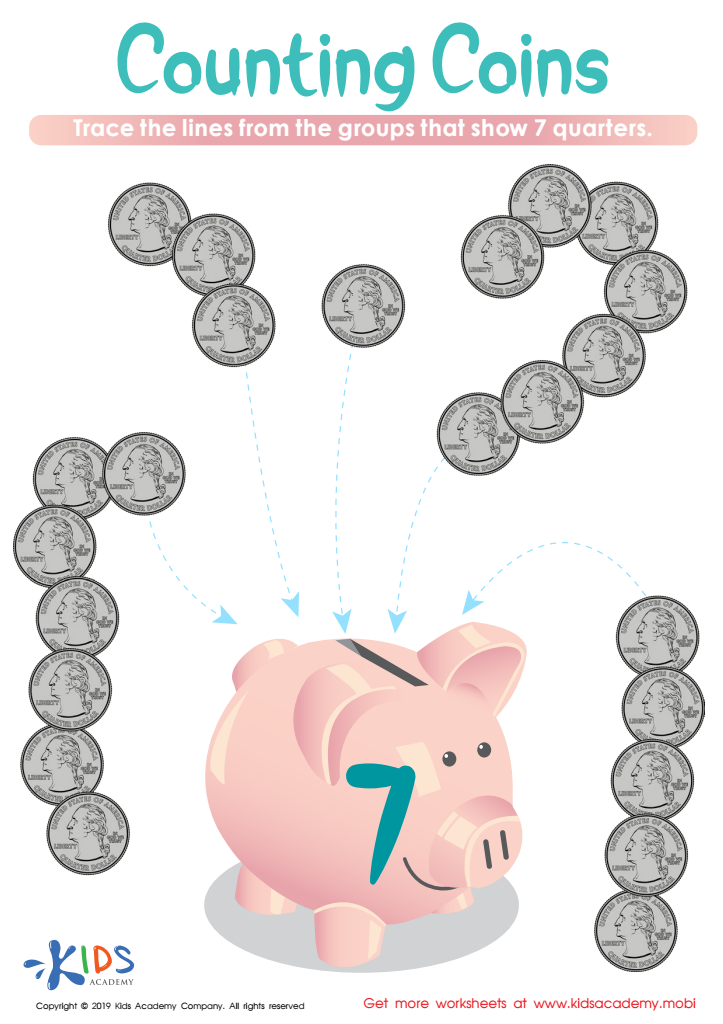
Counting Coins Worksheet
Help your students overcome their fear or aversion of counting and learning numbers with this fun worksheet! It features colorful pictures with four groups of coins. Ask the students to count each group, then trace the lines to the piggy bank. Show them it's easy to count and learn numbers!
 Assign to My Students
Counting Coins Worksheet
Worksheet
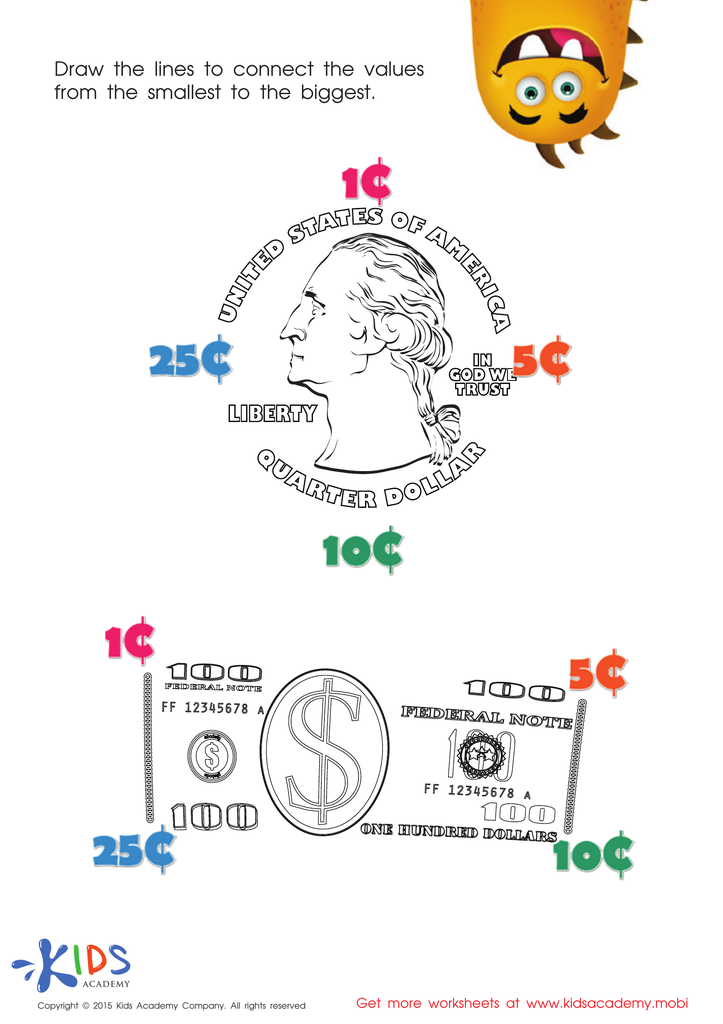
Connecting the Values Money Worksheet
Counting games are a fun way to teach kids about money and counting money. We've learnt the penny, nickel, dime and quarter - can you identify them from the pictures? Draw a line from the smallest to the biggest value and remember the order. Kids Academy has more fun and informative worksheets on counting money.
Connecting the Values Money Worksheet
Worksheet
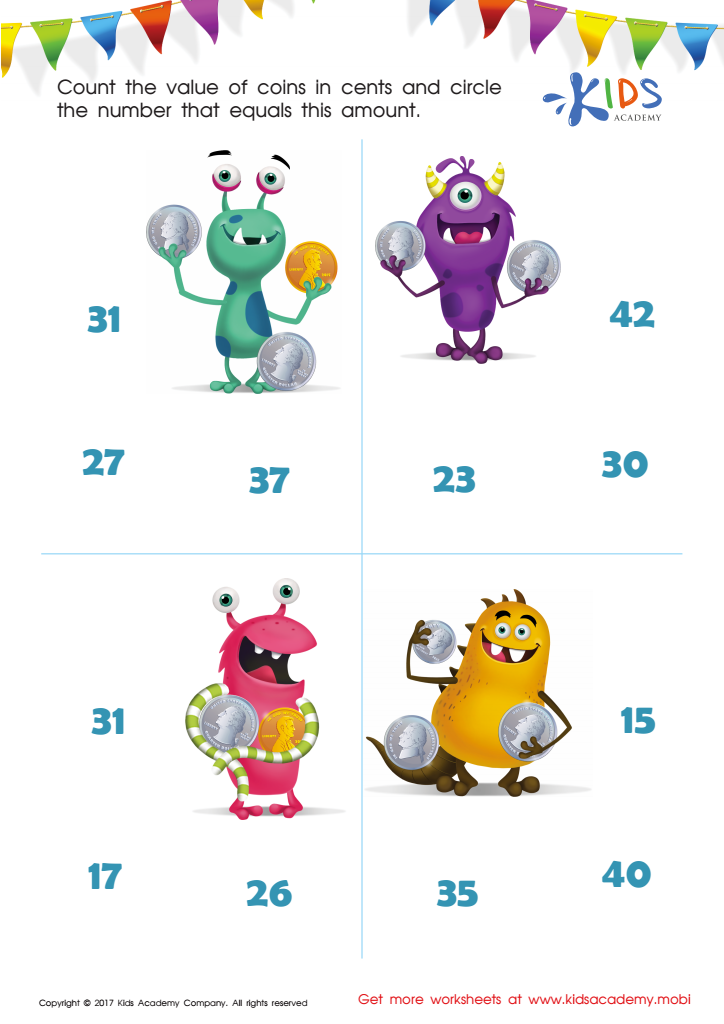
How Many Coins Money Worksheet
Have fun while counting coins: look at the monsters and count the coins in their hands. Challenge your little learners to count and write down the number of coins each one has. Enjoy the time together!
How Many Coins Money Worksheet
Worksheet
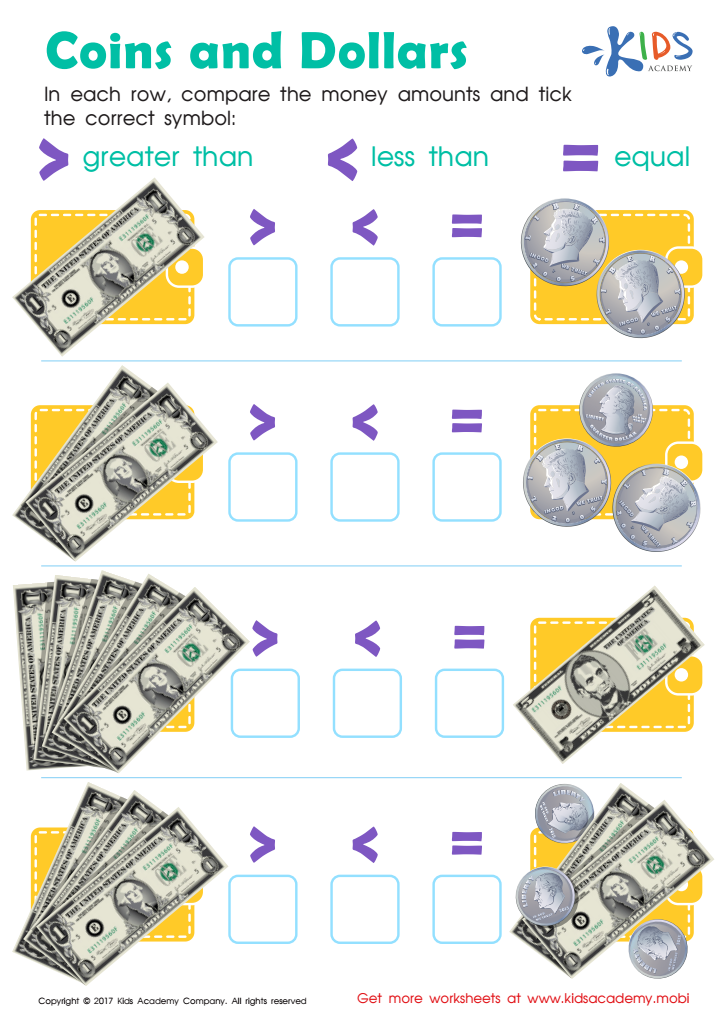
Money: Coins Dollars Printable
Motivate your kid to learn and practise essential math skills, like 'greater than' and 'less than', by introducing the importance of money! The money worksheet "Coins and Dollars" will give them a hands-on experience of counting coins and dollars, making math symbols more memorable.
Money: Coins Dollars Printable
Worksheet
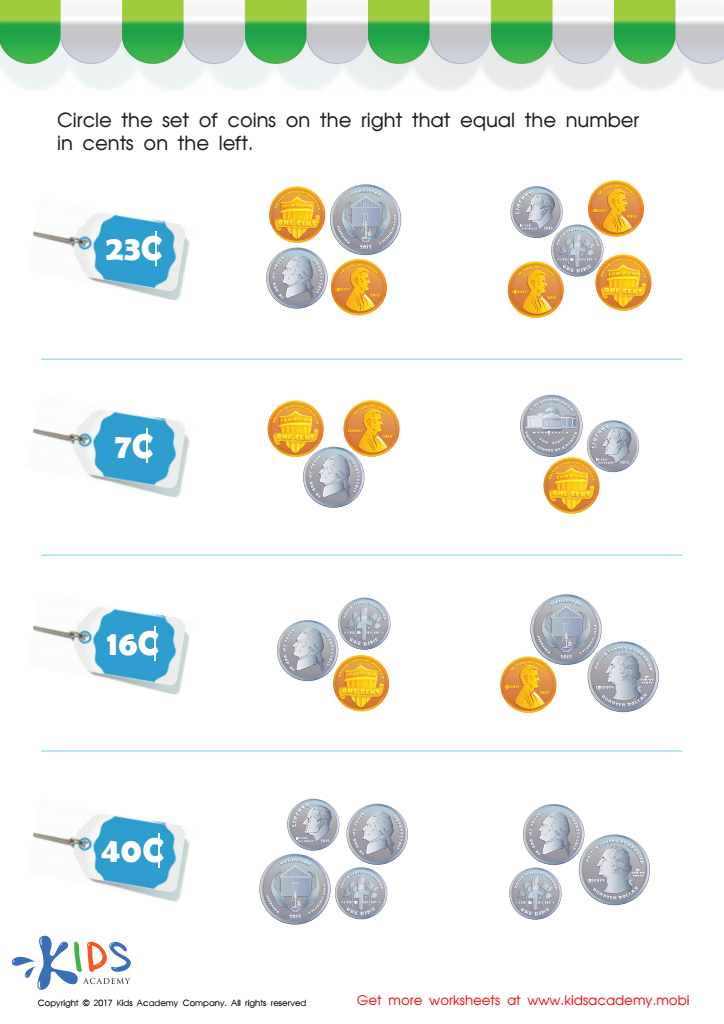
Picking the Coins You Need Money Worksheet
Let's learn to count money with Parents and Kids Academy! Investigate a real shop together: buy a globe, pencils, books, and a school bag using coins. Then, circle the coins you'll need. Visit our website for more free and fun money games for kids!
Picking the Coins You Need Money Worksheet
Worksheet
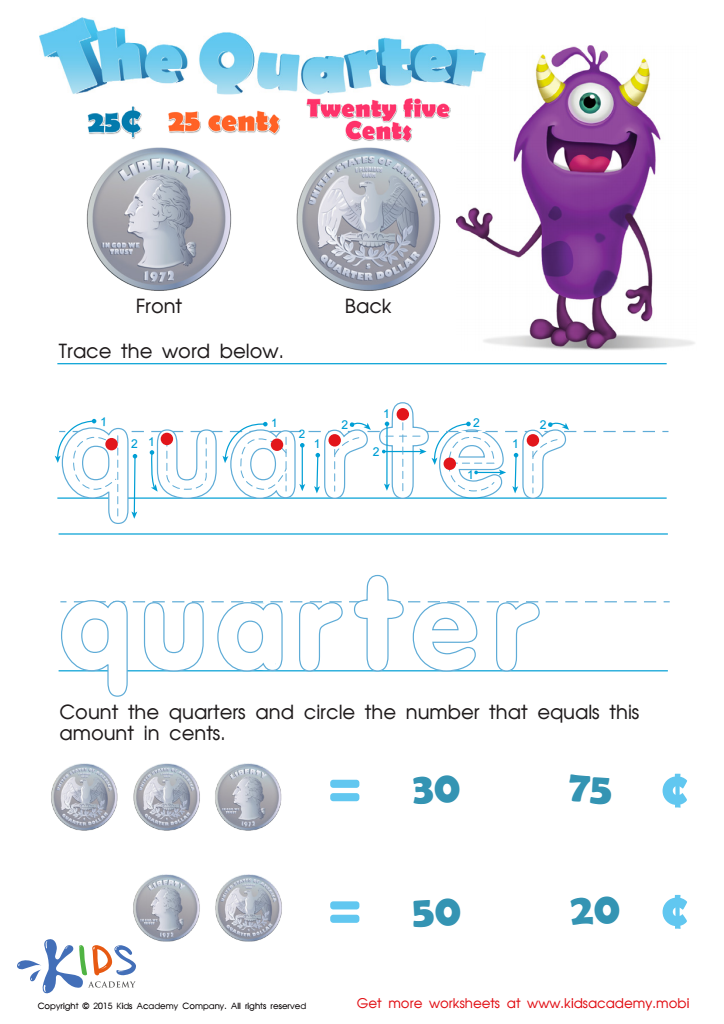
Twenty Five Cents or the Quarter Money Worksheet
Check out our new printable money games - learn to count money easily! With quarters, trace the word, count them and calculate the amount in cents. More worksheets at our website. Give it a try!
Twenty Five Cents or the Quarter Money Worksheet
Worksheet
Join Kids Academy for Free
Who is primarily going to use this learning content?








Counting practice using money for children aged 4-8 is crucial for several developmental and educational reasons. First, it builds foundational math skills. Through handling coins and bills, children learn to count, add, and subtract, establishing early numeracy skills that are essential for their academic progress.
Second, it introduces real-world applications. Money is a tangible medium that children encounter in daily life. By understanding its value and usage, kids connect classroom learning with real-life situations, making abstract concepts concrete and relatable.
Third, it enhances critical thinking and problem-solving abilities. When children count change or determine if they have enough money to make a purchase, they engage in logical reasoning and decision-making processes.
Additionally, counting money teaches valuable lessons in financial literacy. Early exposure to money concepts helps children develop responsible attitudes toward spending, saving, and budgeting, which are critical life skills.
Engaging young learners in these activities also fosters independence and confidence. As children master counting money, they gain a sense of accomplishment and a confidence boost that encourages further learning.
In summary, introducing money-related counting exercises benefits early-grade students by enhancing basic math skills, connecting learning to real-life scenarios, and fostering important financial and problem-solving abilities. Parents and teachers should care about these activities as they lay a vital foundation for future academic and life success.








