
Developing observational skills Math Worksheets for Ages 4-8
4 filtered results
Difficulty Level
Grade
Age
-
From - To
Subject
Activity
Standards
Enhance your child’s learning journey with our "Developing Observational Skills Math Worksheets" designed for ages 4-8. These engaging worksheets focus on fostering critical thinking and observation, allowing young learners to explore math concepts through visual and hands-on activities. By identifying patterns, shapes, and quantities, children improve their attention to detail, boost problem-solving abilities, and build a strong foundation in mathematics. Whether at home or in the classroom, these worksheets provide a fun, interactive way to reinforce essential skills while nurturing a love for math. Help your child excel in a supportive and enjoyable learning environment with our expertly crafted resources!
Favorites
With answer key
Interactive
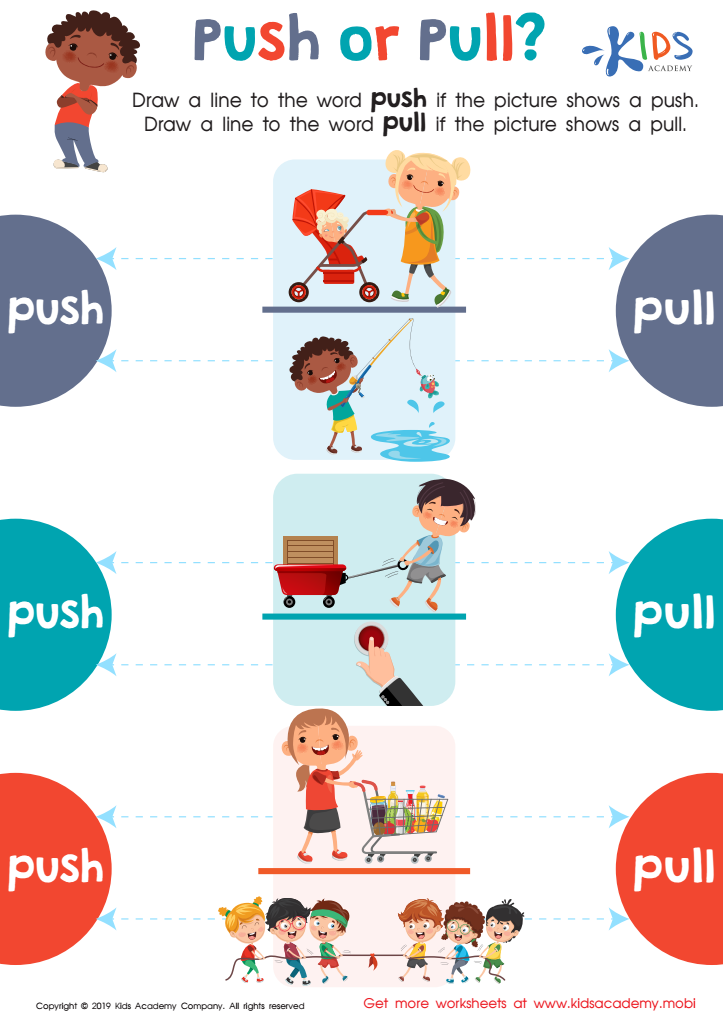
Push or Pull? Worksheet
Young kids may struggle to differentiate push and pull. When they start writing, they may use them interchangeably and wrongly. This worksheet clarifies the concepts: pushing means moving something away, pulling means bringing something closer. It provides pictures and traceable lines for kids to connect each image to the correct word. This helps them understand and remember the difference for future writing and reading.
 Assign to My Students
Push or Pull? Worksheet
Worksheet
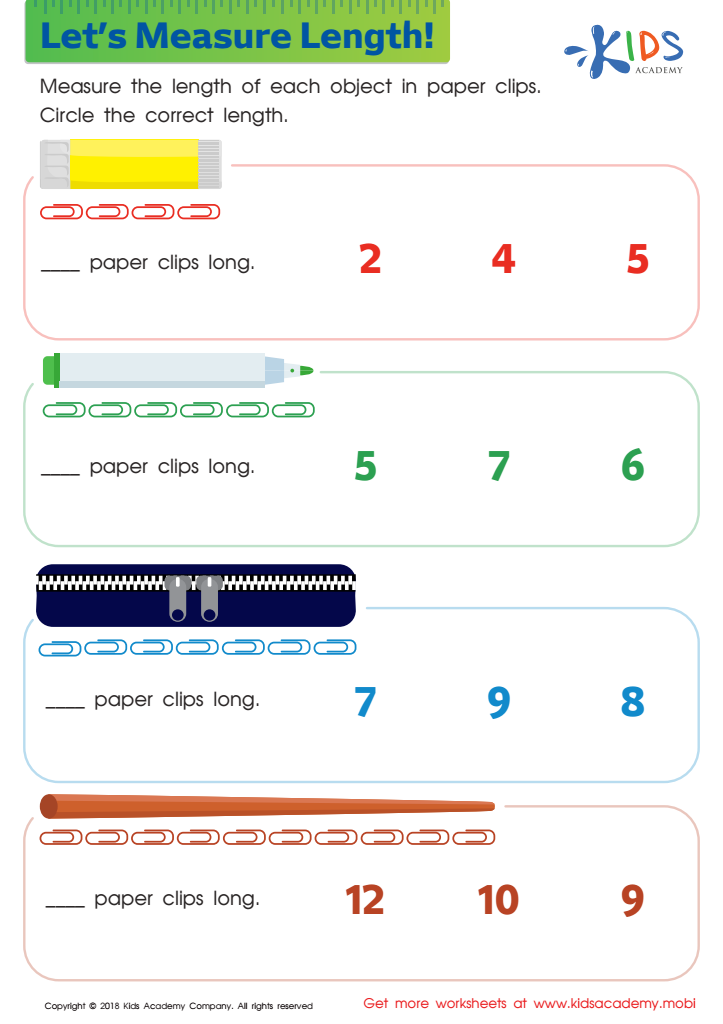
Lets Measure Length Worksheet
It's time to help your child take their measuring skills up a notch! This colorful PDF sheet from Kids Academy introduces kids to measuring with paperclips. Guide them through the page, showing them how to count the clips to measure each image. Then, circle the correct length for each to complete the sheet!
Lets Measure Length Worksheet
Worksheet
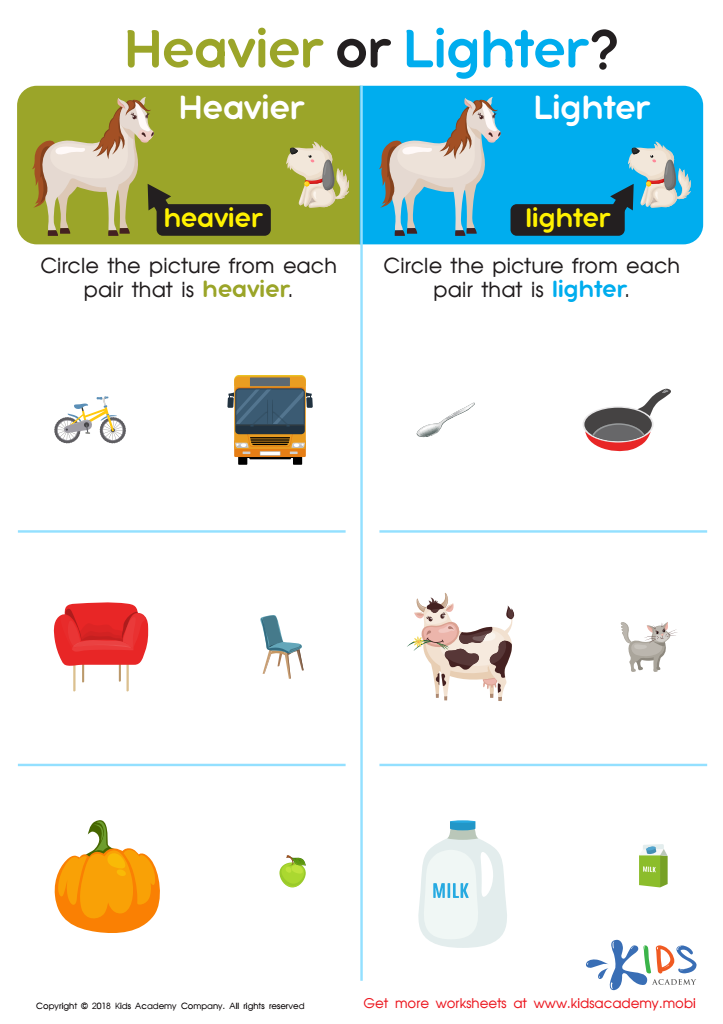
Heavier or Lighter? Worksheet
This PDF provides children an opportunity to practice concepts of heavier and lighter with familiar pictures. They must use fine-motor skills to circle the heavier or lighter item in each pair. Picture clues help build a foundation for future, harder concepts. Kids will love this fun worksheet!
Heavier or Lighter? Worksheet
Worksheet
Join Kids Academy for Free
Who is primarily going to use this learning content?








Developing observational skills in mathematics for children ages 4-8 is crucial for their overall cognitive development and mathematical understanding. At this formative stage, children are naturally curious about the world around them. By honing their observational skills, they learn to notice patterns, shapes, and relationships, laying the groundwork for more complex mathematical concepts.
Teachers and parents play a vital role in fostering these skills through engaging activities that encourage children to explore, analyze, and question their surroundings. Observational skills enhance a child’s ability to classify objects, understand spatial relationships, and compare quantities—abilities essential for mastering addition, subtraction, and even geometry in later years.
Moreover, when children actively engage in observational learning, they develop critical thinking and problem-solving skills that transcend mathematics. These skills also promote self-confidence as children learn to trust their interpretations and findings. Cultivating such abilities sets a positive mindset towards learning and mathematics, reducing anxiety and aversion to the subject.
Support from parents and teachers can make these learning processes joyful and meaningful, as they guide children's curiosity into structured mathematical exploration, fostering lifelong skills that benefit their academic journeys and beyond.








