Enhance vocabulary skills Math Worksheets for Ages 4-8
5 filtered results
-
From - To
Boost your child's vocabulary while developing essential math skills with our engaging Enhance Vocabulary Skills Math Worksheets, designed specifically for ages 4-8. Our worksheets blend language learning with fun math challenges, helping young learners build a robust vocabulary as they grasp core mathematical concepts. Each activity is crafted to enhance word recognition and comprehension, fostering an enjoyable educational experience. Kids will explore math terms through interactive exercises that promote critical thinking and creativity. Perfect for homeschooling or classroom use, these worksheets ensure that vocabulary enrichment becomes an exciting adventure. Start empowering your child's learning journey today!
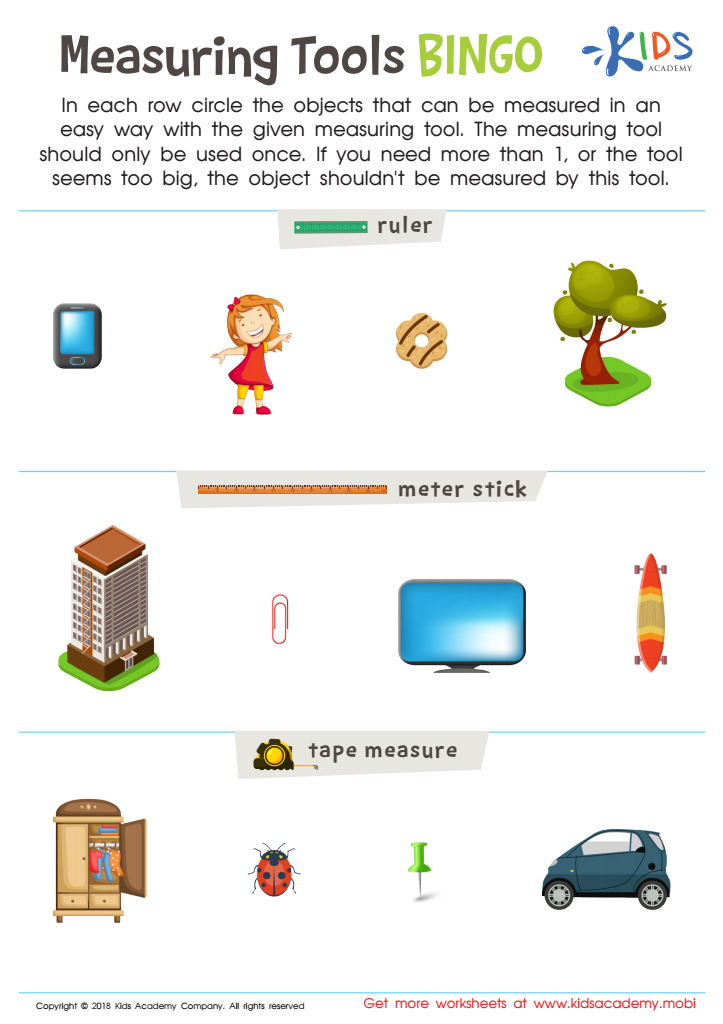
Measuring Tools Bingo Worksheet
 Assign to My Students








Enhancing vocabulary skills in mathematics for children aged 4-8 is crucial for several reasons. First, a solid mathematical vocabulary forms the foundation for understanding concepts such as addition, subtraction, shapes, and measurement. When children can engage with terms like "greater than," "equal," or "triangle," they can better grasp these concepts and apply them in real-world situations.
Second, vocabulary development actually aids in critical thinking and problem-solving. Math is not just about numbers; it involves comprehending questions, following directions, and articulating reasoning. By building a strong math vocabulary, children learn to express their thoughts and strategies clearly.
Additionally, improved vocabulary links to overall language development, enhancing reading comprehension and communication skills. Children who can articulate mathematical ideas are more likely to engage in constructive dialogues about math, making learning a collaborative and enriching experience.
Furthermore, a rich math vocabulary supports the social and emotional aspects of learning. When children feel confident discussing math topics, they tend to have higher self-esteem and are more likely to persevere through challenges.
In summary, fostering vocabulary skills in math from an early age lays the groundwork for academic success, effective communication, and a love for learning. It is essential for parents and teachers to prioritize this aspect of education.








