
Numerical reasoning Math Worksheets for Ages 4-8
3 filtered results
Difficulty Level
Grade
Age
-
From - To
Subject
Activity
Standards
Unlock the potential of young minds with our Numerical Reasoning Math Worksheets for Ages 4-8! These engaging, age-appropriate worksheets from Kids Academy are designed to strengthen your child’s foundational math skills, including counting, number recognition, and basic arithmetic. Each worksheet blends fun challenges with educational content, ensuring kids remain motivated and excited about learning. Tailored for various skill levels, our printables are perfect for classroom use or at-home practice. Foster a love for math early on and watch your child’s confidence soar with our expertly crafted resources. Visit our website for free downloads and start your child’s math journey today!
Favorites
With answer key
Interactive
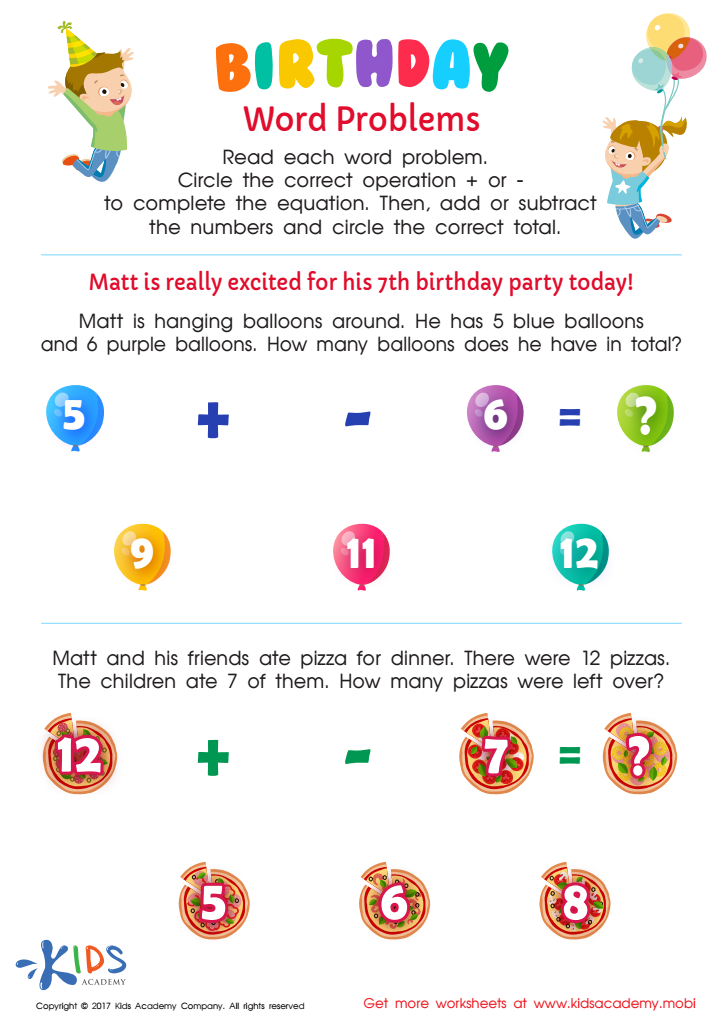
Birthday Word Problems Substraction Worksheet
This worksheet, Birthday Word Problems, is a great way to improve your child's math and literacy skills. It features tricky subtraction equations based on a birthday celebration - perfect for kids who love birthdays!
 Assign to My Students
Birthday Word Problems Substraction Worksheet
Worksheet
Join Kids Academy for Free
Who is primarily going to use this learning content?








Numerical reasoning is a foundational skill that represents more than just the ability to calculate; it involves understanding numbers, recognizing patterns, and applying logical thinking. For children aged 4-8, fostering numerical reasoning early on sets the stage for future academic success and everyday problem-solving abilities.
At this tender age, children's brains are exceptionally receptive and capable of forming new connections. Exposure to numerical concepts helps develop cognitive skills such as memory, attention, and critical thinking. By engaging in activities that include counting, sorting, and recognizing patterns, children learn to make sense of the world around them in a structured way.
Parents and teachers play a vital role in this developmental phase. Encouraging numerical reasoning can be as simple as involving children in everyday situations like grocery shopping, cooking, or playing board games that involve numbers. Such experiences provide practical applications for math concepts, making them easy to grasp and fun.
Furthermore, early competence in numerical reasoning builds confidence. When children realize they can solve problems and make decisions based on logic, they develop a positive attitude toward learning. This early positive mindset can greatly influence their academic journey and their ability to face challenges in the future, fostering persistence and resilience.
Hence, prioritizing numerical reasoning in early childhood education is essential for cultivating a generation of thinkers, problem-solvers, and confident learners.








