
Understand number relationships Math Worksheets for Ages 4-8
3 filtered results
Difficulty Level
Grade
Age
-
From - To
Subject
Activity
Standards
Discover our engaging "Understand Number Relationships" math worksheets designed for children aged 4-8. These worksheets provide a fun and interactive way for young learners to grasp essential math concepts, including counting, number sequencing, and basic comparisons. By using colorful illustrations and age-appropriate exercises, these resources help enhance children's understanding of how numbers relate to each other, fostering critical thinking and problem-solving skills. Perfect for both classroom and home use, our printable worksheets make learning math enjoyable and effective. Encourage your child's mathematical journey today with our comprehensive selection of activities tailored to support their developmental needs!
Favorites
With answer key
Interactive
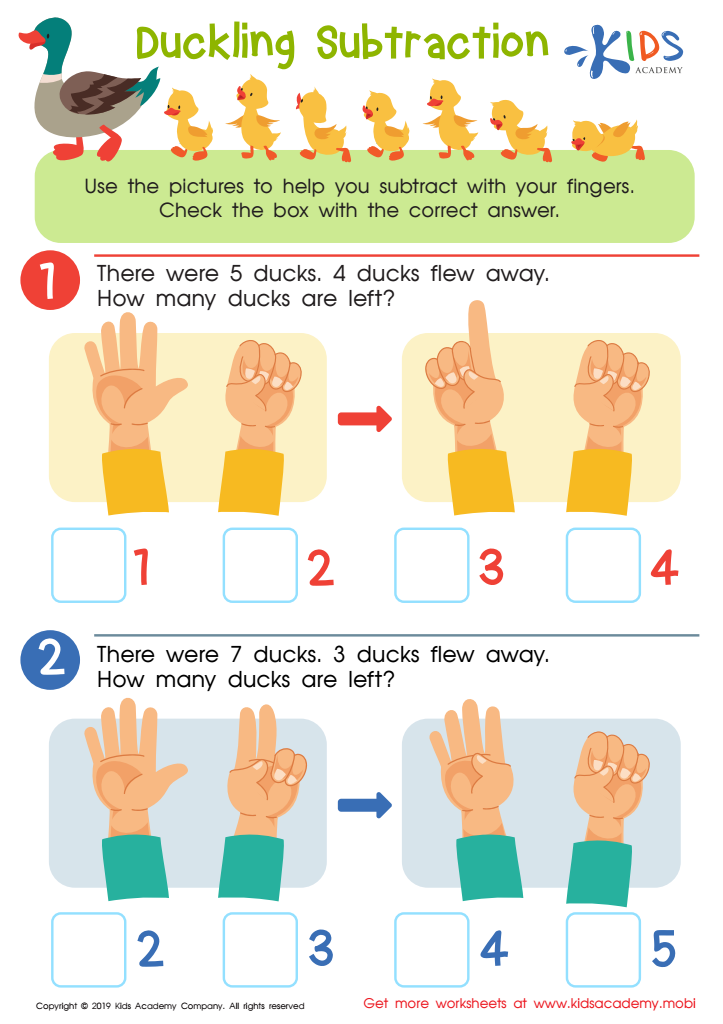
Duckling Subtraction Worksheet
Help your students learn equations and math with this fun worksheet. There are two questions to solve with the help of the pictures. Ask them to subtract with their fingers and check the box with the correct answer. This makes math easier and more enjoyable!
 Assign to My Students
Duckling Subtraction Worksheet
Worksheet
Join Kids Academy for Free
Who is primarily going to use this learning content?








Understanding number relationships during the early years, particularly for children aged 4-8, is crucial for developing a strong foundation in mathematics. This understanding fosters critical thinking and problem-solving skills that extend beyond numeracy. When parents and teachers emphasize number relationships, children learn how numbers interact—how they can be combined, separated, or compared, which equips them to tackle more complex mathematical concepts later on.
This stage of learning helps children make sense of their world. For example, recognizing patterns, understanding greater than and less than, or grasping the concept of addition and subtraction promotes numerical fluency. Kids learn that math isn’t just about rote memorization but about making connections, which can lead to greater confidence in their abilities.
Additionally, a solid grasp of number relationships supports overall cognitive development. It encourages reasoning and logic, which are essential skills not just in math but in reading, science, and everyday decision-making. Ultimately, when parents and teachers invest time in nurturing children's understanding of number relationships, they’re equipping them with essential life skills that can lead to academic success and a more profound appreciation for mathematics as they grow.








