
Understand sequencing Math Worksheets for Ages 4-8
3 filtered results
Difficulty Level
Grade
Age
-
From - To
Subject
Activity
Standards
Discover the fun of sequencing with our engaging math worksheets designed for ages 4-8! These colorful, interactive resources help young learners grasp the fundamental concept of ordering events, numbers, and objects. By practicing sequencing, children enhance their critical thinking and problem-solving skills, laying a strong foundation for future math success. Our worksheets include a variety of activities that cater to different learning styles, making it easy to keep kids motivated and excited about learning. Perfect for classroom activities or at-home practice, these resources encourage cognitive development and provide measurable progress. Start your child's mathematical journey with our effective sequencing worksheets today!
Favorites
With answer key
Interactive
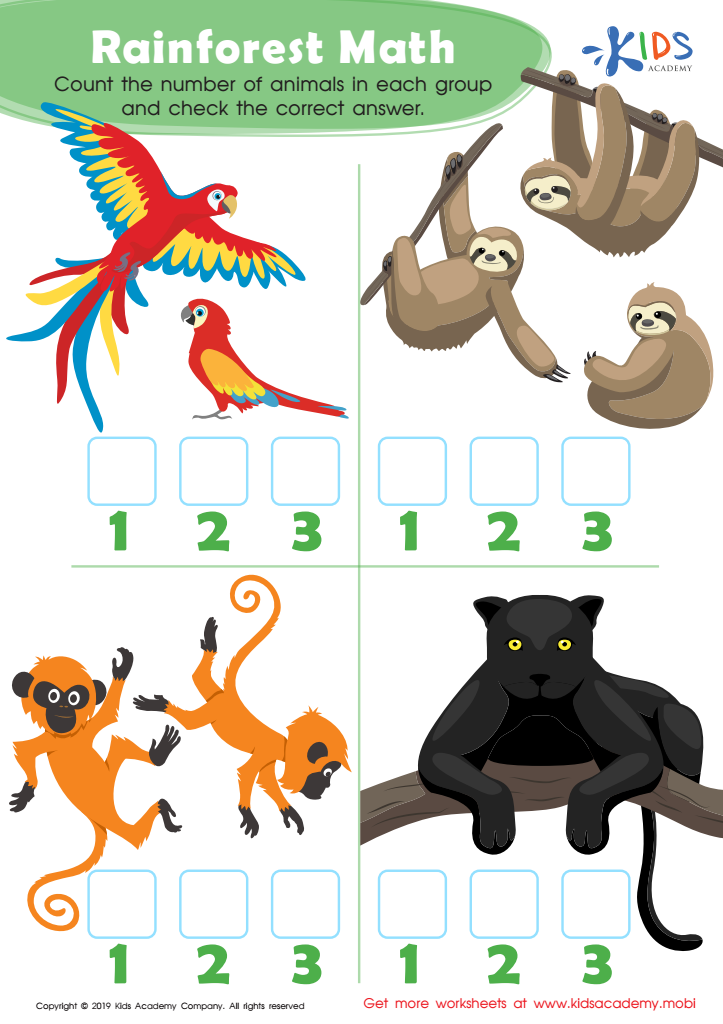
Rainforest Math Worksheet
Kids love learning about rainforest animals! This worksheet helps them with counting and number sense. It features recognizable rainforest animals and asks children to choose the correct number from the answer choices. It's a fun way for children to build their skills - without even knowing it!
 Assign to My Students
Rainforest Math Worksheet
Worksheet
Join Kids Academy for Free
Who is primarily going to use this learning content?





.jpg)


Understanding sequencing in math is crucial for children aged 4-8, as it lays the foundation for various mathematical concepts and problem-solving skills. For parents and teachers, nurturing this understanding is vital because sequencing teaches children how to arrange numbers and events in a logical order, which is essential for basic arithmetic and operations like addition and subtraction.
In early childhood, children learn to recognize patterns, a skill that develops into greater numerical fluency. Sequencing helps them make connections between different concepts, enhancing comprehension and retention. For example, when they learn to follow sequences in solving math problems, they become adept at understanding multi-step processes, which is critical in later years for more complex mathematics.
Moreover, sequencing promotes critical thinking as children analyze order and relationships, a skill that transcends mathematics and is beneficial across all subjects, including reading and writing. Encouraging practice in sequencing can also boost their confidence, setting a positive tone for their overall educational experience. Parents and teachers, therefore, should prioritize sequencing in math as it equips children with tools for academic success and continuous cognitive development.








