Understanding commutative property Math Worksheets for Ages 4-8
4 filtered results
-
From - To
Explore our engaging "Understanding Commutative Property Math Worksheets" designed for children ages 4-8. These worksheets simplify the concept of commutative property, which states that numbers can be added or multiplied in any order and still yield the same result. Fun, interactive problems and vibrant illustrations ensure that young learners grasp this important math skill effortlessly. Parents and teachers can use these printable resources to support classroom learning, boost confidence, and make math fun and accessible. Perfect for early learners aiming to build a strong numerical foundation while enhancing problem-solving skills. Discover the joy of learning with Kids Academy!
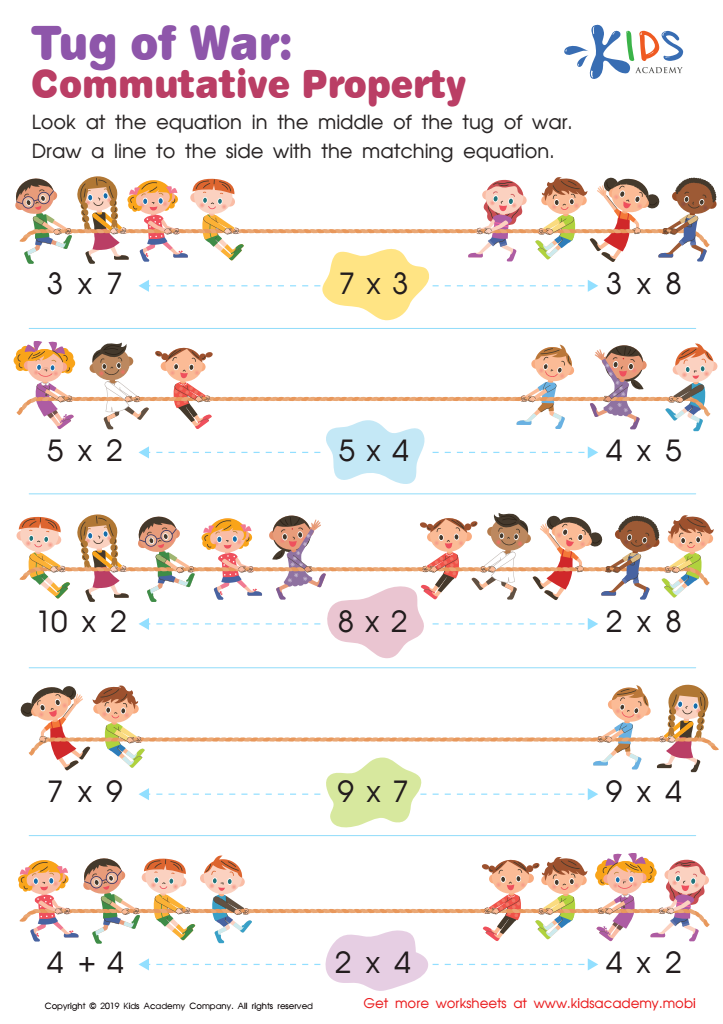
Tug of War: Commutative Property Worksheet
 Assign to My Students
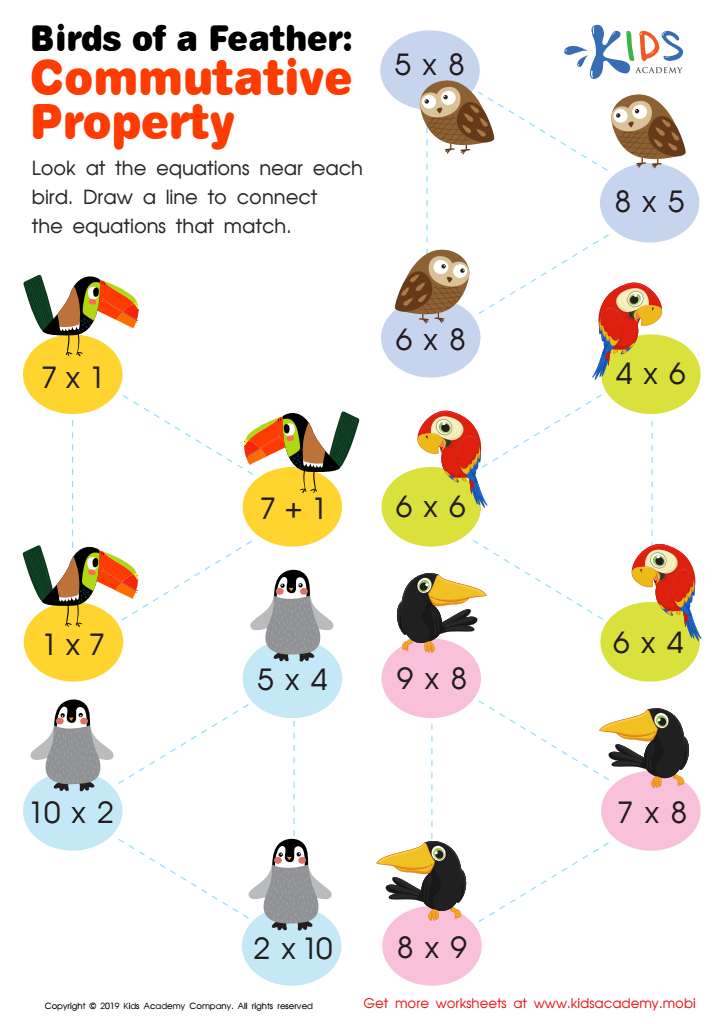
Birds of a Feather: Commutative Property Worksheet
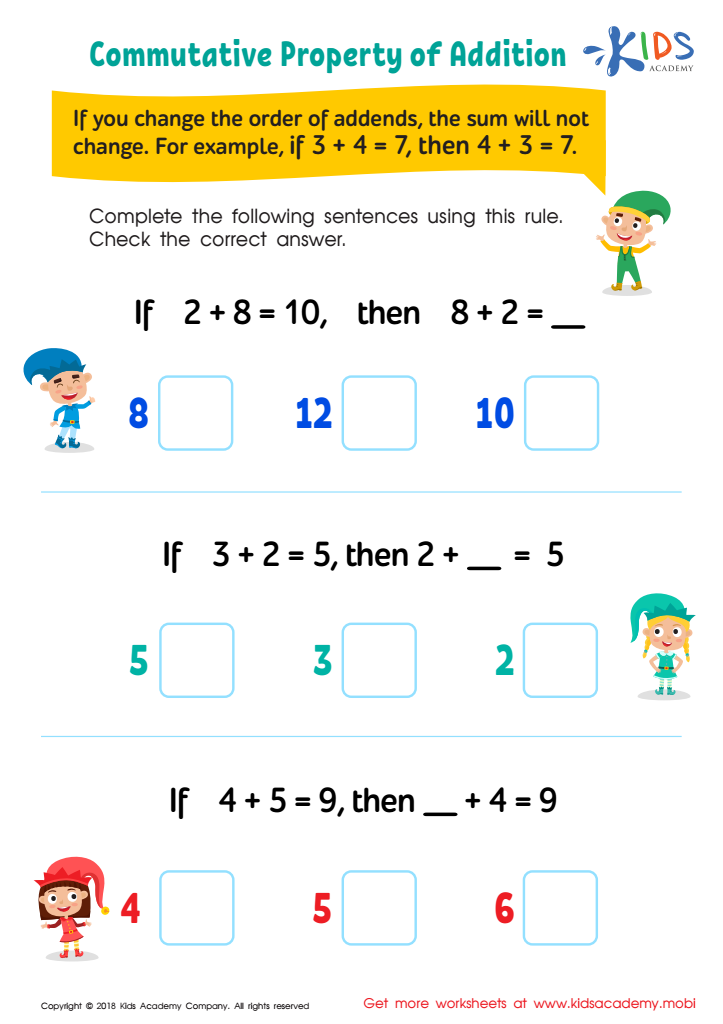
Commutative Property of Addition Worksheet
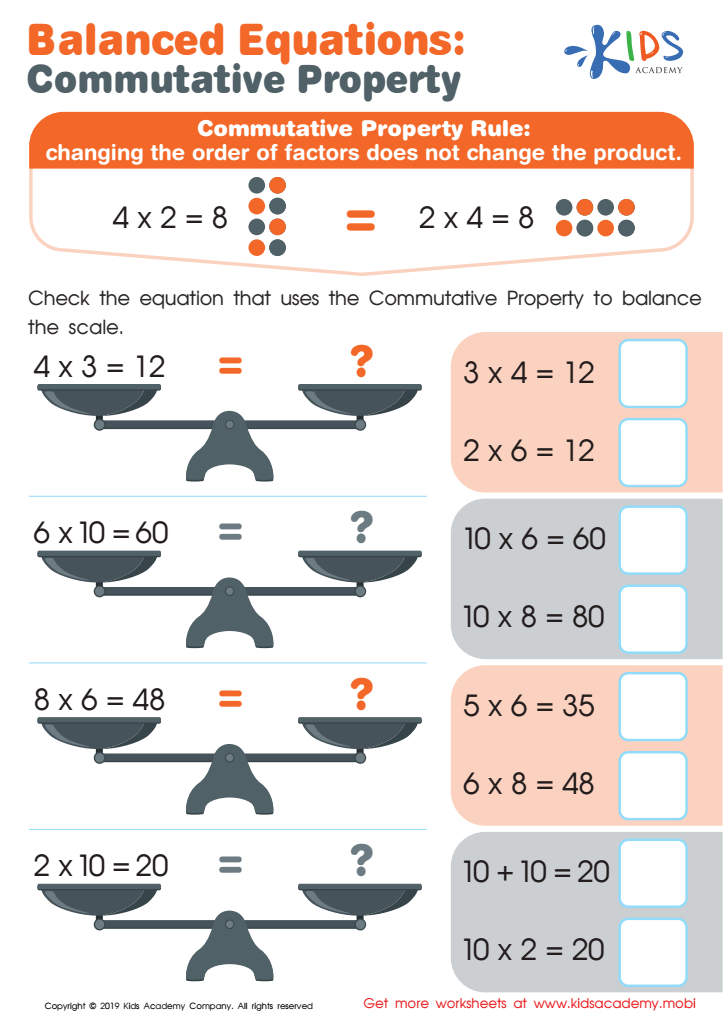
Balanced Equations: Commutative Property Worksheet








Understanding the commutative property in math is essential for young children, and parents and teachers should prioritize fostering this knowledge from ages 4-8. The commutative property states that for addition and multiplication, the order of the numbers does not change the result (e.g., 2 + 3 = 3 + 2 or 4 x 5 = 5 x 4). This basic principle is foundational for more advanced math concepts and problem-solving skills.
Learning this property aids in developing mathematical intuition and flexibility. When children realize that numbers can be re-ordered without affecting the outcome, they approach arithmetic with greater confidence and versatility. This understanding directly supports mental math and makes calculations faster and less prone to errors.
Moreover, mastering this property boosts children’s confidence in their ability to understand and manipulate numbers, fostering a positive attitude toward mathematics. It lays a vital groundwork for future topics such as algebra, where similar properties are applied across more complicated operations.
In sum, grasping the commutative property in early childhood is a small yet crucial step in building strong mathematical foundations, promoting cognitive development, and cultivating a lifelong ability to tackle math with assurance. Encouraging recognition and application of this fundamental concept greatly benefits their overall academic growth.








