Understanding quadrilaterals Math Worksheets for Ages 4-8
4 filtered results
-
From - To
Welcome to our "Understanding Quadrilaterals" math worksheets designed specifically for children aged 4 to 8! These engaging and colorful resources help young learners explore various quadrilaterals, including squares, rectangles, rhombuses, and trapezoids, through fun activities. Each worksheet fosters essential math skills like shape recognition, counting sides, and understanding properties in a kid-friendly way. Our carefully crafted exercises promote hands-on learning and critical thinking. Perfect for home or classroom use, these worksheets make learning about shapes enjoyable and effective. Dive into the world of quadrilaterals with delightful activities that will ignite your child's mathematical curiosity and confidence! Download yours today!
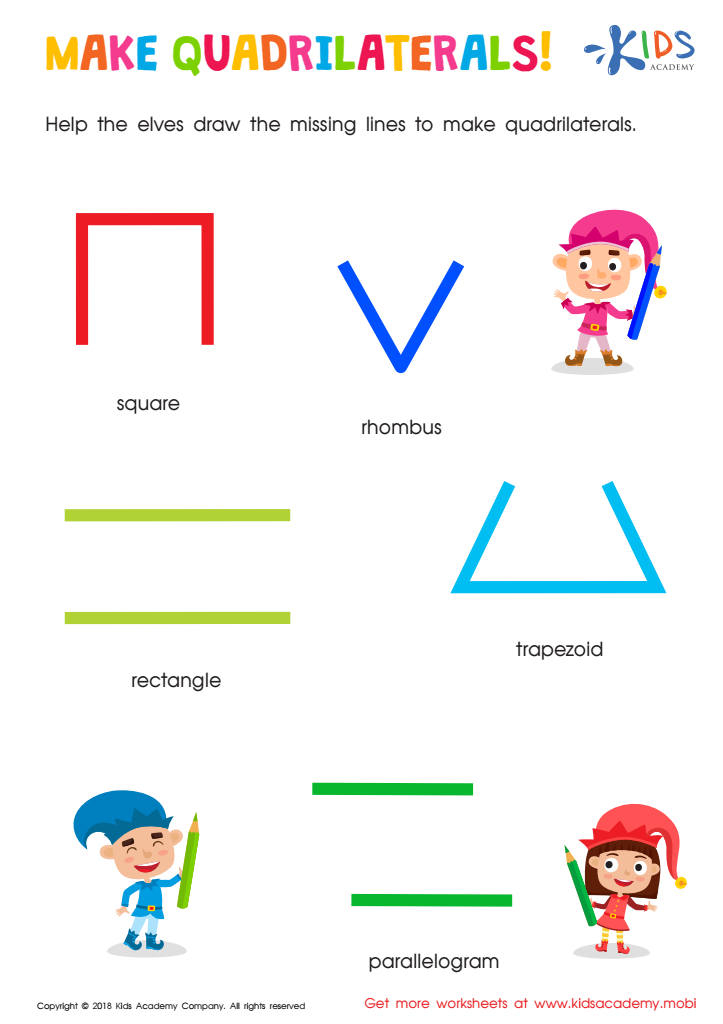
Make Quadrilaterals Worksheet
 Assign to My Students
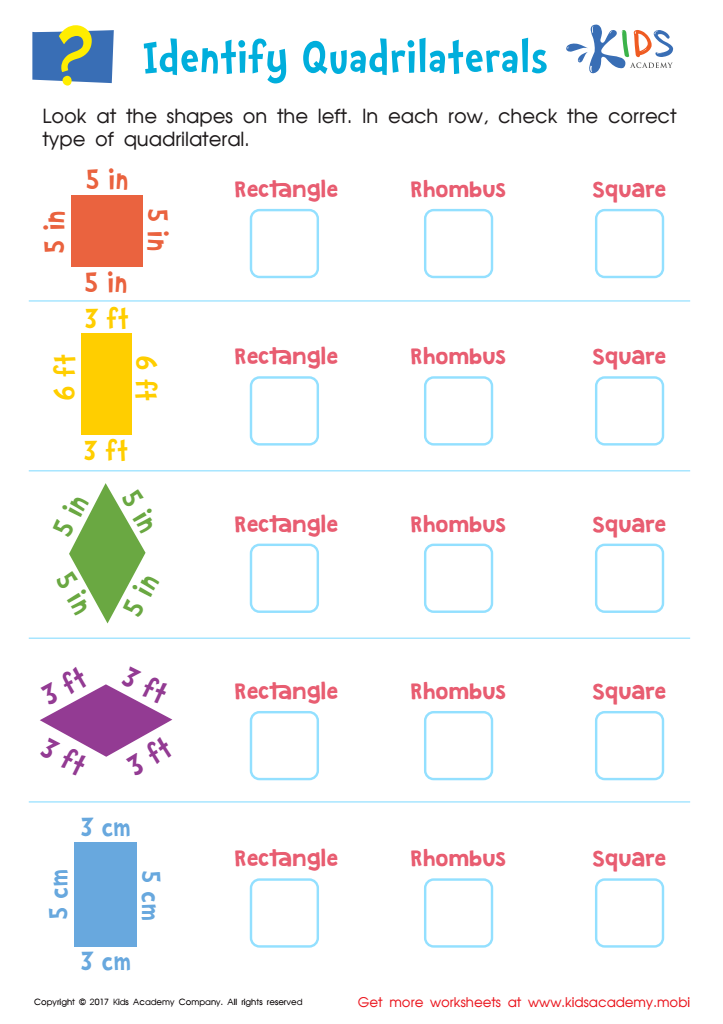
Identify Quadrilaterals Worksheet
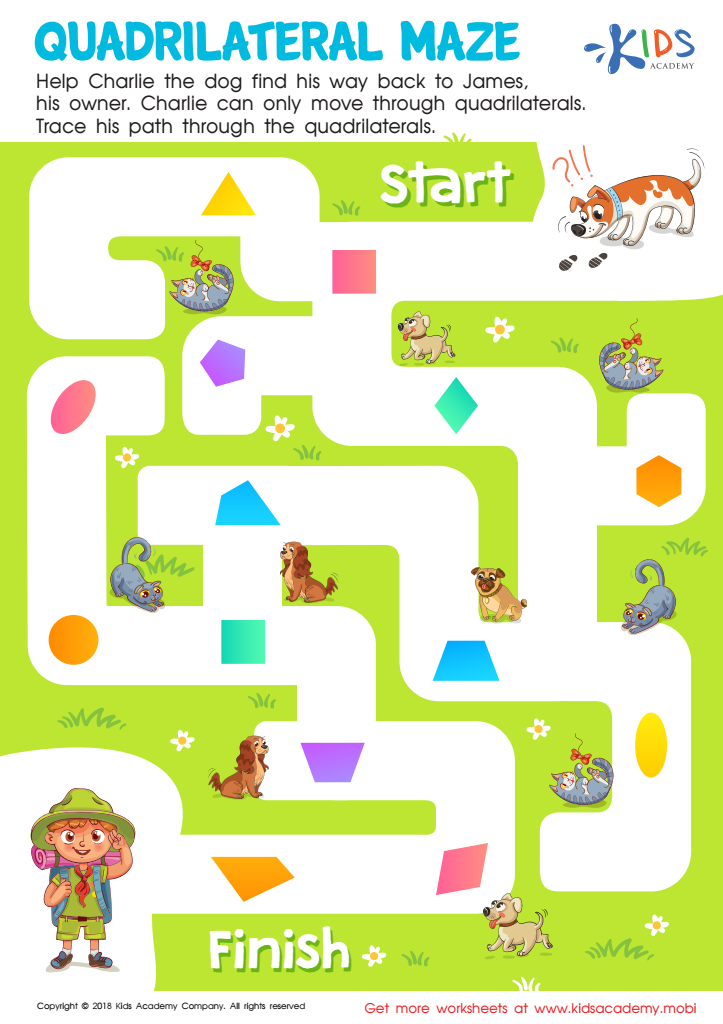
Quadrilateral Maze Worksheet
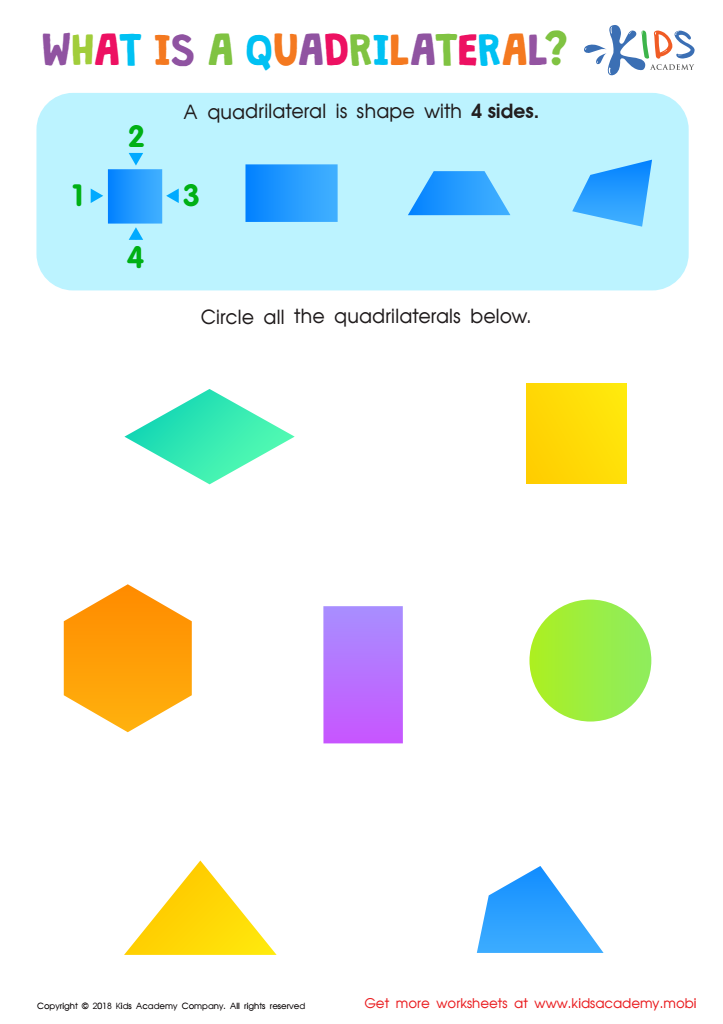
What Is a Quadrilateral? Worksheet








Understanding quadrilaterals is vital for children aged 4-8 as it lays the foundation for essential mathematical concepts. At this stage, children are naturally inclined to explore shapes and patterns, making it an ideal time to introduce them to various quadrilaterals—like squares, rectangles, rhombuses, and trapezoids. Recognizing these shapes helps in developing spatial awareness, a critical skill for future math success.
For parents and teachers, emphasizing quadrilaterals cultivates children's critical thinking abilities. When children observe and describe different quadrilaterals, they engage in comparison and classification, enhancing their analytical skills. Furthermore, it introduces them to the properties of shapes, which is vital for understanding more complex math topics in later grades.
Additionally, learning about quadrilaterals can be made fun and interactive through games, drawing activities, and even real-world applications, thereby making math enjoyable. This foundational knowledge promotes confidence in young learners and motivates them to explore more advanced mathematical ideas. Ultimately, supporting their understanding of quadrilaterals not only strengthens their mathematical skills but also encourages a lifelong appreciation for geometry. Engaged learners today become proficient problem solvers of tomorrow.








