
Logical thinking development Subtraction Worksheets for Ages 4-8
3 filtered results
Difficulty Level
Grade
Age
-
From - To
Subject
Activity
Standards
Boost your child's logical thinking skills with our engaging Subtraction Worksheets designed for ages 4-8! Tailored to enhance mathematical understanding, these worksheets transform subtraction practice into an exciting learning experience. Through vibrant visuals and thoughtful problem-solving exercises, children develop critical thinking as they navigate number concepts and patterns. Our resources cater to different learning styles, making it easy for young learners to grasp the essentials of subtraction while reinforcing cognitive abilities. Ideal for classroom settings or at-home practice, these worksheets encourage independent thinking and foster a strong mathematical foundation. Help your child become a confident learner today!
Favorites
With answer key
Interactive
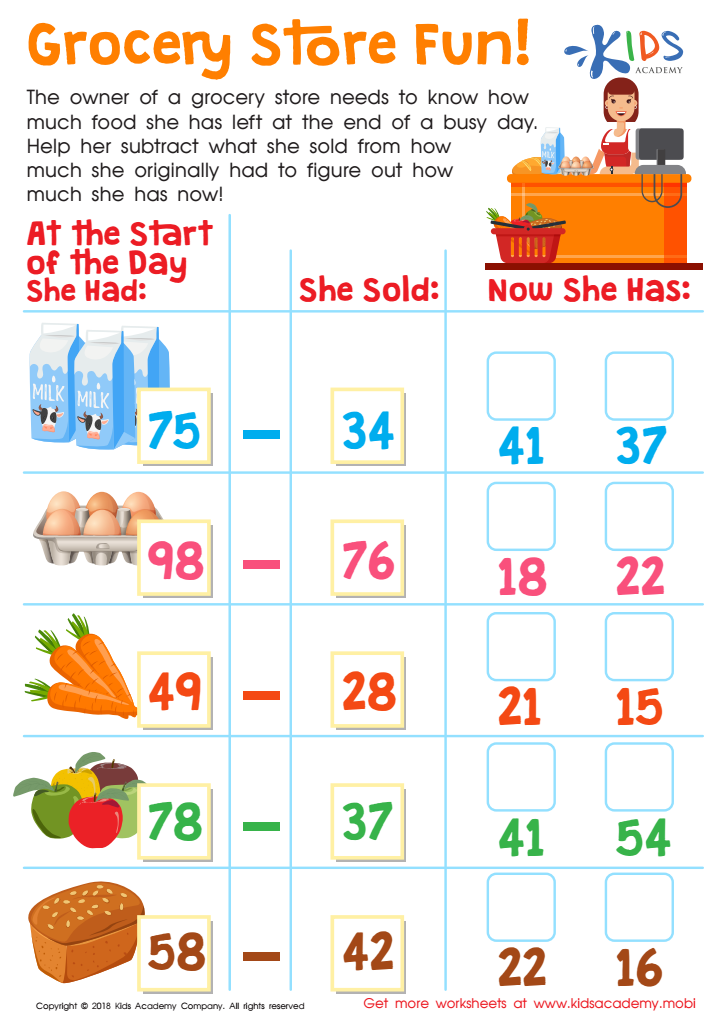
Grocery Store Fun! Worksheet
Let your kids have fun with this store worksheet. It requires them to help the owner by subtracting what she has sold from the original amount to figure out how much is left. Have them read and solve the equations in the printout to give the store owner the answer.
 Assign to My Students
Grocery Store Fun! Worksheet
Worksheet
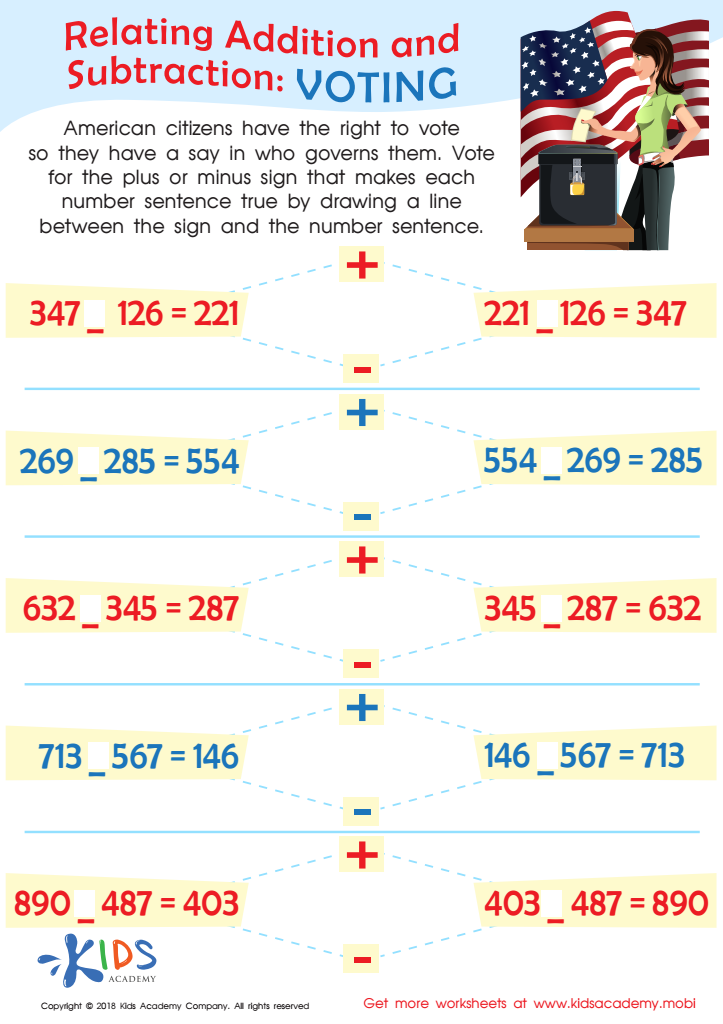
Voting Worksheet
This worksheet combines Social Studies and Math, teaching kids the democratic concept of voting. Guide learners to observe the problem, and decide if it needs a plus or minus. They "vote" for the correct answer by drawing a line from the problem to the correct operation symbol. Tally up the votes to check the answers!
Voting Worksheet
Worksheet
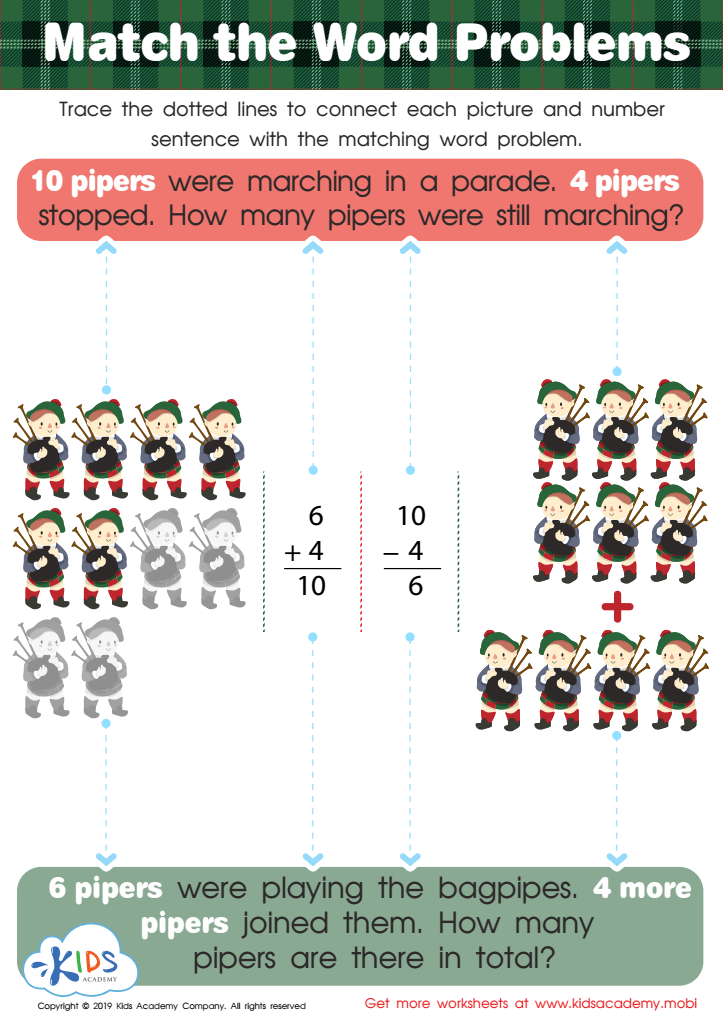
Match the Word Problems Worksheet
Read this word problem to your kids: Help them understand how it can be translated into a number problem. Trace the dotted lines to see how each picture and number sentence match the problem. With this worksheet, you can show your kids how easy it is to transform a word problem into a number problem.
Match the Word Problems Worksheet
Worksheet
Join Kids Academy for Free
Who is primarily going to use this learning content?






.jpg)

Logical thinking development in subtraction is crucial for children aged 4-8 as it lays the foundation for their overall cognitive abilities and mathematical understanding. At this stage, children are beginning to grasp the concepts of numbers and operations, making it essential for parents and teachers to nurture their logical reasoning skills.
Subtraction requires children to analyze and understand relationships between numbers, which enhances problem-solving skills. By engaging in activities that promote logical thinking, such as using visual aids, manipulatives, or games, children learn to break down problems into manageable parts and develop strategies for finding solutions. This not only aids in mastering subtraction but also builds a stronger framework for tackling more complex mathematical concepts in the future.
Additionally, enhanced logical thinking supports overall academic success and daily life skills. It empowers children to make informed decisions, fostering independence and confidence. As they learn to approach subtraction with a logical mindset, they also develop perseverance and resilience, essential traits for lifelong learning.
In summary, logical thinking in subtraction helps children understand mathematical operations, enhances problem-solving skills, and prepares them for future academic challenges, making it a key focus for parents and educators alike.








