Analog Clock Understanding Worksheets for Ages 4-9
3 filtered results
-
From - To
Help your child master the art of telling time with our "Analog Clock Understanding Worksheets for Ages 4-9." Perfectly designed for preschool to early elementary students, these worksheets offer engaging activities that make learning to read an analog clock both fun and educational. Children will practice identifying hours and minutes, understanding time intervals, and honing their problem-solving skills. Bright illustrations and intuitive exercises ensure your child stays interested while grasping essential concepts. Boost your child’s confidence in telling time while enhancing their cognitive development with our expertly crafted worksheets, available now for easy download and endless learning fun!
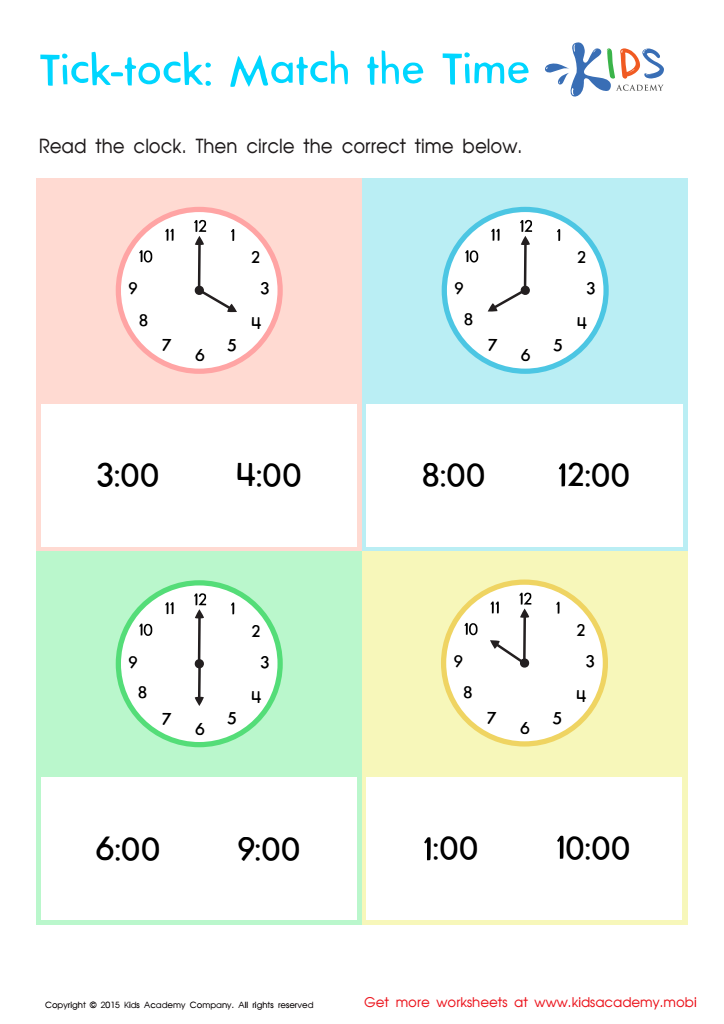
Telling The Time Worksheet: Part 4
 Assign to My Students
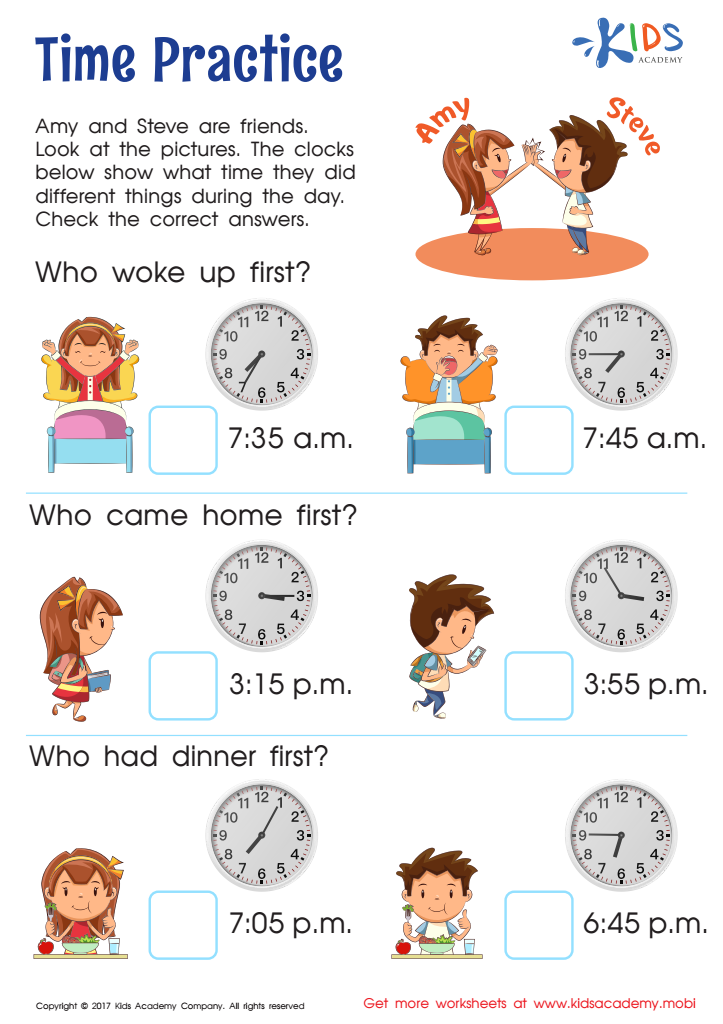
Time Practice Worksheet
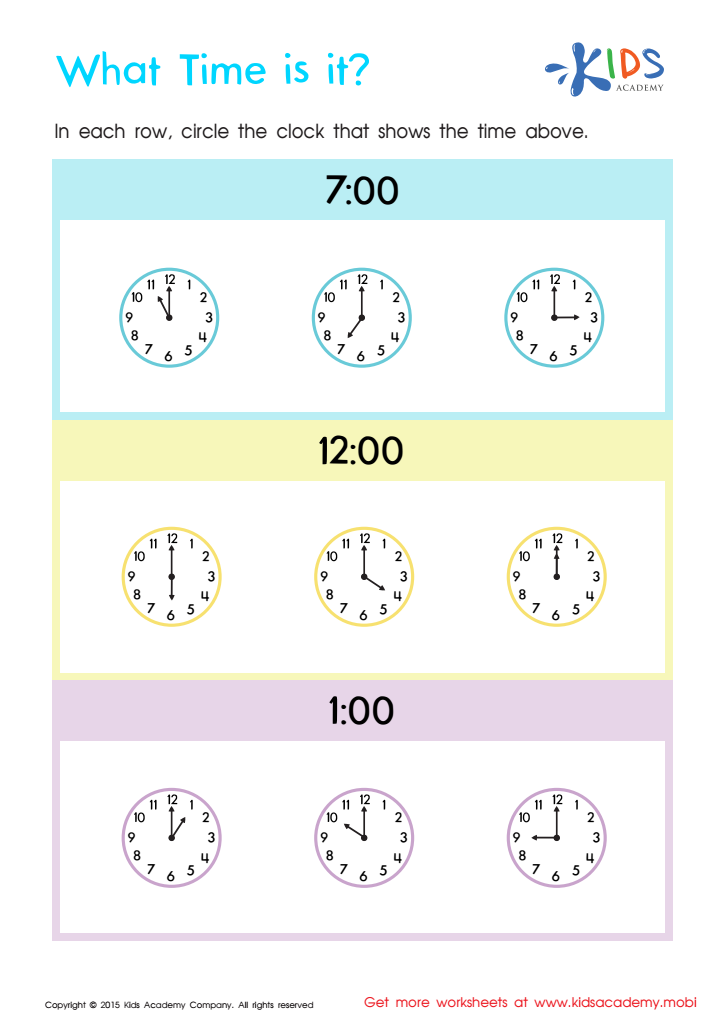
Telling The Time Worksheet: Part 3






Understanding how to read an analog clock is an essential skill for children ages 4-9 as it lays the foundational groundwork for time management—a critical component of daily life.
Firstly, reading an analog clock helps improve mathematical skills. It requires children to grasp concepts like skip counting by fives, understanding the 12-hour cycle, and recognizing number patterns, all of which reinforce their math curriculum.
Additionally, it enhances cognitive development. Learning to tell time on an analog clock demands concentration and bolsters problem-solving skills, as children must discern where the hour and minute hands are pointing. This, in turn, improves their ability to manage their routines and schedules independently.
Moreover, mastering an analog clock fosters a sense of responsibility. When kids know how to read time, they're more likely to develop punctuality, understand the sequence of events, and respect timelines—qualities crucial for both academic and personal success.
Analog clocks also offer a tangible connection to time, unlike digital clocks. This hands-on interaction aids in better comprehension since children can visually see “quarter past” or "half past" concepts.
Finally, analog clocks are ubiquitous; they can't be as easily dismissed or ignored as digital displays, embedding the time-telling habit naturally. Therefore, investing in a child’s ability to read an analog clock enriches not just their arithmetic skills but their overall time literacy, making it a beneficial focus for parents and teachers alike.








