
Differentiating push/pull Worksheets for Ages 4-9
3 filtered results
Difficulty Level
Grade
Age
-
From - To
Subject
Activity
Standards
Boost your child’s understanding of basic physics concepts through our engaging Differentiating Push/Pull Worksheets for Ages 4-9! These printables are designed to simplify the idea of forces in a fun and interactive way. Perfect for young learners, the worksheets foster critical thinking and motor skills as children identify, categorize, and practice distinguishing between push and pull actions. Our age-appropriate exercises are colorful and captivating, ensuring your child remains intrigued while learning about movement through everyday objects. Empower your young adventurers to explore the dynamics of force with activities geared towards sparking curiosity and nurturing foundational knowledge.
Favorites
With answer key
Interactive
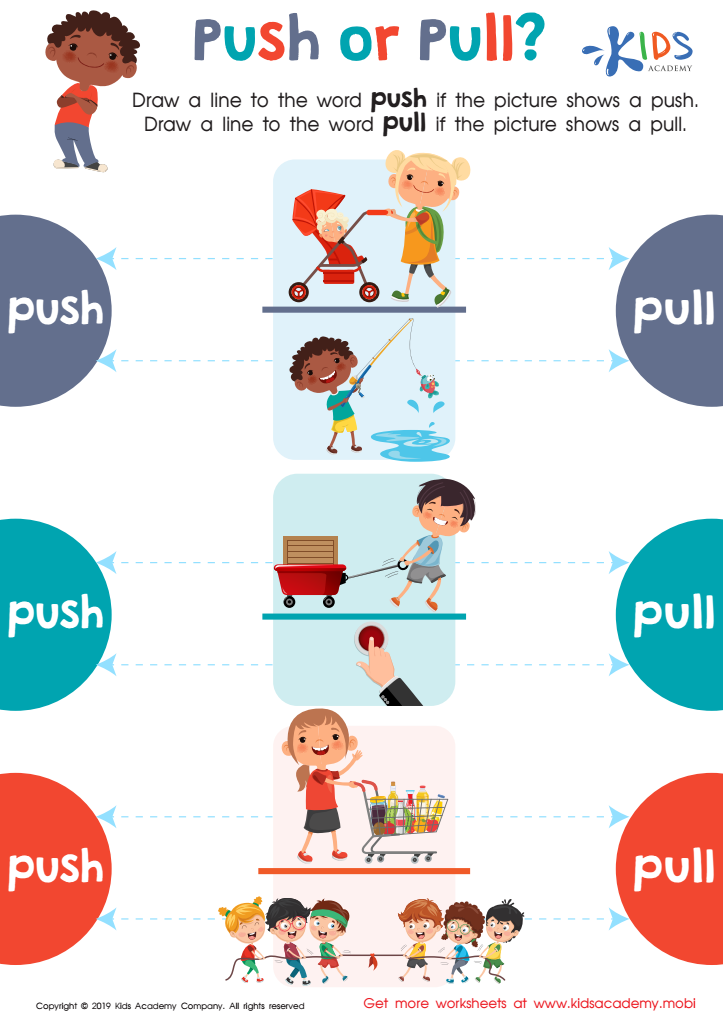
Push or Pull? Worksheet
Young kids may struggle to differentiate push and pull. When they start writing, they may use them interchangeably and wrongly. This worksheet clarifies the concepts: pushing means moving something away, pulling means bringing something closer. It provides pictures and traceable lines for kids to connect each image to the correct word. This helps them understand and remember the difference for future writing and reading.
 Assign to My Students
Push or Pull? Worksheet
Worksheet
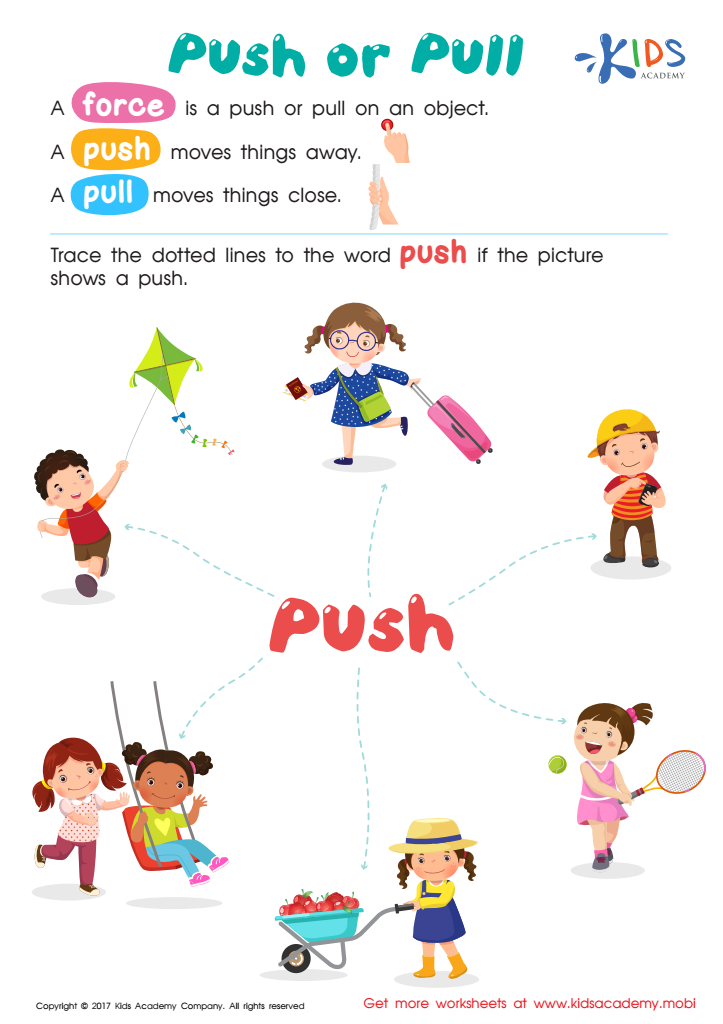
Push or Pull Worksheet
and which involve pulling! With this fun worksheet, your child will learn about force and its simple application in everyday activities. Get them started with Push or Pull! (80 words)
Push or Pull Worksheet
Worksheet
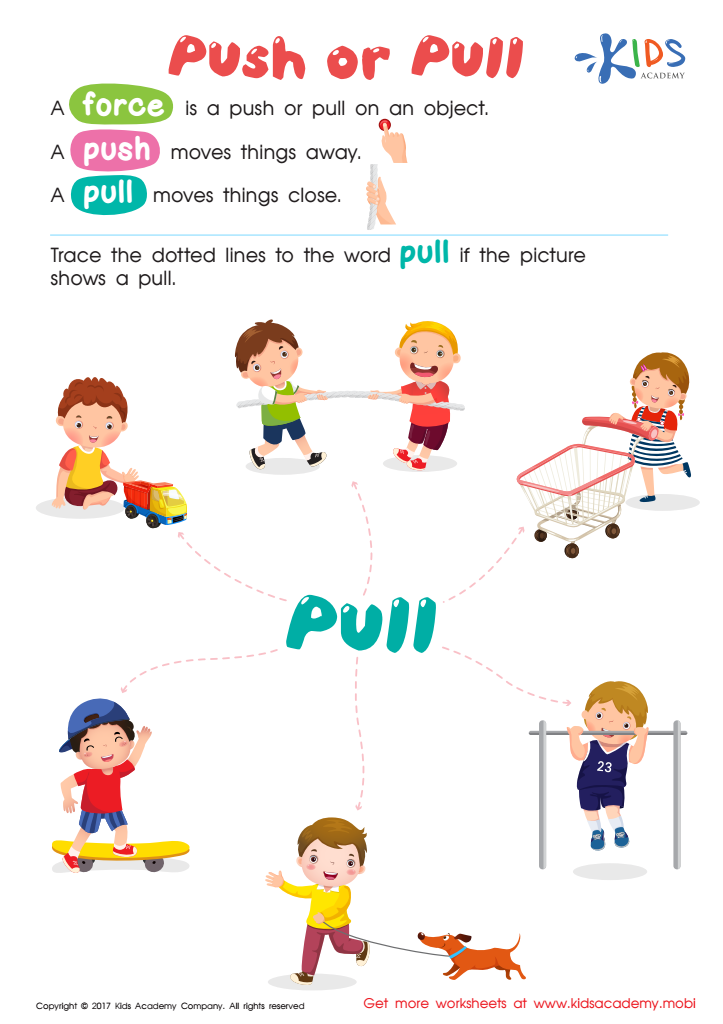
Pull or Push Worksheet
With this fun worksheet, they'll explore physics by sorting objects into categories according to their mode of motion. It's a great way to get them interested in science.
Pull or Push Worksheet
Worksheet
Join Kids Academy for Free
Who is primarily going to use this learning content?






Understanding the difference between push and pull is fundamental for young children aged 4-9, as it forms the basis of basic physics and helps them make sense of the world around them. When parents or teachers teach children about push and pull, they are not just teaching them science; they're helping them develop critical thinking and problem-solving skills.
Children at this age are naturally curious and learn best through hands-on experiences and play. Differentiating between push and pull allows kids to explore their environment in a meaningful way. It encourages physical activity and coordination, as children experiment with how to move objects effectively, whether it's pulling a wagon or pushing a toy car. These activities also help in developing fine motor skills and muscle memory.
Moreover, understanding these basic concepts will set the foundation for more complicated scientific principles they'll encounter later in their education. It’s a stepping stone to grasp more abstract ideas like force, motion, and energy. When kids learn to make these distinctions, it fosters a growth mindset, improves their vocabulary, and enhances language skills as they learn to describe their actions and observations accurately.
Thus, preparing children with a strong perceptual and cognitive framework for understanding their everyday interactions not only aids in academic success but also in their overall cognitive development.








