
Differentiating shapes Worksheets for Ages 4-9
5 filtered results
Difficulty Level
Grade
Age
-
From - To
Subject
Activity
Standards
Explore our "Differentiating Shapes Worksheets for Ages 4-9" designed to develop your child's ability to recognize and differentiate between various shapes. Perfect for kids aged 4 to 9, these engaging worksheets combine fun activities with essential learning to enhance visual-spatial skills. Each printable sheet is crafted to make learning interactive, aiding in the identification of shapes such as circles, squares, triangles, and more. Equip your child with the foundational knowledge required for advanced geometry, while encouraging creativity and cognitive development. Visit Kids Academy today to make shape learning an exciting adventure!
Favorites
With answer key
Interactive
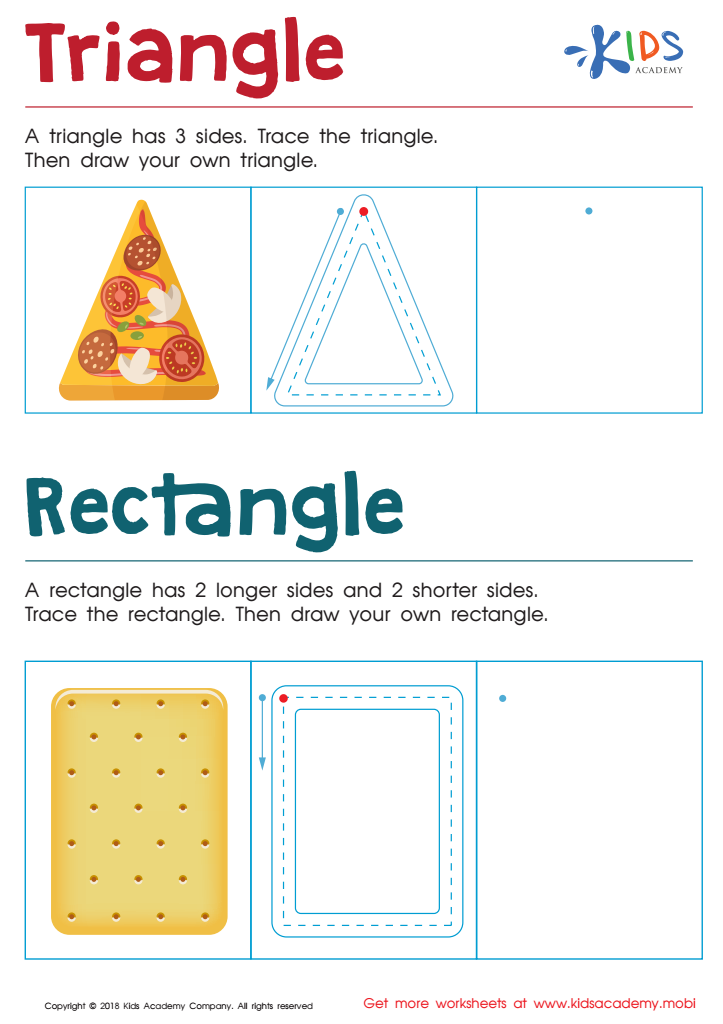
Triangle Rectangle Worksheet
This printable worksheet helps kids draw rectangles and triangles. Have your child trace the pizza and cracker shapes to become familiar, then try their own. Perfect for second graders! Coloring and creativity make this fun and educational.
 Assign to My Students
Triangle Rectangle Worksheet
Worksheet
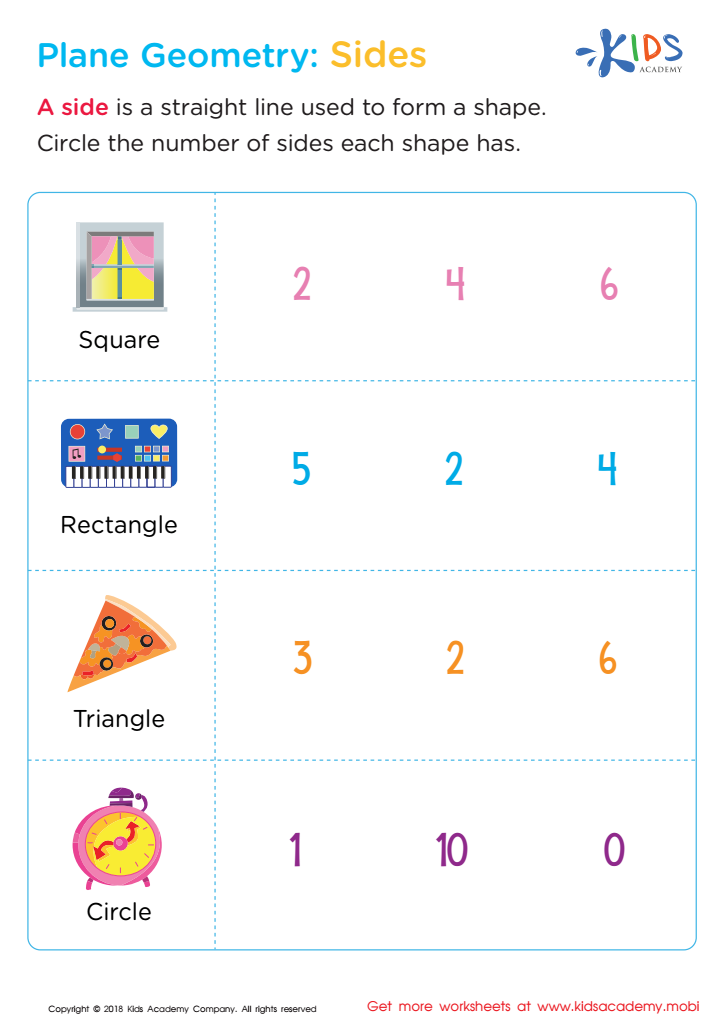
Plane Geometry: Sides Worksheet
Knowing the properties of basic geometric shapes is a great skill to have. Download this free worksheet and let your kids learn about sides and shapes using colorful pictures. They'll see each shape has its own number of sides, laying the groundwork for identifying and recognizing shapes in the future.
Plane Geometry: Sides Worksheet
Worksheet
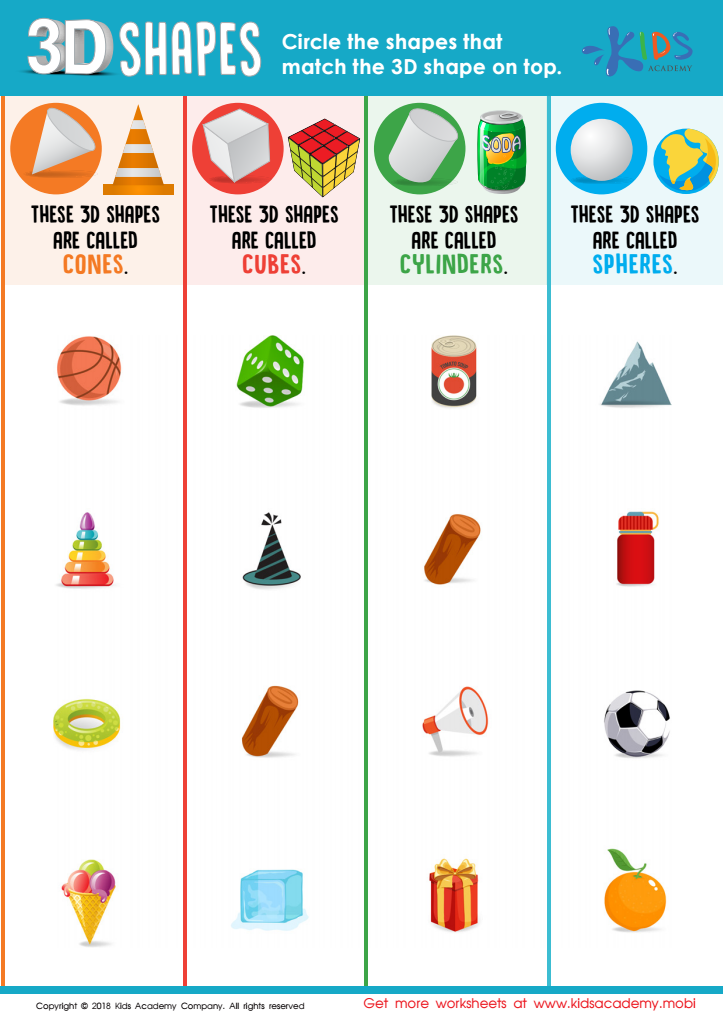
3D Shapes Worksheet
It's time to identify 3D shapes! This worksheet helps kids find and name shapes like cones, cylinders, cubes, and spheres using pictures of everyday objects. Let's explore 3D shapes in the real world!
3D Shapes Worksheet
Worksheet
Join Kids Academy for Free
Who is primarily going to use this learning content?


.jpg)





Parents and teachers should prioritize differentiating shapes for children aged 4–9 because this fundamental skill critically supports their overall cognitive, mathematical, and spatial development. During these formative years, children are incredibly receptive to learning, making it an opportune time to introduce and reinforce concepts of shapes and geometry.
Firstly, understanding shapes lays a strong foundation for mathematical learning. Recognizing and describing shapes enables children to grasp more complex mathematical ideas later on, like geometry, measurement, and problem-solving. For instance, differentiating between a square and a rectangle helps them comprehend broader spatial relationships and properties, such as sides and angles.
Additionally, learning about shapes enhances visual-spatial abilities. These skills are essential not only in math but also in everyday tasks like reading, writing, and understanding maps and diagrams. By engaging in shape differentiation, children improve their visual perception and ability to judge distances and sizes.
Moreover, shape recognition positively influences language development. Discussing and describing shapes encourages the use of comparative language and spatial vocabulary (e.g., “circle,” “bigger,” “curved”), which bolsters verbal communication and descriptive skills.
Overall, early shape differentiation isn’t just about learning geometry; it’s a multi-faceted educational tool that fosters critical thinking and lays the groundwork for future academic success in various domains. This is why attentive guidance in this area from parents and teachers is invaluable.








