
Learning subtraction Worksheets for Ages 4-9
4 filtered results
Difficulty Level
Grade
Age
-
From - To
Subject
Activity
Standards
Explore our engaging learning subtraction worksheets designed specifically for children ages 4 to 9! These printable resources provide a fun and interactive way for young learners to master subtraction skills. Each worksheet is crafted to suit different learning levels, featuring vibrant illustrations and age-appropriate exercises that captivate children's attention. From simple problems to more challenging tasks, our worksheets promote critical thinking and problem-solving abilities. Ideal for both classroom and home use, these resources help foster a positive learning environment while reinforcing essential math concepts. Download and discover the joy of subtraction today to build a strong foundation for future math success!
Favorites
With answer key
Interactive
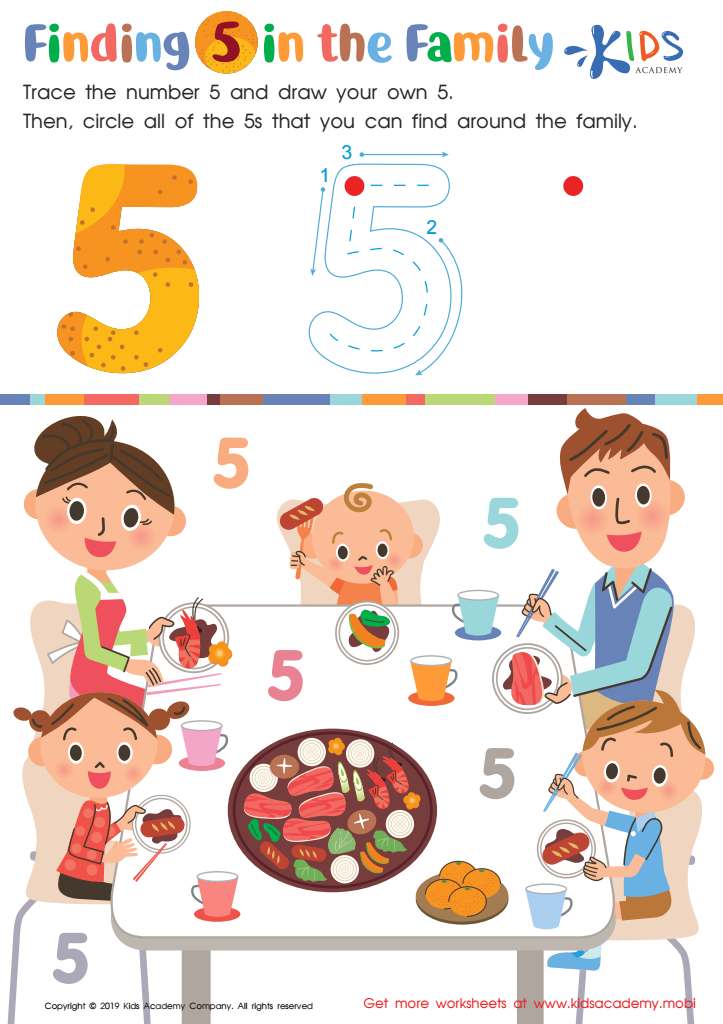
Finding 5 in the Family Worksheet
This worksheet helps kids identify and write the number 5. Ask what the family is doing and who the family members are. Help them trace and draw the 5, then have them circle all 5s in the picture.
 Assign to My Students
Finding 5 in the Family Worksheet
Worksheet
Join Kids Academy for Free
Who is primarily going to use this learning content?








Learning subtraction is a fundamental mathematical skill that significantly impacts a child's cognitive development and everyday life. For parents and teachers of children aged 4-9, understanding the importance of subtraction is vital for fostering a strong foundation in math. At this young age, children are not just learning numbers; they are also developing critical thinking, problem-solving abilities, and an understanding of relationships between quantities.
Subtraction introduces the concept of taking away, which helps children grasp more complex ideas such as addition, multiplication, and division later on. Mastering subtraction also builds a child's confidence and promotes a positive attitude towards mathematics. When children can navigate basic subtraction effectively, they are more equipped to tackle higher-level math concepts as they progress through school.
Moreover, using real-life examples to teach subtraction—such as sharing snacks or counting toys—makes learning engaging and relatable. This practical application enhances their comprehension and retention of the concept. Finally, intervening early in a child’s mathematical education can prevent future learning gaps, ensuring that they are not left behind as education progresses in complexity. Overall, prioritizing subtraction equips children with essential life skills and lays the groundwork for future academic success.








