
Telling time Worksheets for Ages 4-9
4 filtered results
Difficulty Level
Grade
Age
-
From - To
Subject
Activity
Standards
Explore our engaging "Telling Time Worksheets for Ages 4-9," designed to help young learners develop essential time-telling skills. These interactive worksheets cater to children at different learning stages, featuring a variety of exercises focused on reading clocks, understanding time intervals, and differentiating between AM and PM. With colorful visuals and simple instructions, your child will enjoy mastering both analog and digital time formats. Perfect for classroom use or just for fun at home, our worksheets encourage independent learning while building confidence in time management. Download today to introduce your child to the exciting world of telling time!
Favorites
With answer key
Interactive
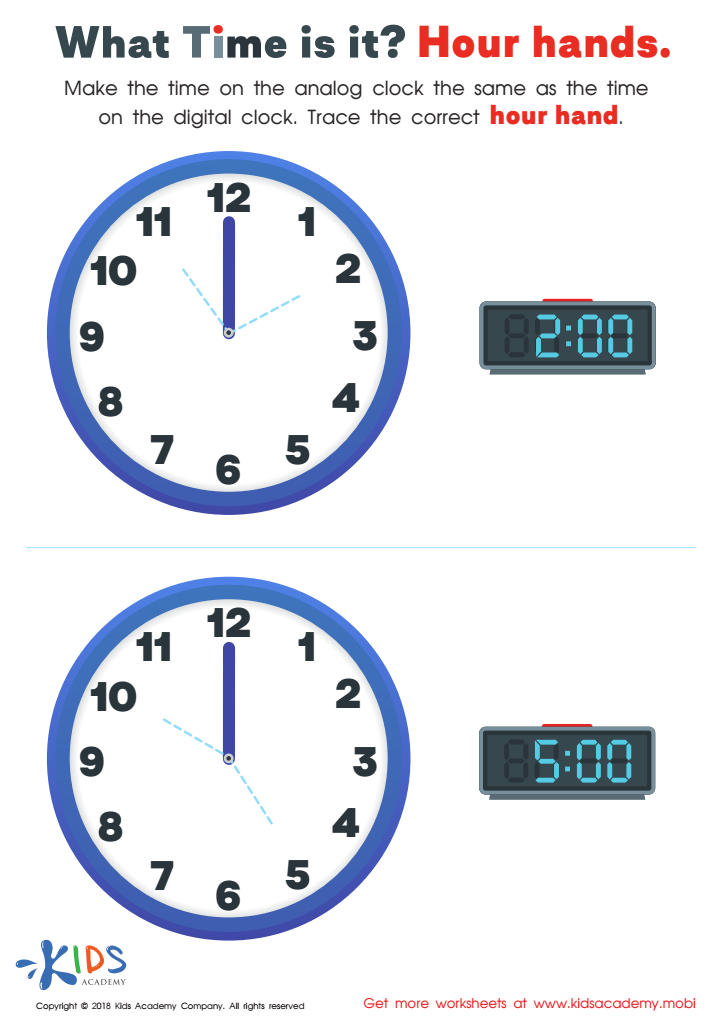
What Time Is it? Hour Hands Worksheet
Does your child know how to read analogue and digital clocks? This worksheet will help them learn. Trace the correct hour hand to match the time on a digital clock to the analogue clock. Help them read the time correctly, both on analogue and digital clocks.
 Assign to My Students
What Time Is it? Hour Hands Worksheet
Worksheet
Join Kids Academy for Free
Who is primarily going to use this learning content?





Learning to tell time is a fundamental skill that shapes a child's understanding of order, responsibility, and independence. For children aged 4-9, mastering time doesn't just involve reading a clock; it fosters critical life skills that extend beyond simply knowing the hour.
Firstly, telling time enhances cognitive development. As children learn to correlate numbers with place and meaning, they strengthen their analytical skills and improve their ability to solve problems. This cognitive engagement is essential at this developmental stage.
Moreover, knowing how to tell time empowers children by giving them a sense of control and responsibility. When kids can manage their daily routines—understanding when it's time for school, play, or bedtime—they become more self-reliant and confident in their ability to navigate their world.
In the classroom and at home, lessons about time can stimulate conversations about schedules, planning, and the concept of time passing, encouraging children to set goals and appreciate the value of punctuality.
For these reasons, time-telling skills should be a priority for parents and teachers, equipping children with essential tools they will use throughout their lives as they learn to balance responsibilities and foster independence.








