
Understanding equivalence Worksheets for Ages 4-9
3 filtered results
Difficulty Level
Grade
Age
-
From - To
Subject
Activity
Standards
Discover the fun and engaging "Understanding Equivalence Worksheets" for children aged 4-9! These worksheets are designed to help young learners grasp the concept of equivalence through exciting activities and colorful visuals. As kids progress through various levels, they’ll develop essential mathematical skills while enhancing their problem-solving abilities. With a variety of exercises that include matching, comparing, and identifying equivalent values, students will enjoy a hands-on approach to learning. Perfect for classroom use or at-home practice, these worksheets will foster a strong foundation in mathematics and boost confidence in young learners as they explore the world of numbers. Get started today!
Favorites
With answer key
Interactive
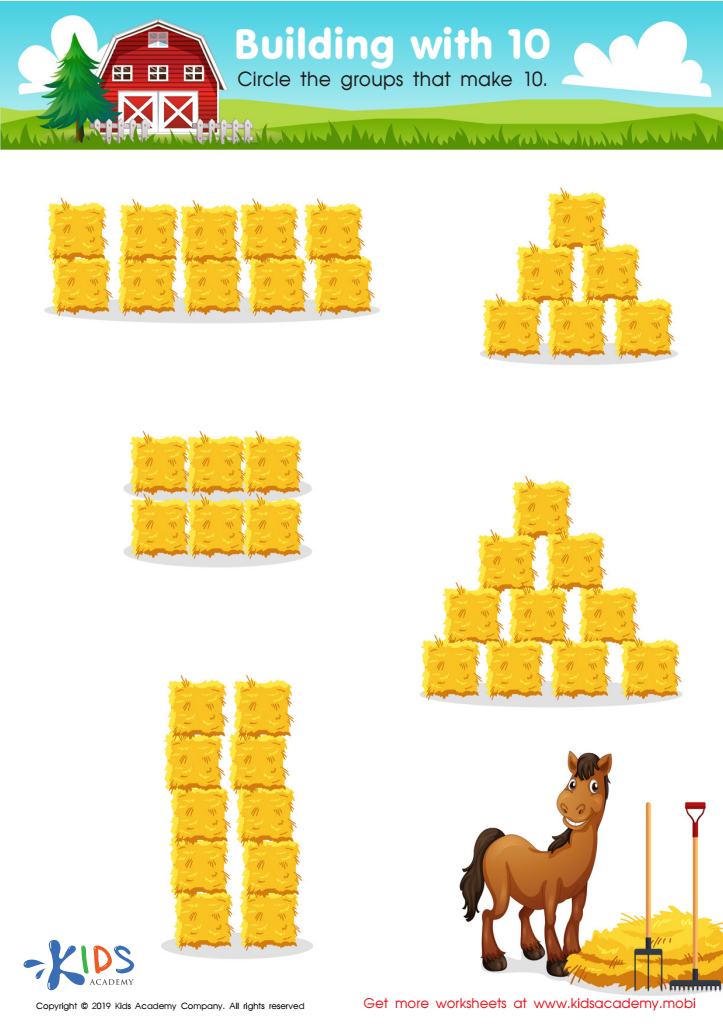
Building with 10 Worksheet
Counting numbers can be simple with this worksheet: Ask your kids to count the stacks of objects, ensure accuracy with your help, then circle the ones of ten. With practice and guidance, your children will soon become counting pros!
 Assign to My Students
Building with 10 Worksheet
Worksheet
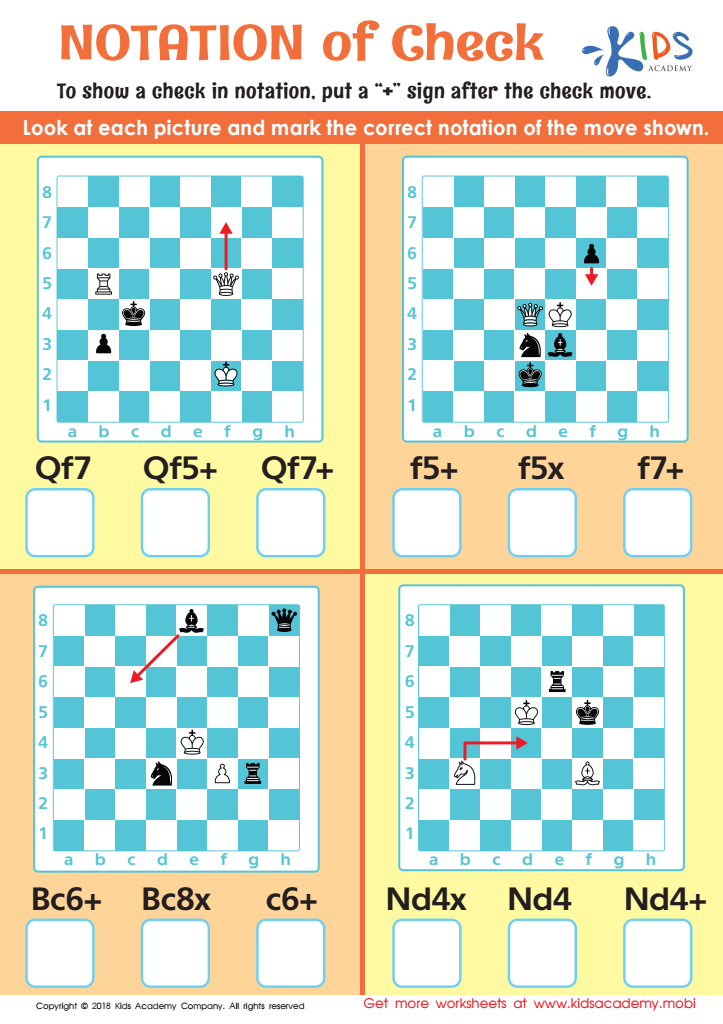
Notation of Check Worksheet
Chess is an addictive game! Once you know the basics of check and checkmate, you'll be hooked! Teach your little one to make check notation with this free PDF worksheet. They can use downloadable practice to look at each picture and mark the correct notation, strengthening their problem-solving skills while they learn to play - and win - this fun game!
Notation of Check Worksheet
Worksheet
Join Kids Academy for Free
Who is primarily going to use this learning content?





Understanding equivalence is a fundamental mathematical concept that lays the groundwork for a child's ability to comprehend numbers, operations, and relationships. For children aged 4-9, mastering this concept is essential for their cognitive development and their ability to engage in more complex mathematical reasoning later on. Parents and teachers should care deeply about this for several reasons.
Firstly, understanding equivalence helps children grasp the idea that different representations can express the same value, such as recognizing that 2 + 3 is equivalent to 5 or that 10 is equal to 10/2 times 2. This fosters flexibility in thinking and problem-solving skills. Secondly, it cultivates a deeper sense of number sense, allowing children to engage with mathematics in a meaningful way rather than through rote memorization.
Moreover, early mastery of equivalence can boost confidence in children's mathematical abilities, reducing anxiety and fostering a positive attitude towards learning. It encourages discussions around comparisons and relationships, promoting higher-order thinking. By focusing on equivalence, educators and parents can equip children with the tools they need to navigate mathematical challenges effectively, setting them up for academic success in later grades. Prioritizing this concept is an investment in their educational future.








