Understanding ordinal numbers Worksheets for Ages 4-9
3 filtered results
-
From - To
"Understanding Ordinal Numbers Worksheets for Ages 4-9" guide your child through the concept of ordinal numbers with fun, easy-to-follow activities. Perfect for young learners, these engaging printables help children recognize the positions of objects in a series. Each worksheet features colorful illustrations and varied exercises designed to build a solid foundation in early math skills. Ideal for both classroom and at-home learning, these worksheets support the development of logical thinking and number proficiency. Equip your child with the tools to excel in basic math and foster a love for learning through enjoyable and pedagogical exercises. Explore today!
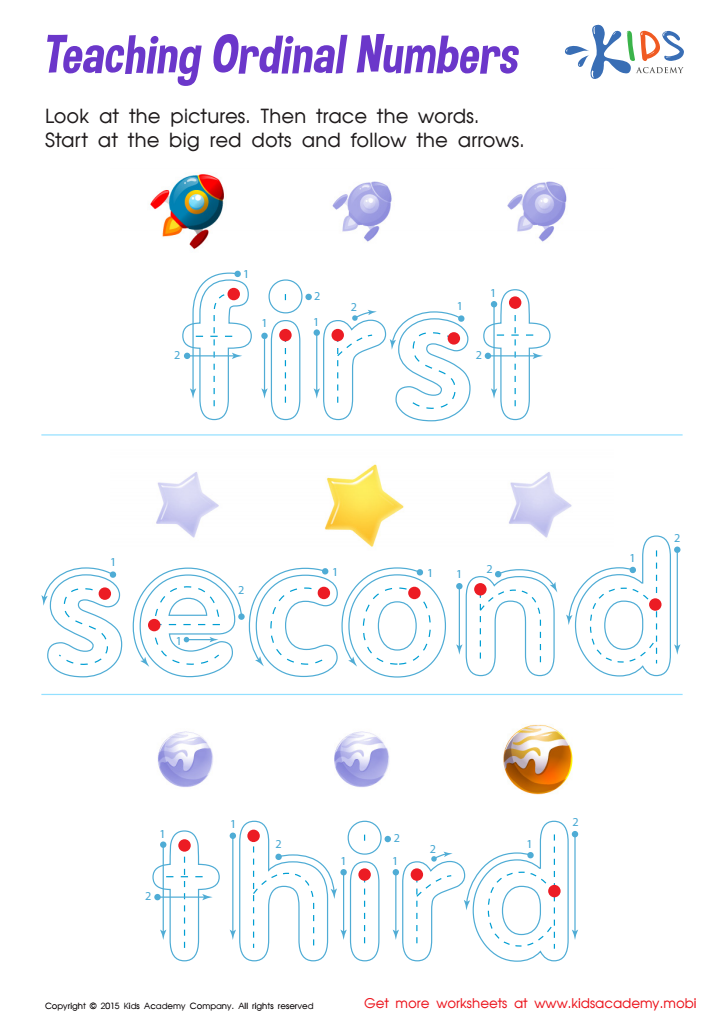
Ordinal Numbers: Teaching Ordinal Numbers Printable
 Assign to My Students
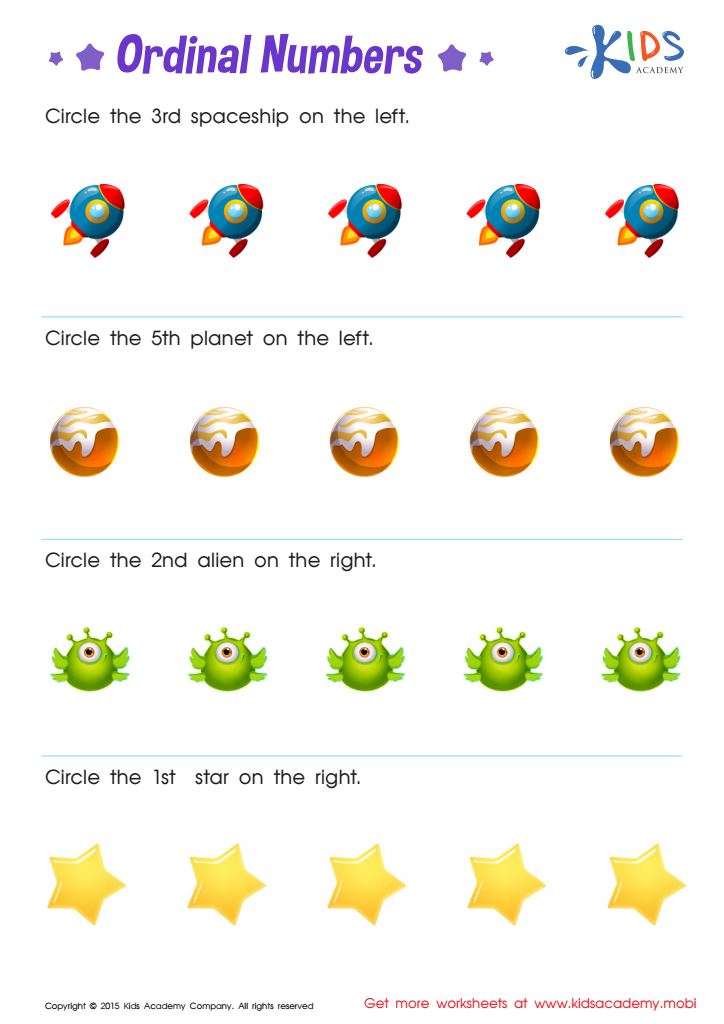
Ordinal Numbers: Space Ordinals Worksheet








Understanding ordinal numbers is crucial for children ages 4-9 as it lays the foundation for vital mathematical concepts and day-to-day tasks. Ordinal numbers, or numbers that express sequence (first, second, third, etc.), help young learners grasp the order of things in their environment, whether they're lining up in class, identifying the date, or following steps in a process.
Firstly, understanding ordinals enhances children's comprehension of categorization and organization, essential skills in both academic and life scenarios. For example, knowing that the third book on the shelf is a specific one they want teaches positional terms and improves spatial awareness.
Secondly, a solid grasp of ordinal numbers supports more advanced math learning. Many concepts in mathematics rely on sequence and order, and an early understanding of ordinals paves the way for this. Whether they are learning the order of operations in arithmetic or the sequencing of events in storytelling, these numbers are integral to logical thinking and reasoning.
Moreover, this knowledge fosters cognitive development. Practical activities, such as games and interactive story-time, incorporating ordinal terminology enrich children's language and vocabulary. It creates an engaging backdrop for mental growth, critical thinking, and communication skills.
Teachers and parents should engage children with activities that highlight the importance and usefulness of ordinal numbers, ensuring they see their relevance in everyday life, thus promoting a deeper, more intuitive understanding.








