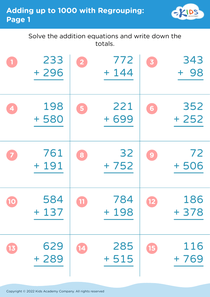
Counting practice Adding up to 1000 Without Regrouping Worksheets for Ages 4-9
4 filtered results
-
From - To
Introduce your young learner to the world of numbers with our "Counting Practice Adding up to 1000 Without Regrouping Worksheets for Ages 4-9" at Kids Academy! These worksheets are designed to make math fun and engaging, helping kids build essential counting and addition skills. Perfect for children aged 4-9, our printable activities simplify the addition process up to 1000, all without the need for regrouping. Foster confidence and a love for math in your child with interactive exercises that encourage practice and progress. Boost their math abilities and watch them excel seamlessly! Explore our educational resources today!
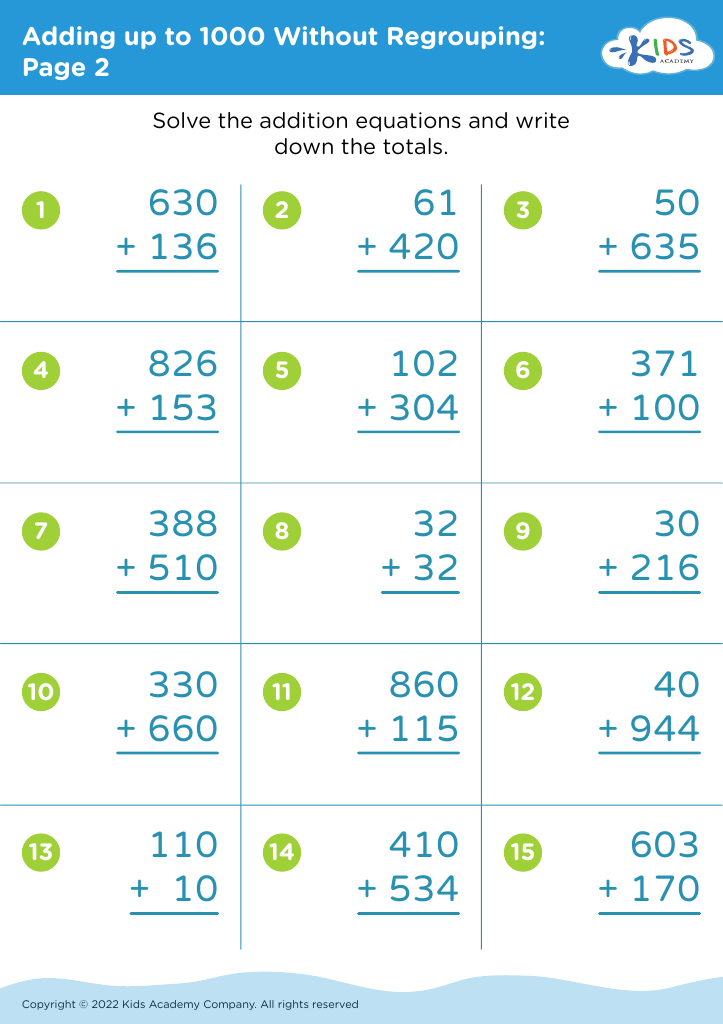
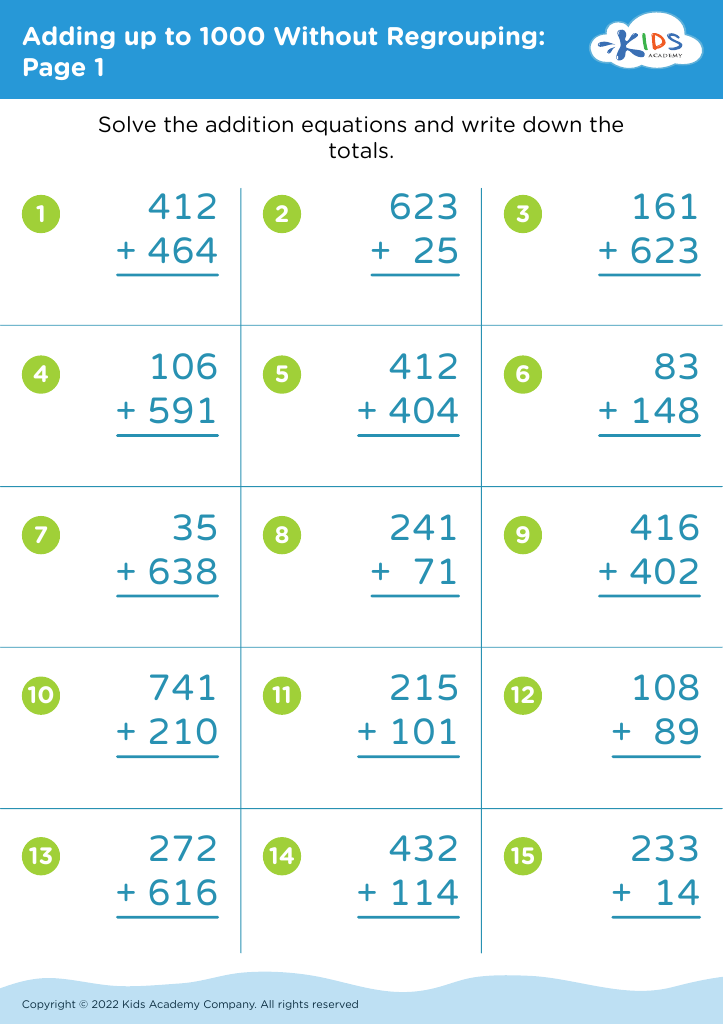
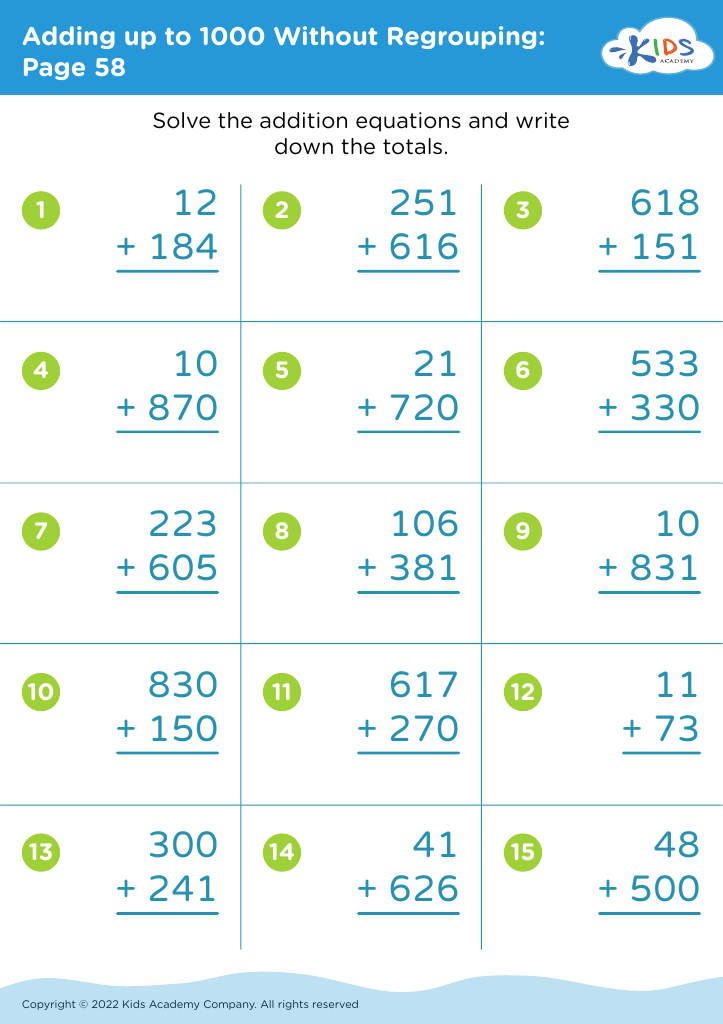
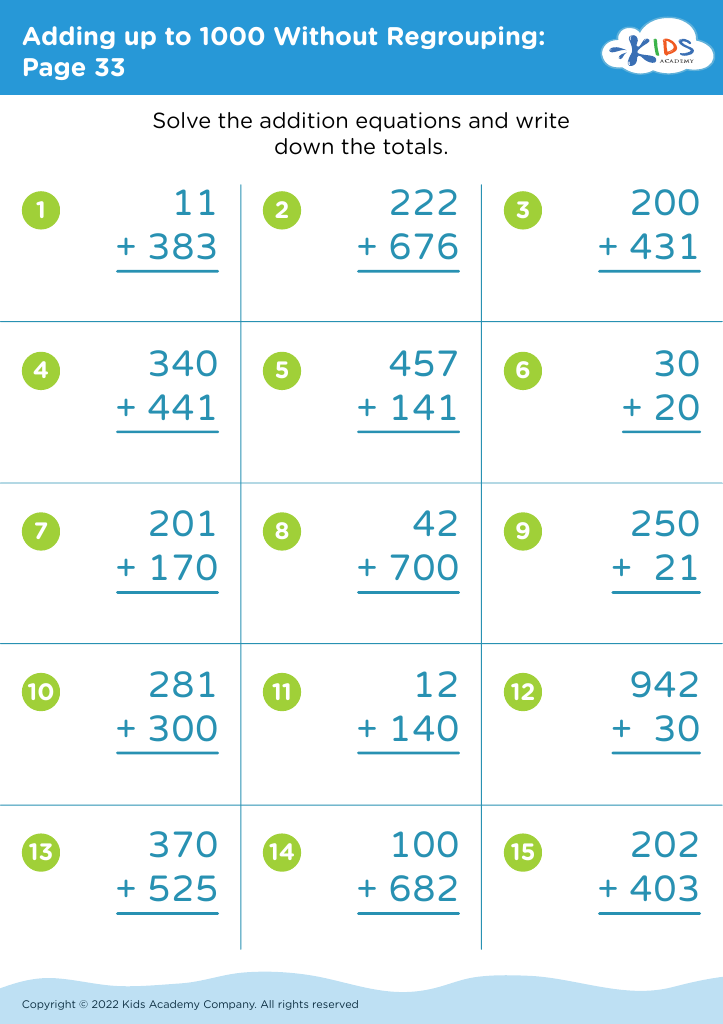


Counting practice, including adding up to 1000 without regrouping, is an essential building block in mathematical education for children ages 4-9. During these formative years, mastering these skills not only lays the groundwork for more advanced arithmetic but also fosters critical cognitive development. For parents and teachers, nurturing this ability is crucial for several reasons.
Firstly, counting and basic addition enhance a child's number sense, enabling them to understand and manage quantities, recognize patterns, and develop logical thinking. These skills serve as a precursor to complex mathematics and problem-solving tasks, which are integral in daily life and numerous academic subjects.
Additionally, practicing addition up to 1000 without regrouping helps bolster a child's confidence and boosts their self-esteem. When children successfully perform these operations, they gain a sense of accomplishment, which encourages a positive attitude towards math and learning in general.
Furthermore, interactive practices, such as these, can strengthen the parent-child or teacher-student bond. Engaging in educational activities together creates conducive environments for communication and support, displaying that adults value and support the child's learning journey.
Overall, investing in counting practice and addition fundamentals ensures children are well-prepared for future academic challenges and helps cultivate a lifelong appreciation and competence in mathematics.