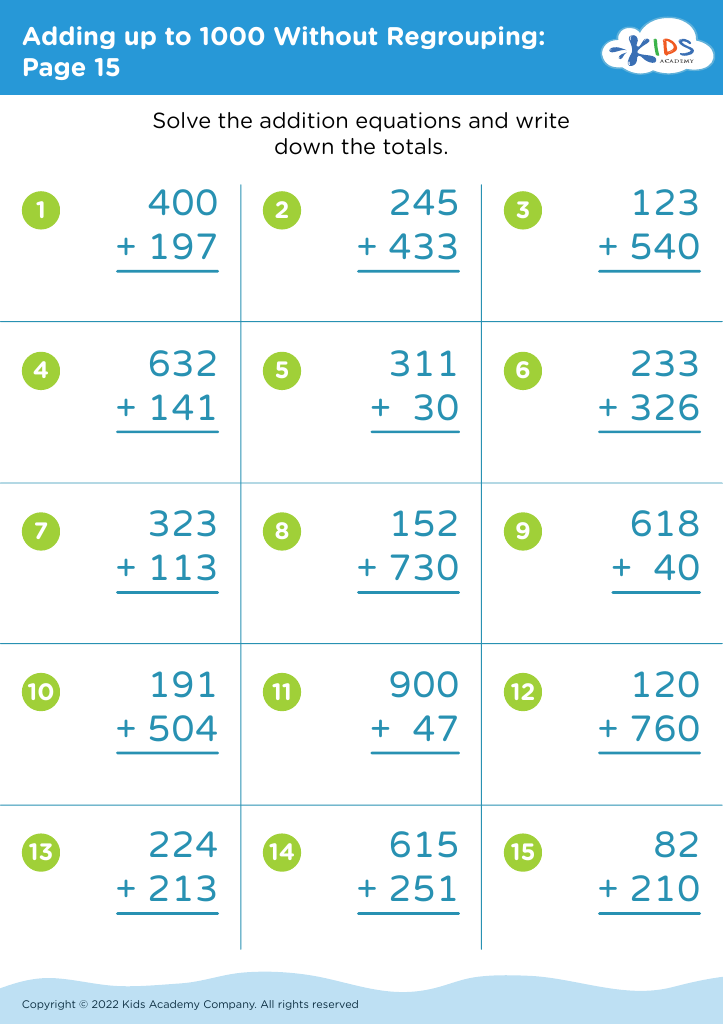




Parents and teachers play a crucial role in developing problem-solving skills in children aged 4-9, specifically in understanding numbers and arithmetic that add up to 1000. At this formative age, children begin to build foundational cognitive structures that support higher-level mathematical thinking and everyday decision-making. Teaching them to add up to 1000 boosts their numerical literacy, making abstract concepts more concrete and accessible.
By establishing a strong grasp of basic addition at an early age, parents and teachers prepare children for more complex mathematical processes, such as subtraction, multiplication, and division. Early exposure to numerical problem-solving nurtures children's logical reasoning, enhancing critical thinking abilities applicable across various subjects and real-life situations. For instance, understanding how to manage simple financial transactions or distribute items fairly among peers hinges on these skills.
Moreover, fostering problem-solving skills lays the groundwork for children to approach challenges with confidence and persistence. By overcoming mathematical problems, children develop a growth mindset—embracing errors as learning opportunities and cultivating resilience.
Ultimately, instilling problem-solving skills related to addition helps children navigate a world driven by numerical and analytical understanding, paving the way for academic success and informed, adaptable adults. Investing time in these early competencies provides a long-term payoff, benefiting both the individual child and society at large.








