Motor skills development Addition & Subtraction Worksheets for Ages 4-9
5 filtered results
-
From - To
Boost your child's math and fine motor skills simultaneously with our Motor Skills Development Addition & Subtraction Worksheets designed for ages 4-9. These engaging worksheets blend essential math practice with activities that enhance hand-eye coordination and dexterity. Perfect for young learners, each worksheet is crafted to foster a seamless integration of learning and fun. Build a solid math foundation while developing crucial motor skills needed for writing and other academic tasks. Whether at home or in the classroom, our printable worksheets offer a fantastic resource to support your child's growth and confidence in mathematics.
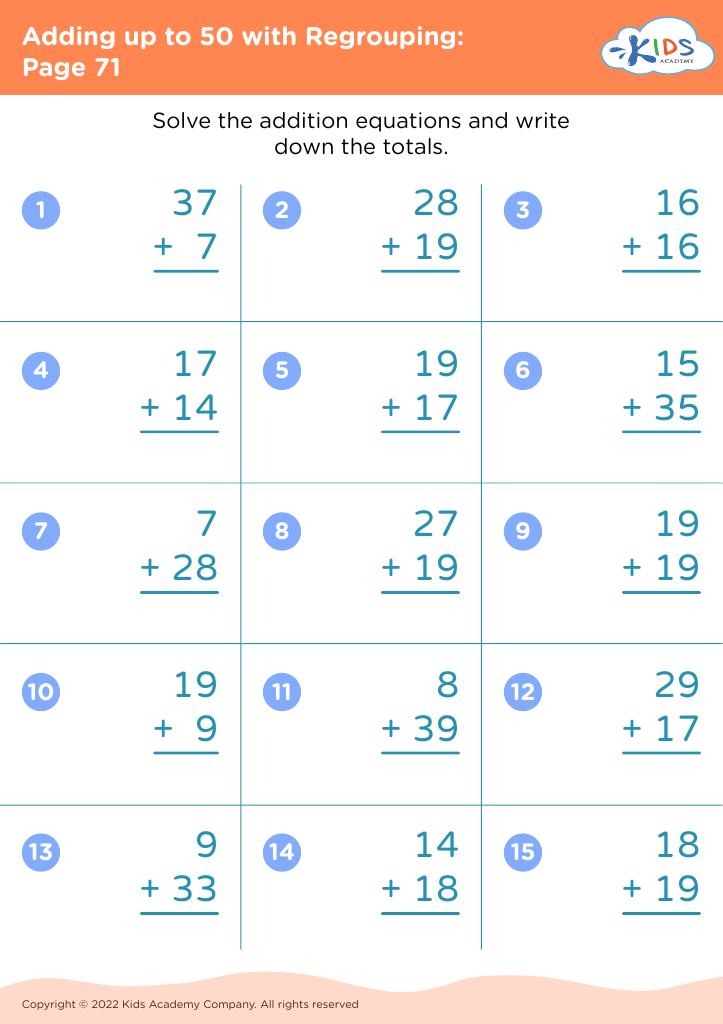








Parents and teachers should prioritize the development of motor skills, addition, and subtraction in children aged 4-9 because these foundational skills play critical roles in their overall growth and academic success.
Motor skills are divided into fine and gross motor skills. Fine motor skills involve precise movements using small muscle groups, crucial for tasks like writing, buttoning a shirt, or handling utensils. Gross motor skills involve larger muscle groups, essential for running, jumping, and playing sports. Developing these skills enhances children's physical coordination, independence, and confidence. For instance, mastering fine motor skills aids in activities like drawing, which is essential for academic subjects that involve writing and creativity.
Addition and subtraction are fundamental math skills that form the building blocks for more complex arithmetic and problem-solving abilities. These concepts introduce children to basic mathematical operations and logical thinking, which are essential in their daily lives and future educational pursuits. Learning these skills at an early age promotes cognitive development, enhances critical thinking, and builds a solid foundation for subjects such as math, science, and even everyday activities like shopping or cooking.
Together, motor skills and arithmetic develop are intertwined and contribute broadly to a child's education, socialization, and independence, aiding both academic achievement and essential life skills.








