
Observation skills Addition & Subtraction Worksheets for Ages 4-9
3 filtered results
Difficulty Level
Grade
Age
-
From - To
Subject
Activity
Standards
Enhance your child's math abilities with these engaging "Observation Skills Addition & Subtraction Worksheets" designed for ages 4-9. These printable resources effectively build foundational math skills necessary for understanding addition and subtraction. Through a variety of visually appealing activities and exercises, children will strengthen their observation and critical thinking abilities while mastering key math concepts. Crafted to keep young learners entertained and focused, these worksheets offer age-appropriate challenges that promote confidence and fluency in math. Ideal for parents and teachers alike, these tools make learning math fun and interactive, setting the stage for future academic success.
Favorites
With answer key
Interactive
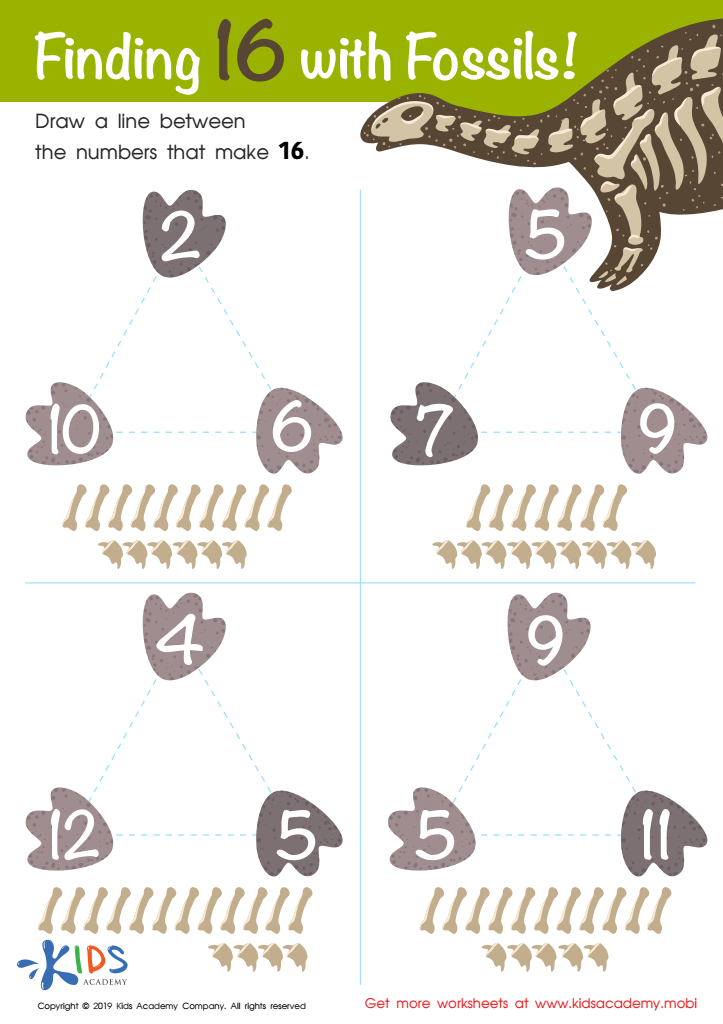
Finding 16 With Fossils Worksheet
Experts hunt for fossils, dig them up, and study them to learn more about past life forms - how they lived, what they looked like, and when they lived. Show kids the picture in this worksheet and point out the fossils. Help them count the bones and draw a line between the numbers that add up to 16 in each triangle.
 Assign to My Students
Finding 16 With Fossils Worksheet
Worksheet
Join Kids Academy for Free
Who is primarily going to use this learning content?








Developing observation skills in addition and subtraction at an early age is crucial for the cognitive and academic growth of children aged 4-9. These fundamental mathematical skills serve as the building blocks for more advanced concepts, promoting logical thinking and problem-solving abilities. Observation skills help children notice patterns and sequences, allowing them to recognize relationships between numbers, which is key to mastering basic arithmetic operations.
Parents and teachers should care about nurturing these skills because it encourages active learning and engagement. When children observe how numbers interact within the context of addition and subtraction, they develop a deeper understanding of mathematical principles. This foundational knowledge will assist them in future mathematical endeavors and real-life situations requiring numerical literacy, such as managing money and measuring objects.
Additionally, strong observation skills in math foster confidence and a positive attitude towards learning. Children who grasp these concepts early are more likely to enjoy math, reduce anxiety related to the subject, and achieve academic success. By focusing on these skills, adults are not merely teaching children how to add and subtract—they are also instilling critical thinking, attention to detail, and a lifelong affinity for learning. Hence, emphasizing observation in early math education sets children on a path towards comprehensive intellectual growth.








