Understanding equality Addition & Subtraction Worksheets for Ages 4-9
4 filtered results
-
From - To
Discover our comprehensive "Understanding Equality Addition & Subtraction Worksheets" designed for children aged 4-9. These engaging worksheets help young learners grasp the concept of equality in mathematical equations. By using fun visuals and interactive exercises, children will develop a strong foundation in addition and subtraction while learning to balance equations effectively. Our resources support educators and parents in fostering essential math skills through enjoyable activities that promote critical thinking. Perfect for home practice or classroom use, these worksheets aim to build confidence and proficiency in early math concepts, setting students on the path for future success in mathematics. Explore today!
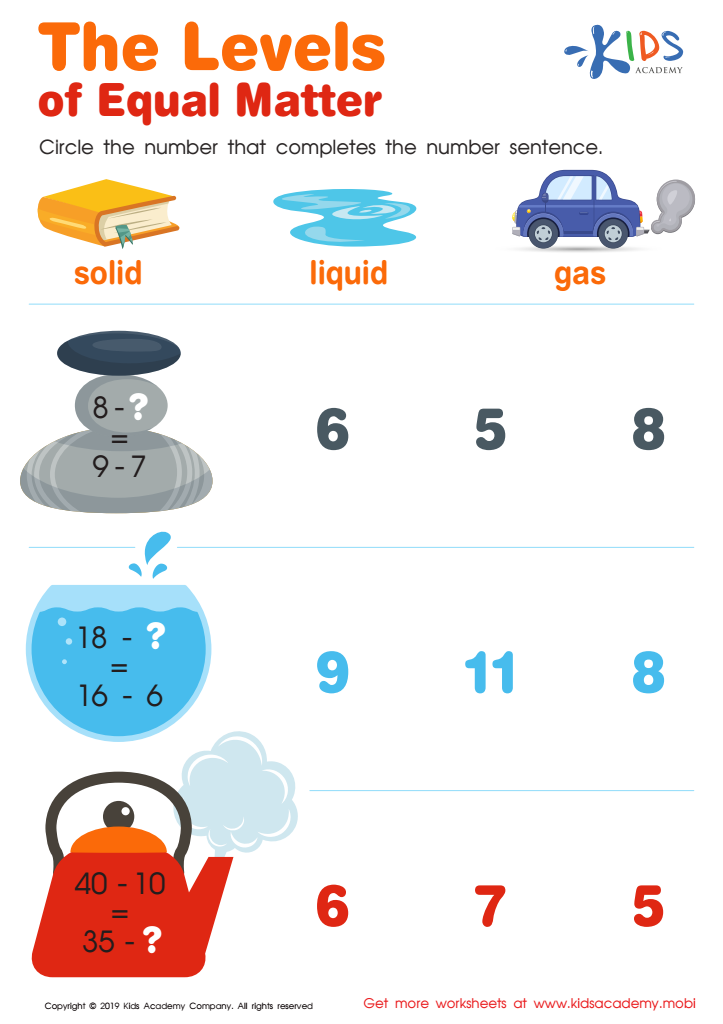
The Levels of Equal Matter Worksheet
 Assign to My Students








Understanding equality in addition and subtraction is crucial for children aged 4-9 because it forms the foundation for their mathematical development. At this early stage, children begin to grasp basic concepts and relationships in numbers, making it essential for them to learn what equality means. Recognizing that expressions like 2 + 3 and 5 are equivalent helps them understand the fundamental notion of balance in mathematics.
Parents and teachers should care about this concept as it promotes critical thinking. When children engage with equality, they learn to solve problems and become comfortable with numbers, laying the groundwork for more advanced math concepts they'll encounter later on. This understanding also enhances their confidence, as they learn that mathematics is logical and structured, contributing to a positive attitude toward the subject.
Furthermore, grasping these fundamental concepts aids in developing computation skills. Mastery of addition and subtraction ensures that children can tackle more complex mathematical challenges as their education progresses. By fostering a strong understanding of equality, parents and teachers can support children in becoming proficient, flexible thinkers, ultimately leading to future academic success in mathematics and related fields.








