
Developing observational skills Math Worksheets for Ages 4-9
4 filtered results
Difficulty Level
Grade
Age
-
From - To
Subject
Activity
Standards
Discover our engaging "Developing Observational Skills Math Worksheets for Ages 4-9" designed to enhance your child's analytical abilities and attention to detail. These specially curated worksheets provide young learners with fun and interactive exercises to sharpen their observational skills through math concepts. Perfect for early grade students, our activities blend education and play, helping kids to identify patterns, compare figures, and solve puzzles. Ideal for both classroom and home use, these worksheets support critical thinking and boost confidence in math. Unlock your child's potential and foster a love for learning with our expertly crafted resources at Kids Academy!
Favorites
With answer key
Interactive
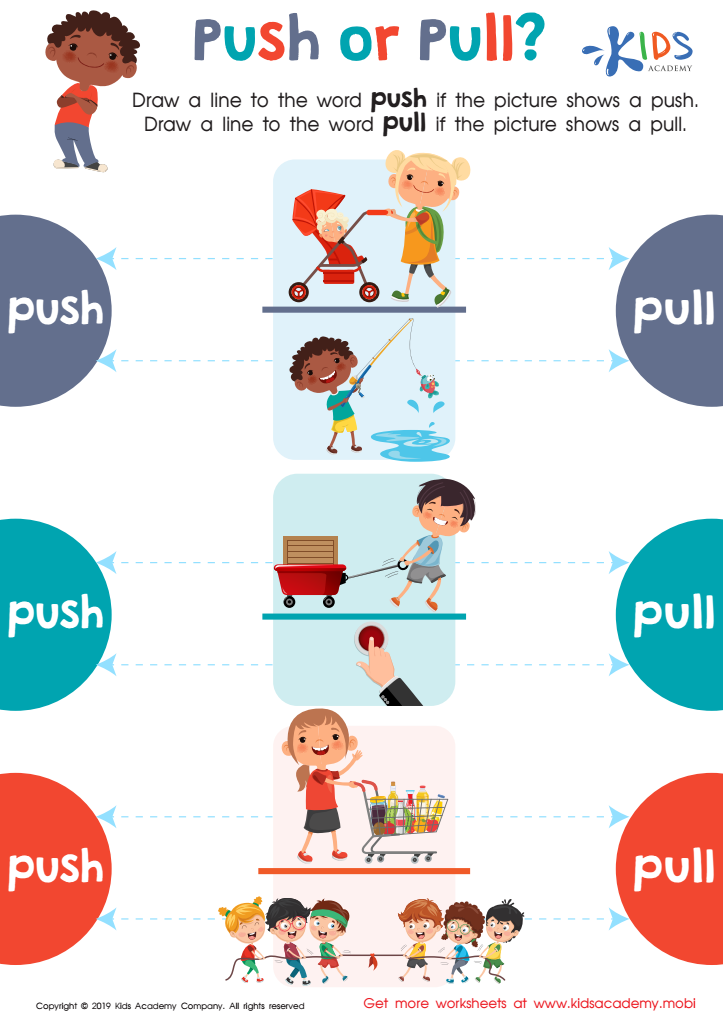
Push or Pull? Worksheet
Young kids may struggle to differentiate push and pull. When they start writing, they may use them interchangeably and wrongly. This worksheet clarifies the concepts: pushing means moving something away, pulling means bringing something closer. It provides pictures and traceable lines for kids to connect each image to the correct word. This helps them understand and remember the difference for future writing and reading.
 Assign to My Students
Push or Pull? Worksheet
Worksheet
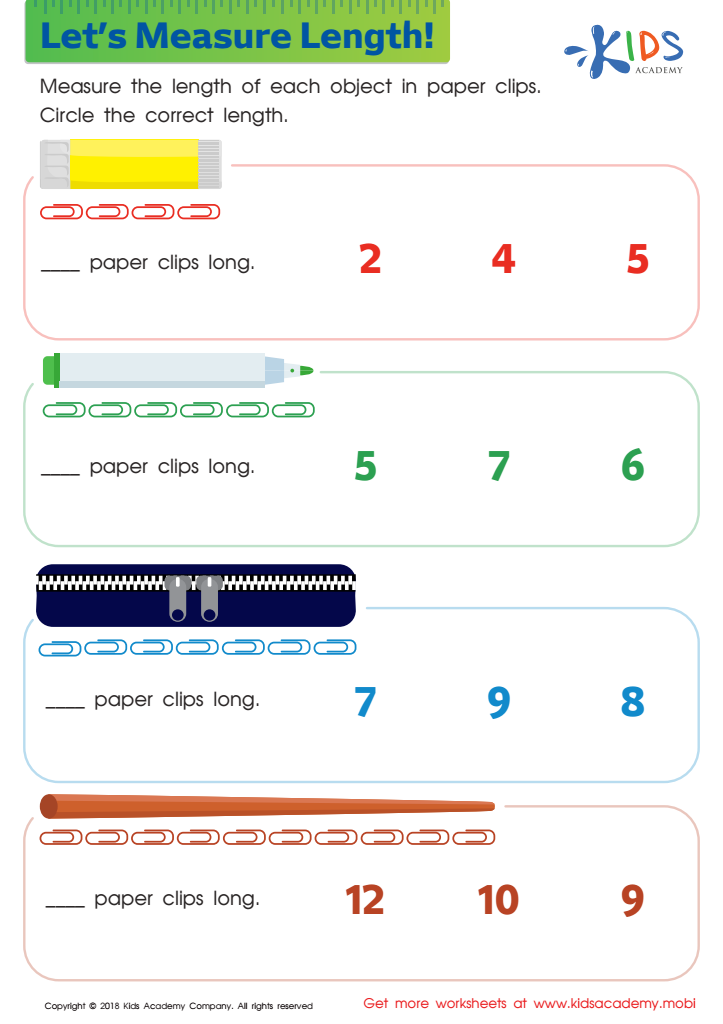
Lets Measure Length Worksheet
It's time to help your child take their measuring skills up a notch! This colorful PDF sheet from Kids Academy introduces kids to measuring with paperclips. Guide them through the page, showing them how to count the clips to measure each image. Then, circle the correct length for each to complete the sheet!
Lets Measure Length Worksheet
Worksheet
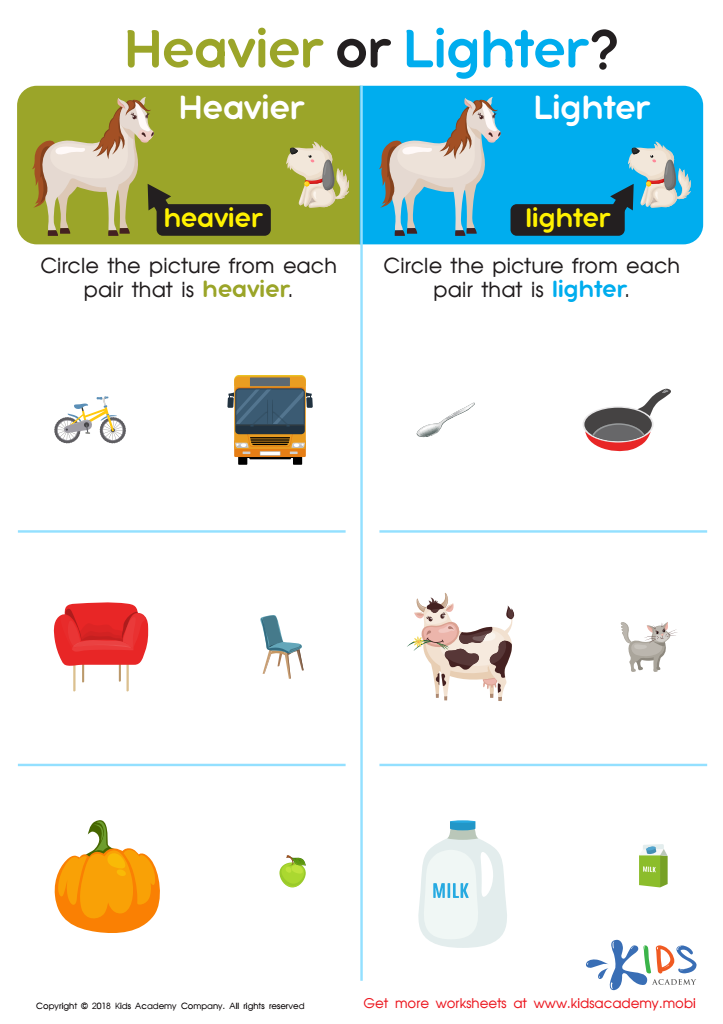
Heavier or Lighter? Worksheet
This PDF provides children an opportunity to practice concepts of heavier and lighter with familiar pictures. They must use fine-motor skills to circle the heavier or lighter item in each pair. Picture clues help build a foundation for future, harder concepts. Kids will love this fun worksheet!
Heavier or Lighter? Worksheet
Worksheet
Join Kids Academy for Free
Who is primarily going to use this learning content?







Developing observational skills in math for children ages 4-9 is crucial as it lays the groundwork for future academic and life skills. At this stage, children are naturally curious and possess a heightened sensitivity to the world around them. By tapping into this natural inclination, parents and teachers can enhance their ability to recognize patterns, shapes, and numbers in everyday environments.
Observational skills contribute significantly to a child's mathematical understanding. Recognizing and understanding patterns can improve their ability to predict sequences and solve problems—key activities in math. For example, spotting a sequence in shapes can help children understand more complex algebraic concepts later.
Furthermore, honing observational skills enhances critical thinking and decision-making abilities. When children observe closely, they learn to notice details and distinctions, forming a solid conceptual foundation. Being able to observe and process what they see can also help in different areas such as reading, science, and even social interactions.
Incorporating games, puzzles, and everyday scenarios, like counting objects during a walk, can make learning enjoyable and relevant. This engagement helps children see math not just as a subject but as a part of their lives, thereby fostering a positive attitude towards learning.
Ultimately, parents and teachers nurturing these skills give children tools that are not just confined to the classroom but applicable throughout their lives, encouraging a lifelong affinity for learning and problem-solving.








