Enhances number recognition Math Worksheets for Ages 4-9
5 filtered results
-
From - To
Discover the perfect solution for boosting number recognition in young learners with our expertly designed Math Worksheets for Ages 4-9. Tailored to engage and educate, these worksheets offer a range of activities that make learning numbers fun and intuitive. Each worksheet is crafted to enhance numerical understanding and counting skills, suitable for various skill levels. Ideal for both classroom and home use, our worksheets provide a strong foundation in early math concepts. Give your child the head start they deserve with our comprehensive, growth-focused resources. Dive into a world of exciting, educational adventures today!
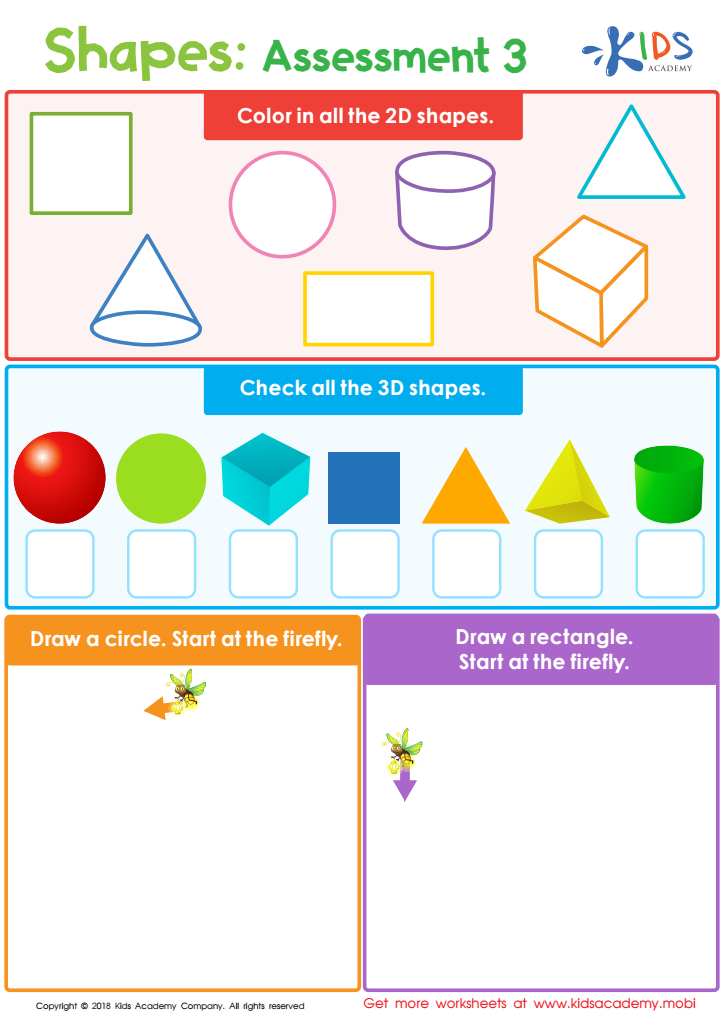
Shapes: Assessment 3 Worksheet
 Assign to My Students








Enhancing number recognition skills in children aged 4-9 is crucial for several reasons. During this formative period, a child's brain is exceptionally receptive to learning new concepts, and foundational math skills form a critical part of overall cognitive development. Strong number recognition skills can significantly ease the transition into more complex mathematical operations, such as addition, subtraction, multiplication, and division, which are essential not just academically but also for everyday problem-solving and decision-making.
Early competence in number recognition helps in boosting a child's self-confidence and fosters a positive attitude towards math. When children can quickly identify numbers and comprehend their values, they are more likely to participate actively in class, engage with math-related activities, and pursue educational opportunities in science, technology, engineering, and math (STEM) fields later in life.
Moreover, cultivating these skills enhances other key cognitive abilities, including memory, pattern recognition, and logical thinking. Early attention to number recognition sets the stage for academic success, paving the way for a more enriched learning experience. Therefore, both parents and teachers should prioritize activities and curricula that strengthen these vital skills, as they serve as building blocks for future academic achievement and practical life skills.








