Identifying fractions Math Worksheets for Ages 4-9
5 filtered results
-
From - To
Explore our engaging Identifying Fractions Math Worksheets designed specifically for children aged 4-9. These worksheets promote early math skills by helping young learners understand the concept of fractions through fun, interactive activities. Each worksheet offers visual aids and examples that cater to varying learning styles, making it easy for kids to grasp the basics of fractions. Our resources are perfect for homeschooling, extra practice, or enhancing classroom learning. With a range of difficulty levels, your child will build confidence and grow their math skills while enjoying the process. Start their fraction journey today with our colorful, easy-to-use worksheets!
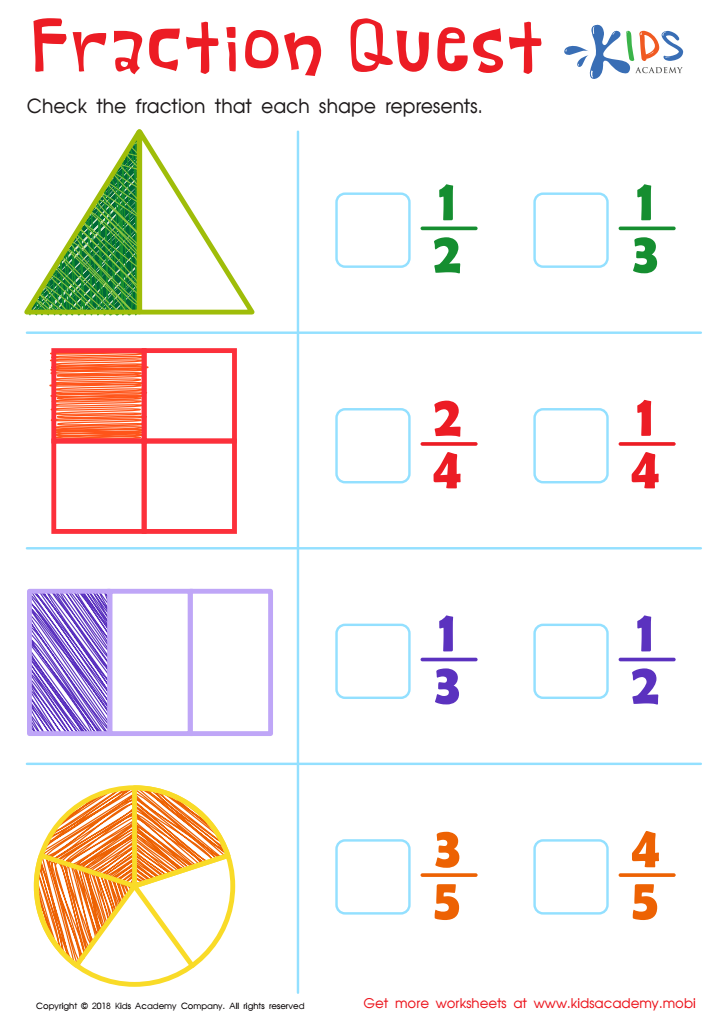
Fraction Quest Worksheet
 Assign to My Students






Identifying fractions is a foundational math skill that is crucial for children ages 4-9. Understanding fractions supports essential cognitive development and helps children make sense of a world filled with parts and wholes. When teachers and parents emphasize the importance of fractions, they foster critical thinking and problem-solving abilities in young learners.
Early fraction concepts introduce kids to essential mathematical reasoning. They learn to partition objects, understand equal parts, and compare sizes—skills that form the basis for more complex math later on. Engaging with fractions also cultivates an understanding of ratios and proportions, which are important in various real-life contexts like cooking, shopping, and measuring.
Moreover, developing fraction recognition helps strengthen a child's confidence in math, reducing future anxieties surrounding this subject. As they engage with fractions through playful activities, such as sharing pizza slices or measuring ingredients, children learn collaboration and sharing skills as well.
By prioritizing the identification of fractions, parents and teachers contribute to a comprehensive mathematical foundation. This early exposure lays the groundwork for advanced math capabilities and promotes a lifelong appreciation for learning in both children and their caretakers.








