Math problem-solving skills Math Worksheets for Ages 4-9
4 filtered results
-
From - To
Discover our engaging Math Problem-Solving Skills Worksheets designed for children aged 4-9. These fun and interactive resources help young learners build essential math skills through problem-solving exercises. Our carefully crafted worksheets offer a variety of challenges, encouraging critical thinking and enhancing logical reasoning abilities. With colorful illustrations and relatable scenarios, students will love exploring mathematical concepts while fostering a growth mindset. Perfect for use in the classroom or at home, these worksheets provide an ideal learning experience that caters to diverse learning styles. Empower your child’s mathematical journey today and watch them flourish as confident problem solvers!
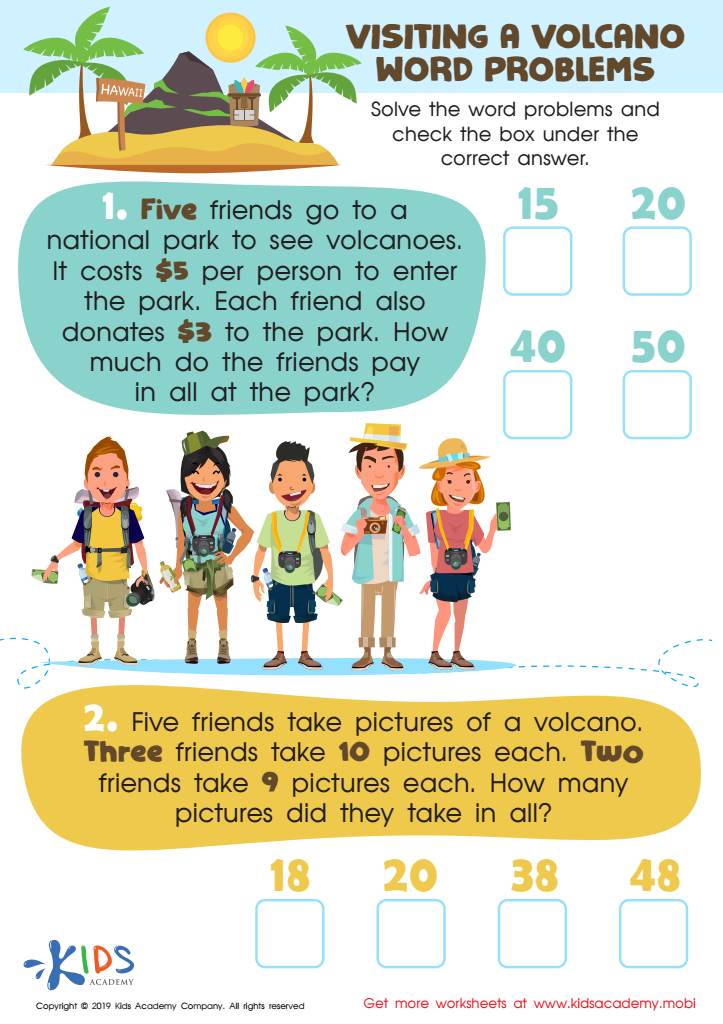
Visiting a Volcano Word Problems Worksheet
 Assign to My Students







Math problem-solving skills are crucial for children aged 4-9, as they lay the foundation for future academic success and everyday life applications. At this stage, children are developing critical thinking and reasoning abilities. Problem-solving in math encourages them to explore various methods and strategies, fostering creativity and resilience in the face of challenges.
Firstly, math teaches essential cognitive skills, such as pattern recognition, logical reasoning, and analytical thinking. These skills are not only vital in mathematics but are also transferable to other subjects, reinforcing learning in science, language arts, and even social studies.
Secondly, problem-solving supports emotional development. When children successfully tackle a math problem, they gain confidence and a sense of accomplishment, reinforcing a positive attitude toward learning. Conversely, facing and overcoming challenges builds perseverance—a skill that will benefit them throughout their academic and personal lives.
Lastly, in our increasingly quantitative world, strong math skills provide children with tools to understand and navigate the world around them, from budgeting allowances to interpreting data in news articles. For these reasons, parents and teachers should emphasize the importance of math problem-solving, ensuring children develop a solid foundation for future learning and real-world applications.








