Number sequence learning Math Worksheets for Ages 4-9
3 filtered results
-
From - To
Unlock the world of number sequences with our engaging Math Worksheets designed for children ages 4-9! These interactive resources help young learners grasp essential counting and sequencing skills in a fun and accessible way. Featuring colorful illustrations and age-appropriate exercises, our worksheets will guide kids through activities that reinforce their understanding of number patterns and order. Ideal for homeschooling or in-class learning, our worksheets make math exciting and enjoyable! Foster your child's mathematical abilities and confidence as they master number sequences, preparing them for future academic success. Start their learning adventure today with our captivating and effective math materials!
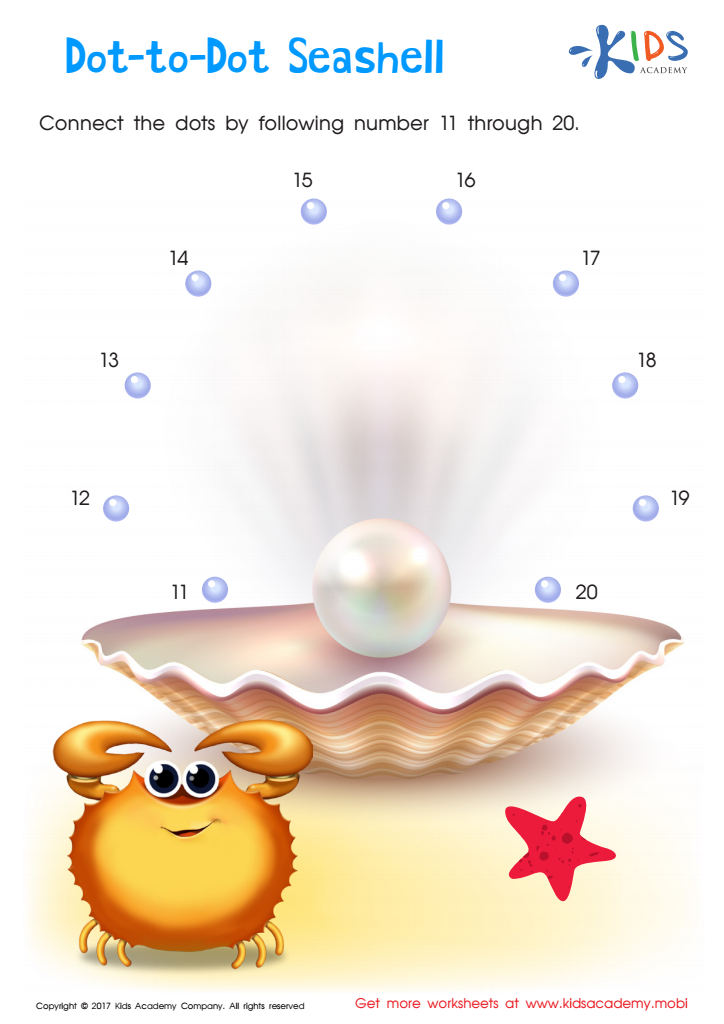
Ordering 11–20: Dot–to–dot Seashell Printable
 Assign to My Students

Counting on the City Skyline: Dot-to-Dot Worksheet







Number sequence learning is crucial for children aged 4-9 as it lays a foundational understanding of mathematics. During these early years, children develop essential cognitive skills that are pivotal for their future academic success. Mastering number sequences enhances their ability to recognize patterns, which is fundamental not only in math but also in problem-solving and critical thinking across various subjects.
Furthermore, number sequences serve as the building blocks for more complex mathematical concepts, such as addition, subtraction, and even multiplication. By mastering sequences, children learn about order and organization, which helps in daily life tasks, like counting objects or telling time.
Additionally, engaging in number sequence activities fosters a positive attitude toward math. When children find joy in counting and sequencing, they become more confident, reducing math anxiety that can hinder their progress in later years. Involving parents and teachers in this learning journey enhances the support system for children, creating collaborative opportunities to reinforce skills through games and discussions.
In summary, it is essential for parents and teachers to prioritize number sequence learning, as it not only cultivates essential mathematical skills but also boosts overall academic performance and fosters a love for learning.








