Recognizing equivalent fractions Math Worksheets for Ages 4-9
5 filtered results
-
From - To
Explore our engaging and educational worksheets designed to help young learners, ages 4-9, effortlessly recognize equivalent fractions. With vibrant illustrations and fun exercises, children will enhance their understanding of fractions through hands-on practice and visual aids. Our expertly crafted materials encourage kids to identify and compare fractions with ease, paving the way for a strong mathematical foundation. Ideal for both classroom and home use, these printable worksheets cater to varying skill levels, offering step-by-step guidance and interactive challenges. Equip your child with the confidence and skills needed to master equivalent fractions with our comprehensive resources.
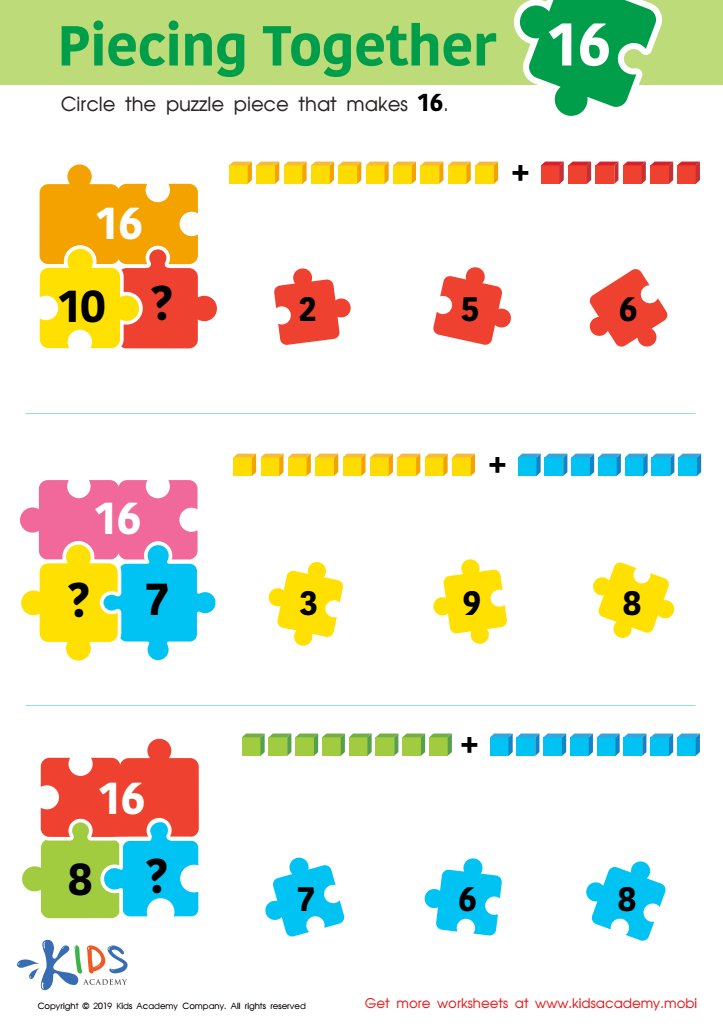
Piecing Together 16 Worksheet
 Assign to My Students







Parents and teachers should care about recognizing equivalent fractions in early math education for several key reasons. First and foremost, early exposure to equivalent fractions helps build a strong mathematical foundation. Understanding how different fractions can represent the same value is crucial for grasping more advanced math concepts later, such as addition, subtraction, multiplication, and division of fractions.
For children between the ages of 4 and 9, developing a solid understanding of equivalent fractions aids in boosting their numerical literacy. It helps them become more comfortable working with ratios, proportions, and even basic algebraic concepts as they progress in their education. Learning about equivalent fractions also fosters critical thinking and problem-solving skills, as children must use logical reasoning to determine which fractions are equivalent.
Moreover, equivalent fractions occur frequently in everyday life, from measuring ingredients in recipes to dividing a pizza among friends. By comprehending these concepts early on, children are better prepared to apply mathematical reasoning to real-world situations.
Furthermore, recognizing equivalent fractions can enhance a child's ability to work collaboratively. Group activities involving fractions require clear communication and understanding of shared concepts. Cultivating such skills early on sets children up for academic success and practical numeracy that they will use throughout their lives.








