Understanding adjectives Math Worksheets for Ages 4-9
6 filtered results
-
From - To
Welcome to our "Understanding Adjectives Math Worksheets" tailored for children ages 4-9! These engaging worksheets seamlessly blend language learning with math skills, helping young learners grasp the concept of adjectives in fun, interactive ways. Each worksheet is designed to enhance vocabulary and critical thinking, guiding students to identify and describe objects in mathematical contexts. From colorful illustrations to age-appropriate challenges, our resources aim to make learning enjoyable. Empower your child to explore the world of adjectives while developing essential math skills. Download our worksheets today and watch their confidence and comprehension grow! Perfect for classroom use or at-home learning!
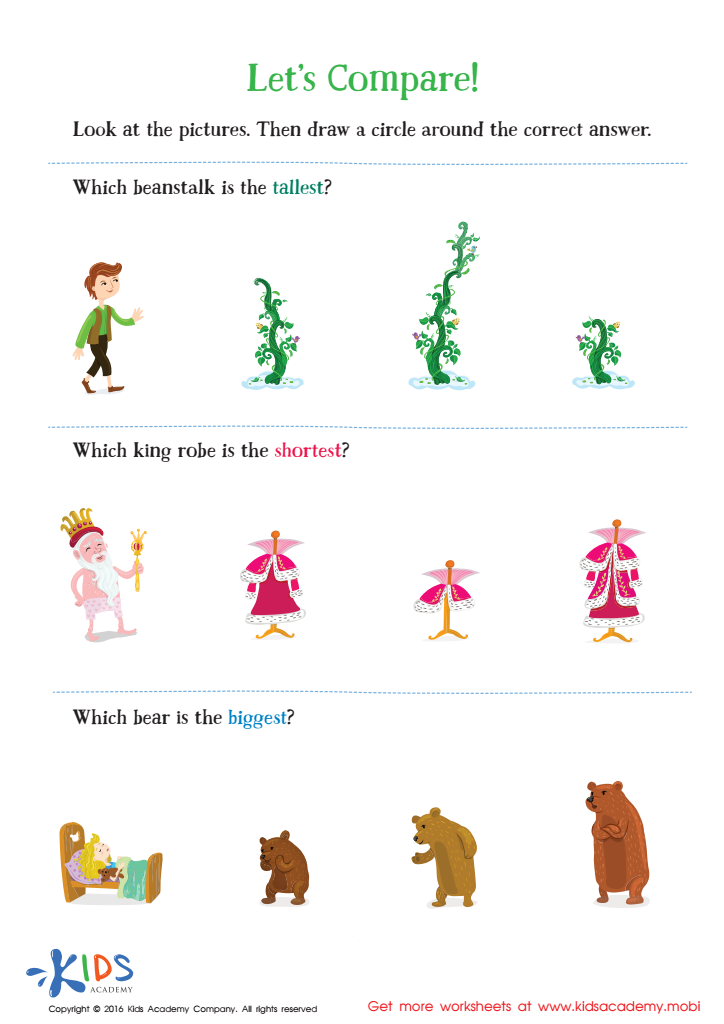
Fairy Tale Worksheet: Let's Compare
 Assign to My Students








Understanding adjectives in math is crucial for children aged 4-9 because language and mathematics are interconnected, enhancing both cognitive and academic development. Adjectives help children describe quantities, shapes, sizes, and patterns, facilitating a deeper understanding of mathematical concepts. For example, when kids learn terms like "greater," "smaller," "equal," or "more," they not only label numbers but also compare and categorize them, laying the groundwork for critical thinking.
Additionally, the use of adjectives enriches a student’s mathematical vocabulary, which is essential for effective communication. When children can articulate their reasoning about problems—“I have more apples than oranges” or “This triangle is smaller than that rectangle”—they build confidence and a clearer understanding of math.
For parents and teachers, focusing on extending mathematical vocabulary, including adjectives, nurtures a child’s overall literacy and numeracy skills. Engaging young learners through playful exploration with descriptive terms boosts their enthusiasm for math. When students fluently use mathematical language, they are better prepared for advanced concepts in the future. Thus, fostering an environment that encourages understanding adjectives in the context of math is vital for holistic education at this critical developmental stage.








