Understanding commutative property Math Worksheets for Ages 4-9
4 filtered results
-
From - To
Explore our "Understanding Commutative Property Math Worksheets for Ages 4-9" to help young learners grasp this fundamental math concept effortlessly. These engaging, age-appropriate worksheets are designed to make learning fun and effective. They provide clear examples and interactive activities that highlight how numbers can be added or multiplied in any order, simplifying complex concepts. Perfect for classroom and at-home practice, our worksheets build a strong math foundation, boost problem-solving skills, and foster a love for math. Equip your child with the tools they need to succeed in mathematics through practical and enjoyable exercises. Visit Kids Academy today!
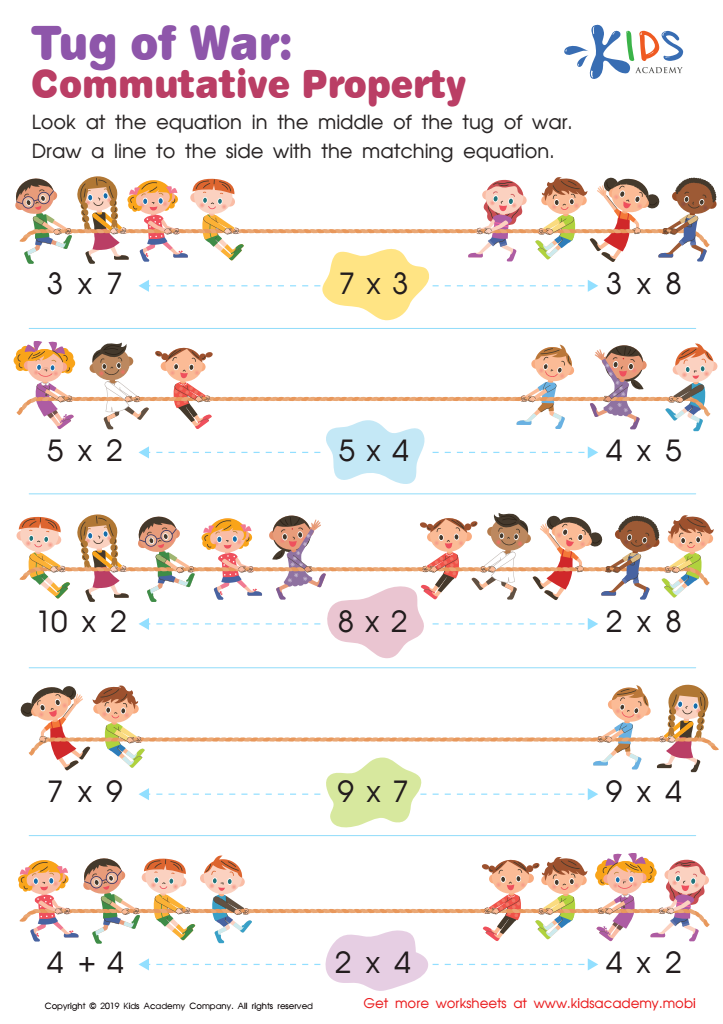
Tug of War: Commutative Property Worksheet
 Assign to My Students
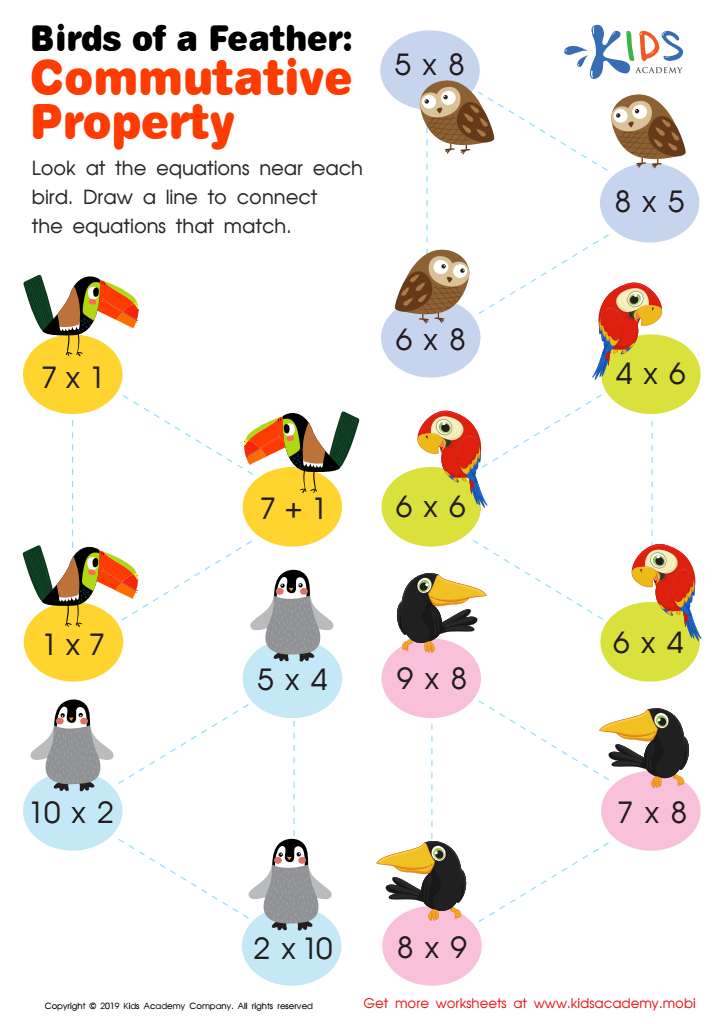
Birds of a Feather: Commutative Property Worksheet
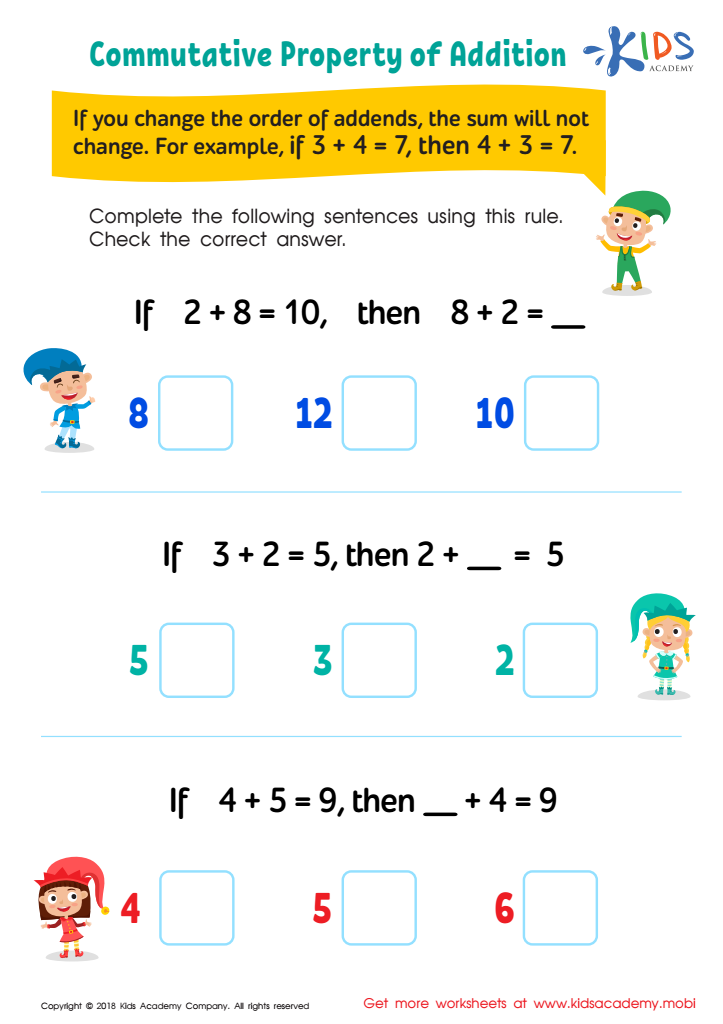
Commutative Property of Addition Worksheet
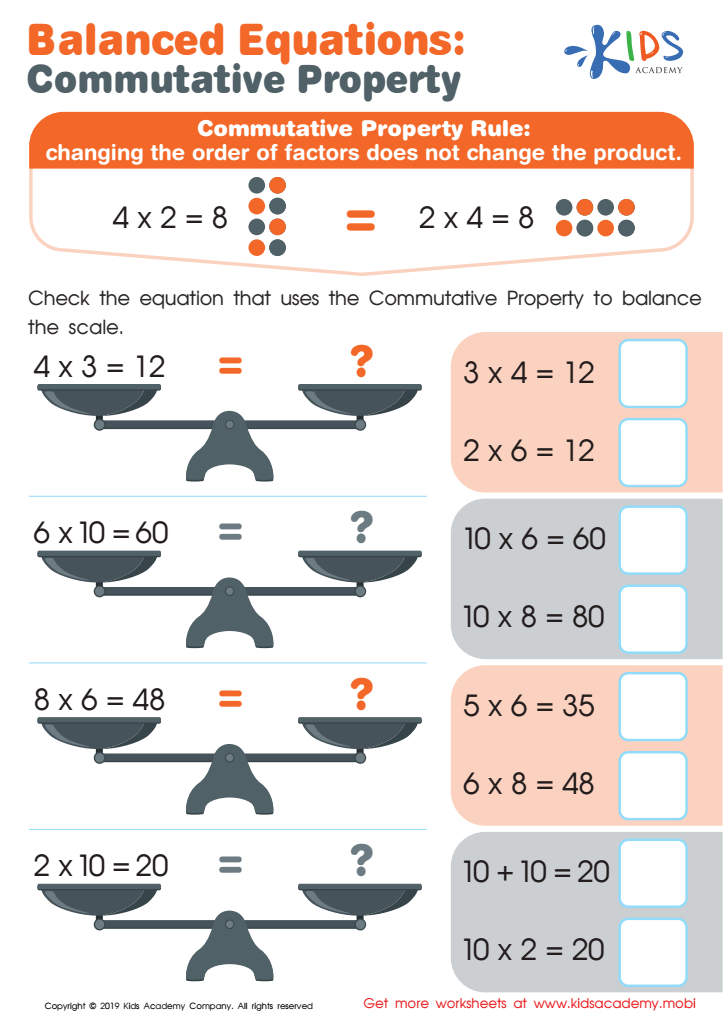
Balanced Equations: Commutative Property Worksheet








Understanding the commutative property of addition and multiplication is foundational for young children aged 4-9 because it enhances their mathematical thinking and problem-solving skills. The commutative property states that numbers can be added or multiplied in any order without changing the result, e.g., 3 + 4 is the same as 4 + 3, and 2 x 5 is the same as 5 x 2.
For parents and teachers, comprehending this principle allows them to foster a child's development in mathematics more effectively. Firstly, it simplifies arithmetic, reducing the cognitive load, and helping children feel more confident in their abilities. When they realize that flipping numbers around does not affect the result, they can approach math problems more flexibly and creatively.
Furthermore, the commutative property builds a foundation for more advanced mathematical concepts they will encounter later in their education, like associative and distributive properties. Early familiarity with such properties promotes logical thinking and highlights patterns in numbers, which is crucial for algebra and beyond.
Finally, understanding this property can also influence teaching strategies by encouraging the use of hands-on activities, games, and visual aids, making math more engaging and enjoyable. In turn, a positive early experience with math can foster a lifelong interest and proficiency in the subject.








