
Understanding division Math Worksheets for Ages 4-9
8 filtered results
Difficulty Level
Grade
Age
-
From - To
Subject
Activity
Standards
Explore our "Understanding Division" math worksheets tailored for children aged 4-9, designed to make learning division engaging and intuitive. These worksheets feature a variety of activities that help young learners grasp the concept of division through visual aids, relatable examples, and hands-on practice. With a focus on both concepts and computation, each worksheet gradually builds proficiency, ensuring children develop a strong mathematical foundation. Ideal for teachers and parents, our resources aim to enhance critical thinking and problem-solving skills in a fun and interactive way. Start your child's journey towards mastering division today with our thoughtfully crafted worksheets!
Favorites
With answer key
Interactive
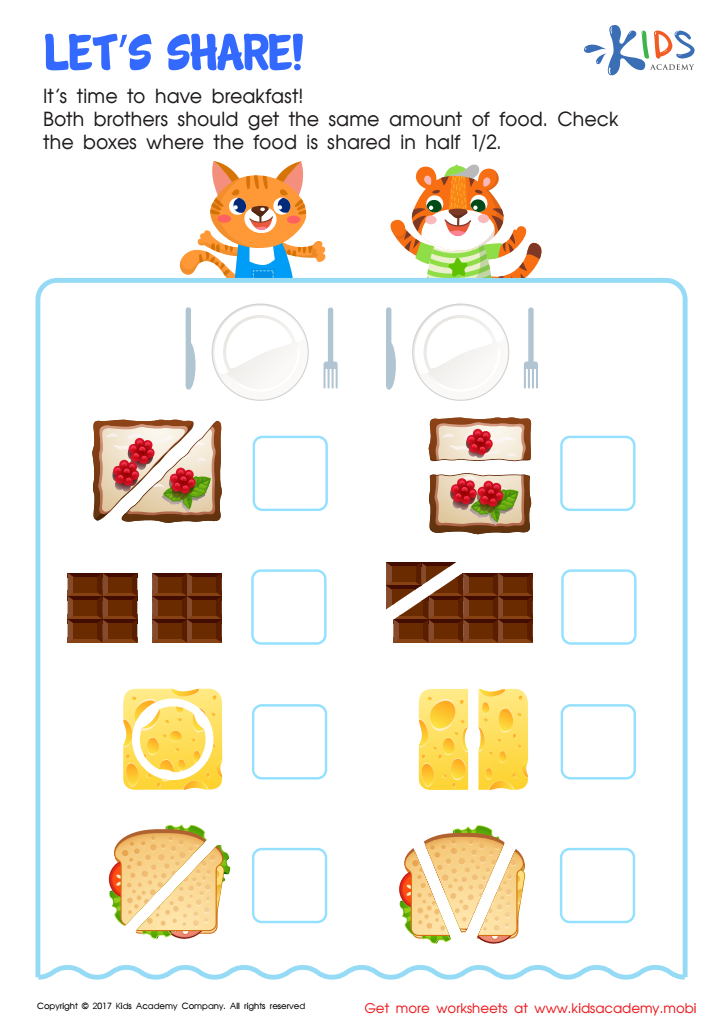
Let's Share Worksheet
It's time to test if your lessons on sharing paid off! With this worksheet, your child can have breakfast and make sure both brothers get equal amounts of food. Have them look at the food images and check the boxes where food is divided equally.
 Assign to My Students
Let's Share Worksheet
Worksheet
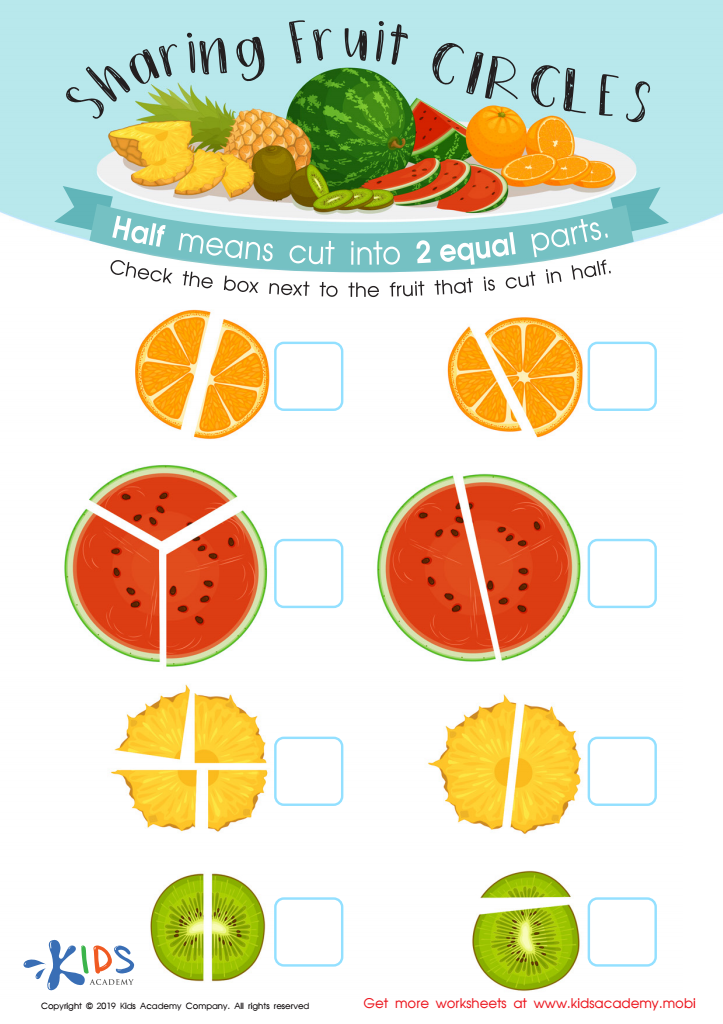
Sharing Fruit Circles Worksheet
Fruits are tasty and bright! Can your kids name some of their favorites? With this worksheet, you can use fruit to teach your kids geometry. Talk about how shapes can be cut into halves. Ask them to tick the box for the fruit halves in the printout.
Sharing Fruit Circles Worksheet
Worksheet
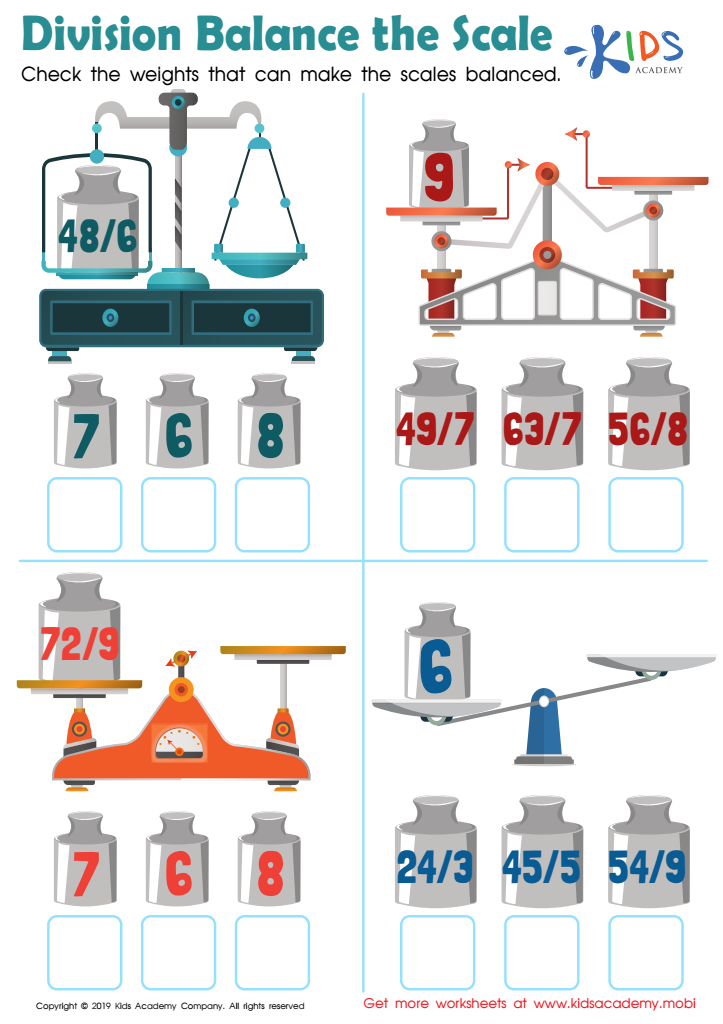
Division Balance the Scale Worksheet
Students can learn math better when they understand the relationships between numbers. This free worksheet helps them practice division: solving problems and matching the correct quotient to balance the scales. Fun visual boxes make it a unique way to engage with the material.
Division Balance the Scale Worksheet
Worksheet
Join Kids Academy for Free
Who is primarily going to use this learning content?








Understanding division is crucial for children aged 4-9 as it lays the foundation for their mathematical skills and logical thinking. At this age, children begin to explore basic arithmetic concepts, and division introduces them to the idea of sharing and grouping—key concepts that they will encounter throughout their education and daily lives. By grasping division, children learn how to break down larger numbers into smaller, more manageable parts, paving the way for success in more complex mathematical operations such as fractions and ratios.
Moreover, understanding division promotes critical thinking and problem-solving skills. It encourages children to think about quantities and relationships in a dynamic way. For parents and teachers, fostering a solid understanding of division can enhance a child’s confidence in math, reducing anxiety around the subject as they progress through school. This early grasp can also aid in developing persistence and resilience in tackling challenging problems.
In sum, division is not just an abstract concept; it creates opportunities for real-life applications and meaningful learning experiences. By supporting children in mastering this skill, parents and teachers are equipping them for future academic success and fostering essential life skills that will benefit them well beyond the classroom.








