
Understanding grouping Math Worksheets for Ages 4-9
3 filtered results
Difficulty Level
Grade
Age
-
From - To
Subject
Activity
Standards
Discover engaging "Understanding Grouping Math Worksheets" tailored for children ages 4-9. These worksheets from Kids Academy provide a fundamental grasp of grouping, an essential math skill. Through interactive exercises, young learners enhance their counting, sorting, and classification abilities. Each activity is designed to be age-appropriate, fostering critical thinking and problem-solving skills. Perfect for classrooms or home learning, these printables make math fun and accessible. Help your child build a strong mathematical foundation and boost their confidence. Explore our collection and watch them master grouping with ease and excitement!
Favorites
With answer key
Interactive
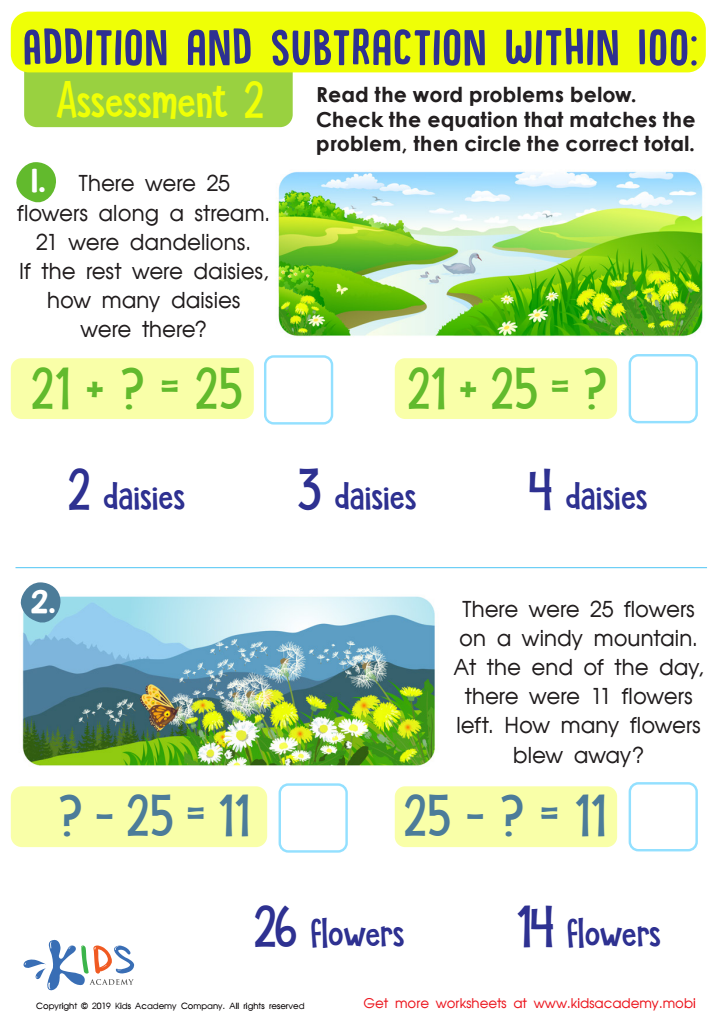
Assessment 2 Math Worksheet
Using fun exercises and pictures, you can get kids excited about math. With practice and reminders of what they've learnt, they'll be solving simple addition and subtraction equations with ease. Read the word problems in the picture to them, then help them check the equation and choose the correct answer.
 Assign to My Students
Assessment 2 Math Worksheet
Worksheet
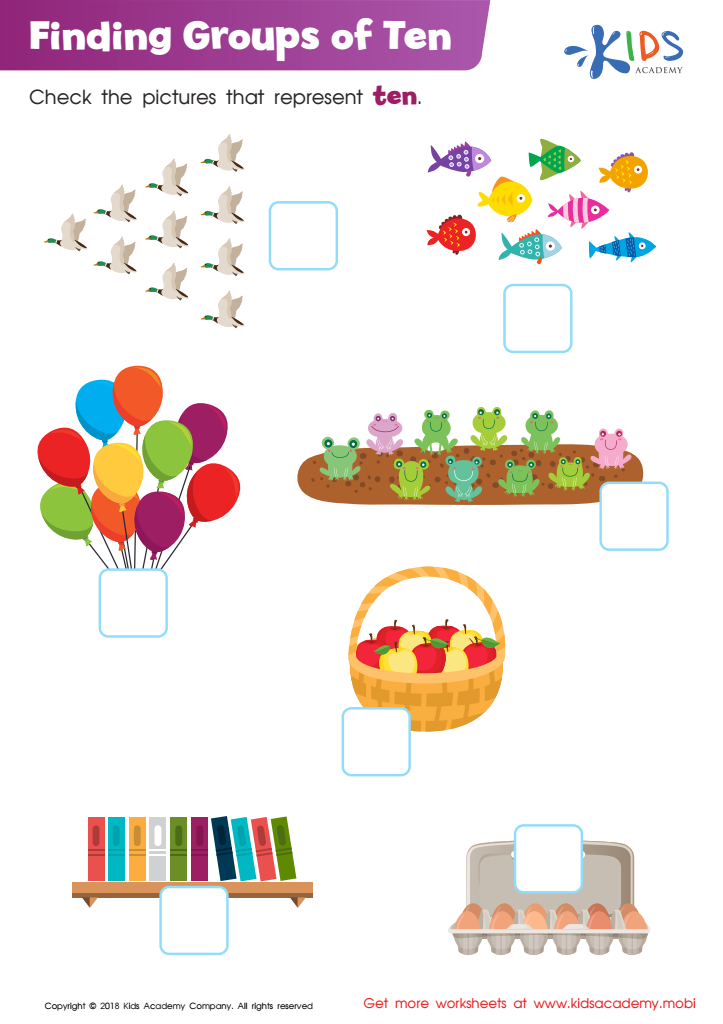
Finding Groups of Ten Worksheet
Can your kids count? If they can't go higher than tens, introduce them to this worksheet. Counting can be fun and easy with this exercise. Ask if they can identify the pictures, then help them count each group. Help them check the pictures that represent ten.
Finding Groups of Ten Worksheet
Worksheet
Join Kids Academy for Free
Who is primarily going to use this learning content?








Understanding grouping in math is fundamental for children aged 4-9 as it lays the groundwork for basic mathematical concepts and problem-solving skills. Grouping helps children comprehend numerical patterns, recognize the value of numbers, and develop efficient counting strategies. For instance, when kids group objects, they begin to understand addition and subtraction, revealing how numbers are composed and decomposed.
Parents and teachers who focus on grouping practices foster critical early math skills such as place value, which is pivotal for more advanced arithmetic operations. Grasping these concepts early can boost a child's confidence and interest in math, setting a positive trajectory for their future learning. Moreover, grouping aids in developing logical thinking and categorization skills, which are useful beyond mathematics and applicable to organizing thoughts and ideas in various academic subjects.
In addition, using hands-on, playful activities involving grouping can engage children more effectively, making math fun and less intimidating. Activities like sorting toys, counting with blocks, or using visual aids can enrich a child’s learning experience. Thus, understanding grouping helps build a strong mathematical foundation, nurtures curiosity, and prepares children for real-world problem solving. Therefore, it is crucial for parents and teachers to emphasize and support grouping concepts in early education.








