
Understanding ordinal numbers Math Worksheets for Ages 4-9
3 filtered results
Difficulty Level
Grade
Age
-
From - To
Subject
Activity
Standards
Discover our engaging "Understanding Ordinal Numbers Math Worksheets" designed for children ages 4-9. These worksheets offer a fun and interactive way for young learners to grasp the concept of ordinal numbers, such as first, second, and third. With visually stimulating activities, children will practice identifying and ordering objects while enhancing their counting and number recognition skills. Our carefully crafted worksheets promote essential early math skills, reinforcing learning with a mix of illustrations and real-world examples. Perfect for classroom use or at-home practice, these resources make learning about ordinal numbers enjoyable and effective. Help your child build a strong math foundation today!
Favorites
With answer key
Interactive
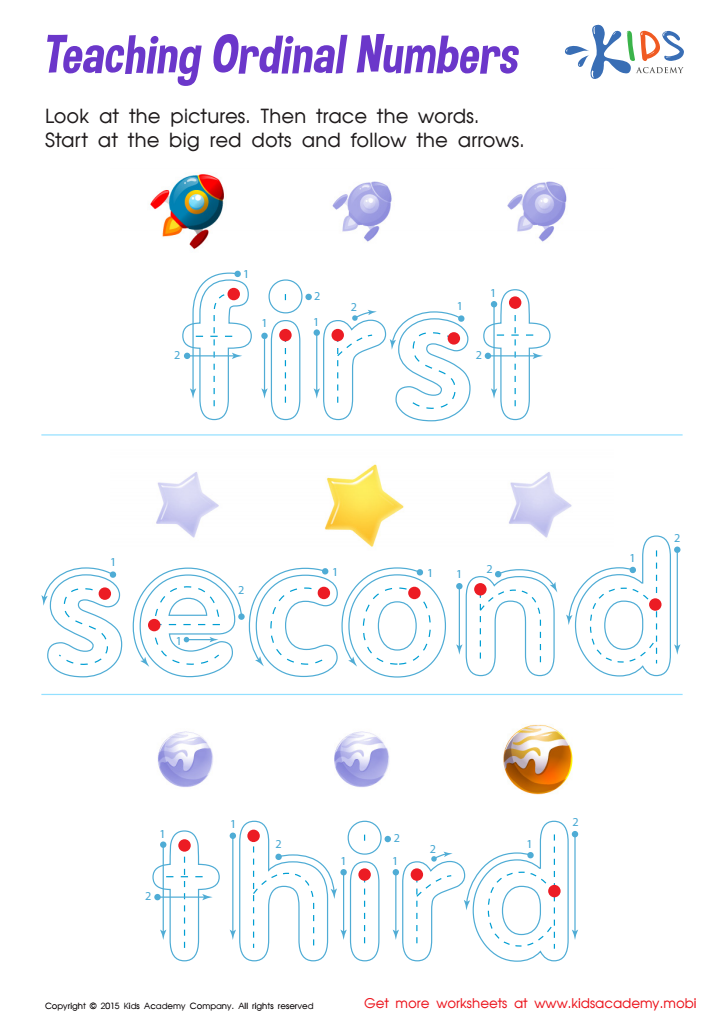
Ordinal Numbers: Teaching Ordinal Numbers Printable
Practice makes perfect!
Kids need to understand ordinal numbers - placement, recognition and spelling. Our worksheet helps kids make connections between the placement and spelling of ordinal numbers. Practice will help your little one perfect this vital number concept.
 Assign to My Students
Ordinal Numbers: Teaching Ordinal Numbers Printable
Worksheet
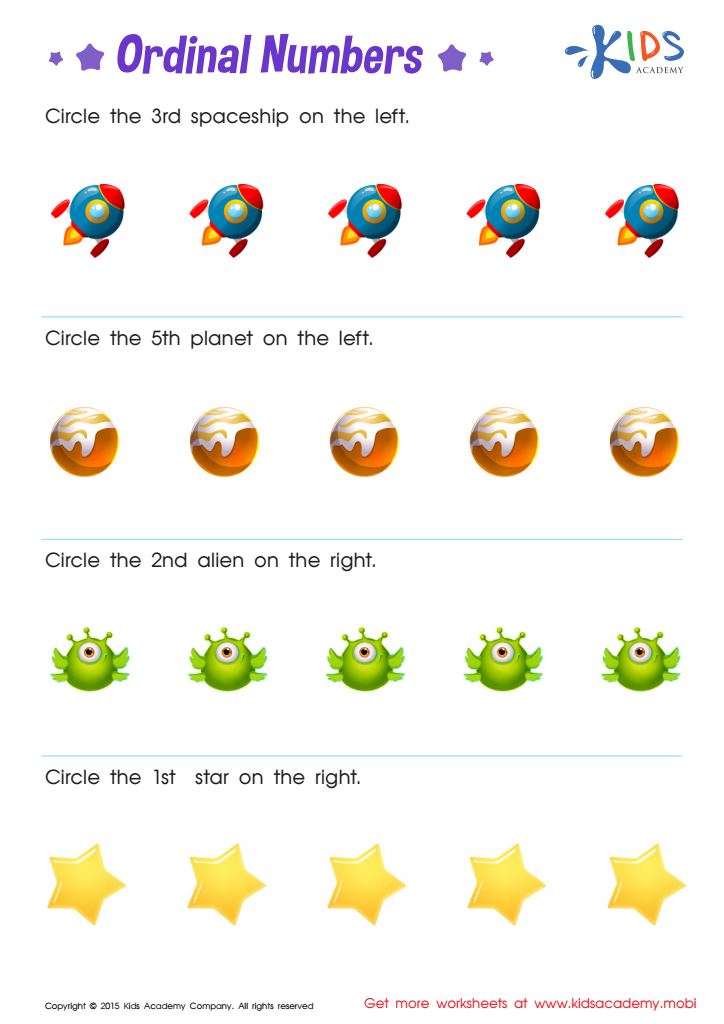
Ordinal Numbers: Space Ordinals Worksheet
Practicing with ordinal numbers worksheet PDFs helps kids master crucial concepts for higher-level math. Plus, when kids have fun learning, the knowledge sticks! So, have your child “blast off” with this space-themed worksheet to read directions, practice relative directions, and learn ordinal numbers.
Ordinal Numbers: Space Ordinals Worksheet
Worksheet
Join Kids Academy for Free
Who is primarily going to use this learning content?








Understanding ordinal numbers is critical for children aged 4-9 as they form the foundation for various mathematical concepts and everyday situations. Ordinal numbers indicate the position or order of objects, such as 1st, 2nd, or 10th, and are vital in helping children navigate their environments. For instance, recognizing their place in line, determining who's next in a game, or even ranking preferences are daily experiences that involve ordinals.
For parents and teachers, fostering an understanding of ordinal numbers enhances children's cognitive development and mathematical fluency. It aids in developing logical thinking and supports skills such as sequencing, categorizing, and understanding patterns—key components for higher-level math skills later on. Furthermore, grasping the concept of order promotes confidence in problem-solving and decision-making.
Engaging children in activities that incorporate ordinals, such as counting games, sorting objects, or storytelling, can be both fun and educational. When children see the practical applications of ordinals in their daily lives, it deepens their learning experience and encourages their curiosity about mathematics, leading to greater academic success. By prioritizing the understanding of ordinal numbers, parents and teachers lay a strong groundwork for children's overall development in mathematics and beyond.








