Spatial awareness Building Vocabulary Worksheets for Ages 4-9
3 filtered results
-
From - To
Enhance your child's spatial awareness and vocabulary with our engaging worksheets designed for ages 4-9. These expertly crafted printables help children grasp essential concepts such as positioning, direction, and relative distance through fun and interactive activities. As they complete exercises, young learners build a rich vocabulary that describes spatial relationships, boosting their reading and cognitive skills. Ideal for use at home or in the classroom, our worksheets support comprehensive development and make learning enjoyable. Propel your child's understanding of the world around them while laying a solid foundation for academic success with our spatial awareness building vocabulary worksheets.
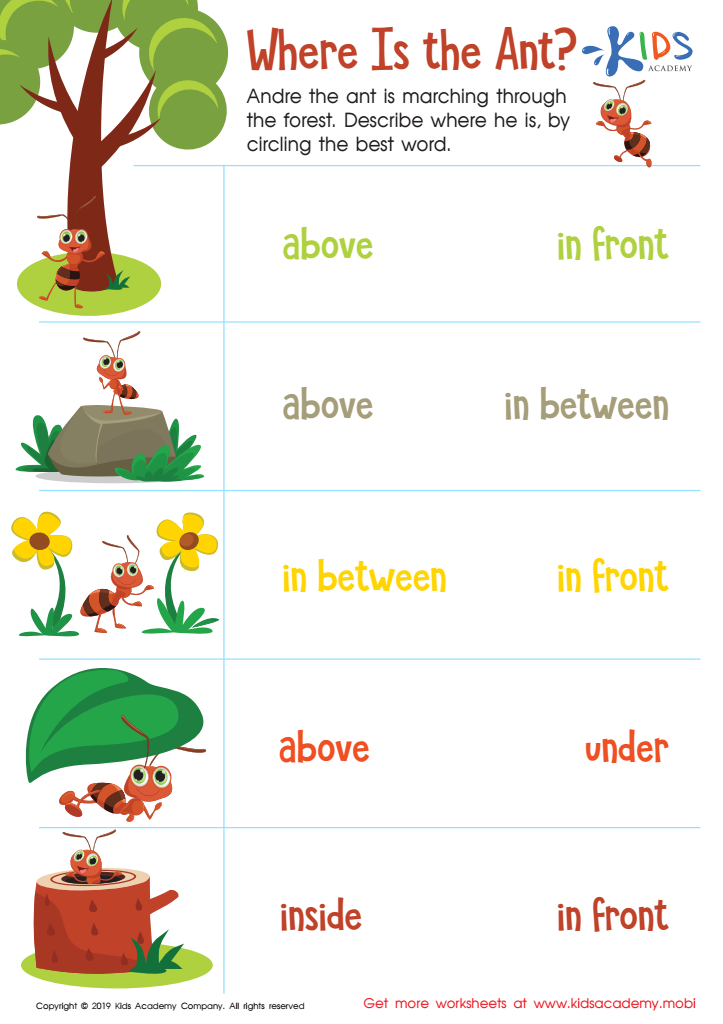
Where Is the Ant? Worksheet
 Assign to My Students











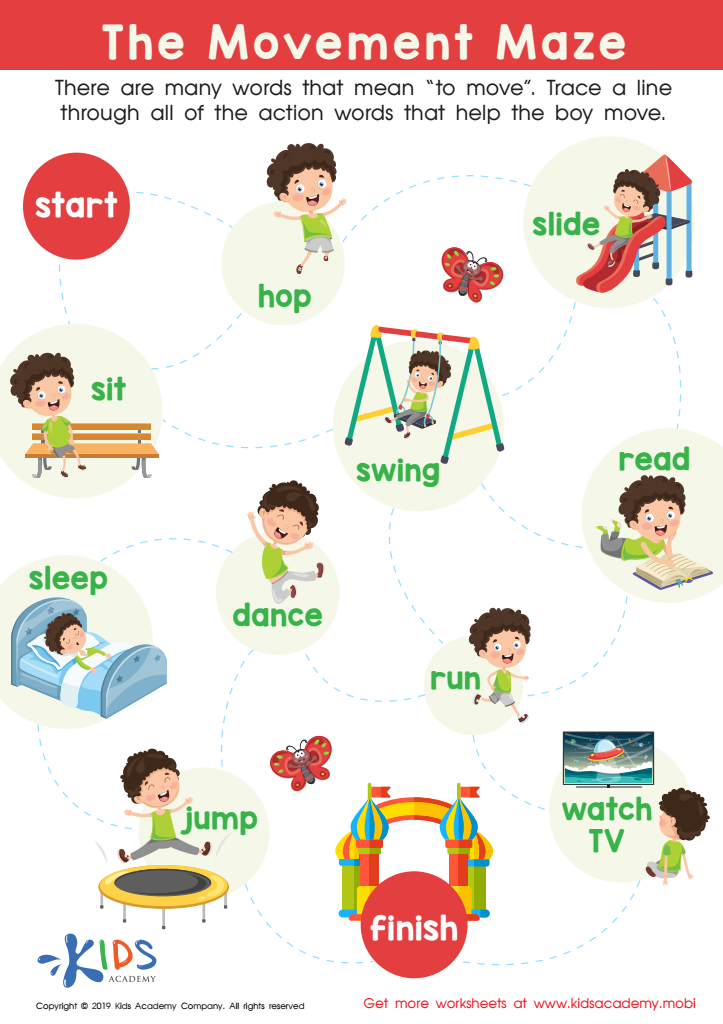
The Movement Maze Worksheet
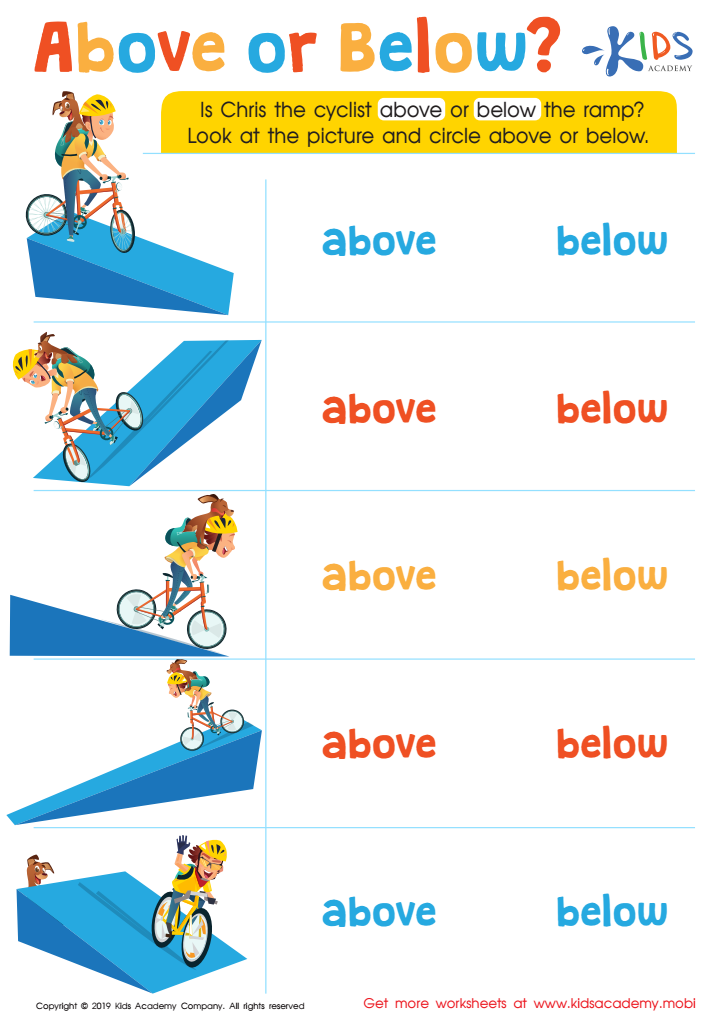
Above or Below? Worksheet








Spatial awareness is a critical cognitive skill that helps children understand how objects and people relate to each other within a given space. For children aged 4-9, developing strong spatial awareness is foundational for many aspects of academic and everyday life. First, it supports mathematical learning. Understanding concepts such as shape, size, distance, and measurement lay the groundwork for geometry and operations involving space and numbers.
For literacy, spatial awareness improves reading comprehension. Children learn to navigate text, recognize letter formation, and understand the orientation of print, which is crucial for developing writing skills. Moreover, spatial vocabulary—words like "over," "under," "between," and "beside"—enhances communication abilities. By using and understanding these terms, children can follow and give directions more effectively, improving their interactions within and outside of school.
Beyond academics, spatial skills impact daily activities, such as playing sports, drawing, and navigating physical spaces without injury. A strong spatial sense helps kids play safely and understand how their bodies move in various environments.
Parents and teachers play a vital role in nurturing these skills. Offering activities like puzzles, building blocks, and drawing can make learning about spatial relationships both fun and educational. Encouraging a rich spatial vocabulary can lead to more precise and higher-order thinking skills, setting children up for future academic success and confident, effective communication in the real world.








