Handwriting practice Letter V Worksheets for 4-Year-Olds
3 filtered results
Difficulty Level
Grade
Age
-
From - To
Subject
Activity
Standards
Enhance your child's writing skills with our engaging Handwriting Practice Letter V Worksheets, designed specifically for 4-year-olds! These printable worksheets offer a fun and interactive way for young learners to master the letter V through tracing, coloring, and anticipation of letter formation. Tailored to support early childhood education, our activities promote fine motor skills and letter recognition while keeping little ones entertained. Encourage creativity as kids explore the world of letters while building their confidence in handwriting. Perfect for at-home learning or classroom activities, these worksheets provide an excellent foundation for literacy development. Download now and watch your child flourish!
Favorites
With answer key
Interactive
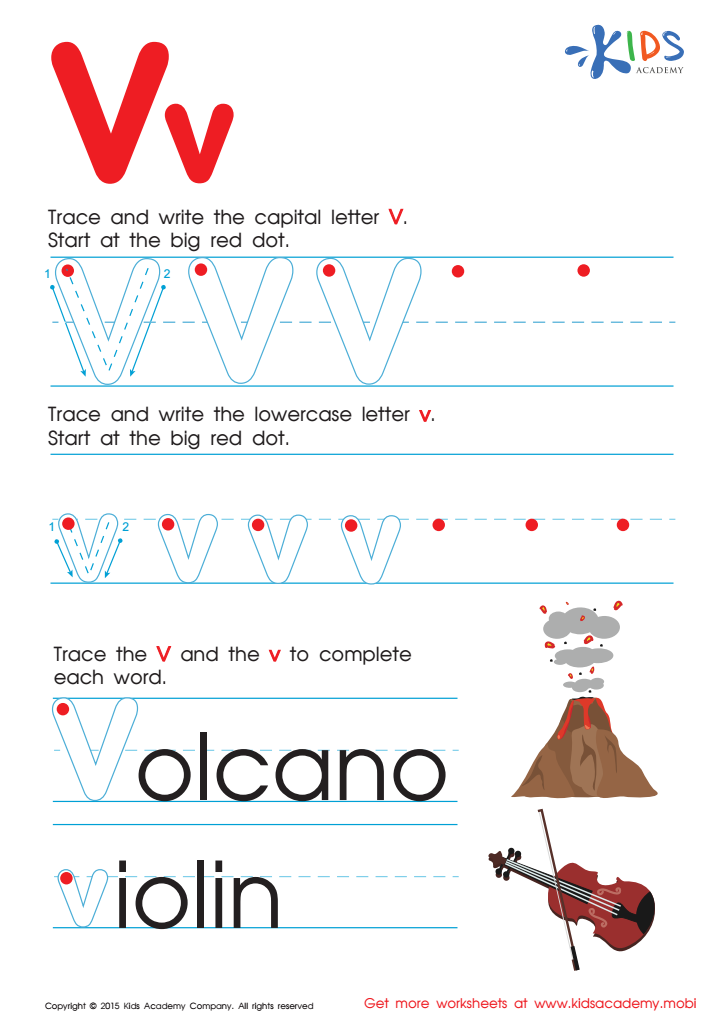
Letter V Tracing Page
Trace the uppercase and lowercase letter "V" with our kindergarten tracing worksheet. Begin at the red dot and follow the lines. Write it several times. Complete the words "Volcano" and "violin". Get more alphabet activities at Kids Academy.
 Assign to My Students
Letter V Tracing Page
Worksheet
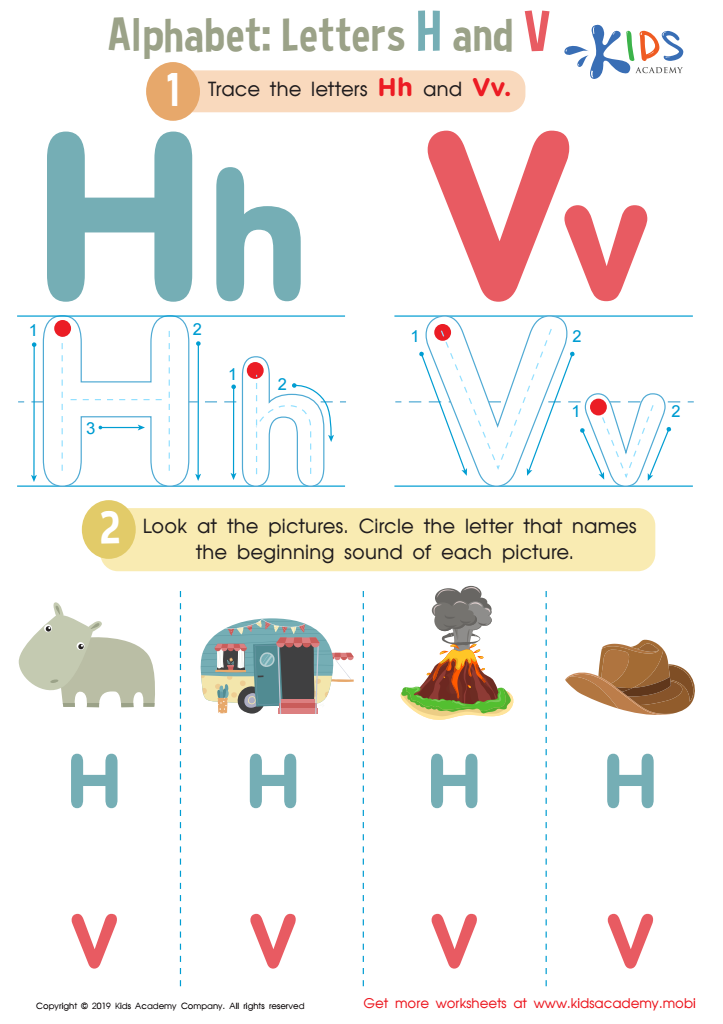
Letters H and V Tracing Worksheet
Kids will trace the letters H and V and circle the letter of the beginning sound of each picture. This helps strengthen writing and identify objects with their beginning sound, with two letter options to choose from.
Letters H and V Tracing Worksheet
Worksheet
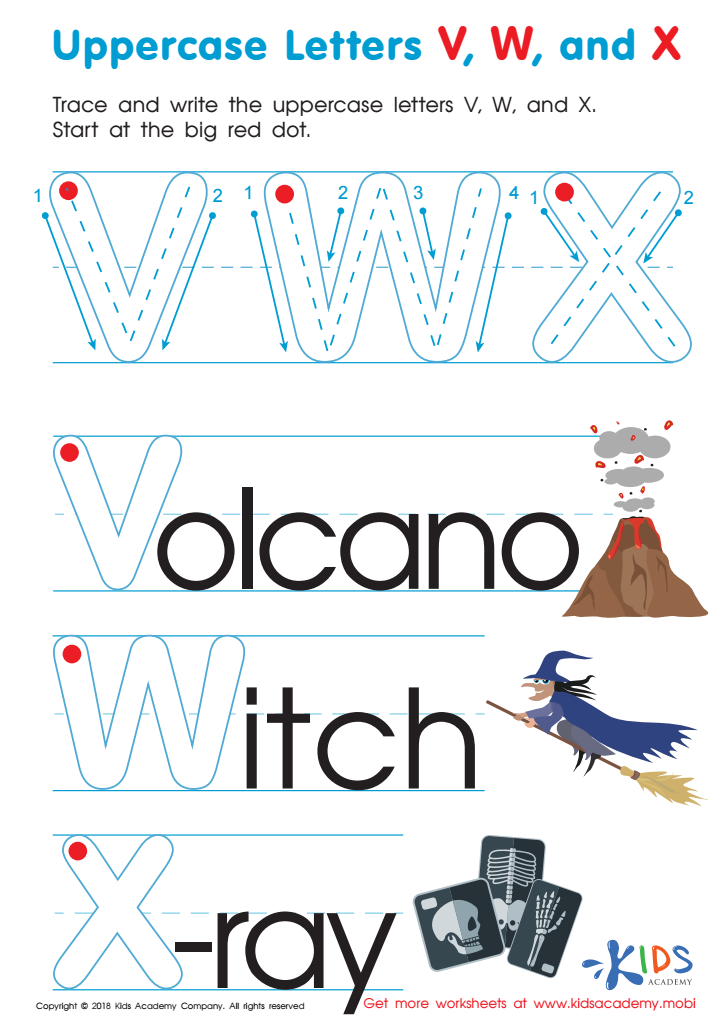
Uppercase Letters V, W, and X Worksheet
This worksheet is perfect for kids struggling to write uppercase letters V, W, and X. Warm up their brains first by having them name words starting with these letters. Then, help them trace and write each letter from the big red dot. With your assistance, they will quickly sharpen their writing skills.
Uppercase Letters V, W, and X Worksheet
Worksheet
Join Kids Academy for Free
Who is primarily going to use this learning content?




Handwriting practice, particularly for letters like 'V', is crucial for 4-year-olds as it plays a significant role in their early childhood development. At this age, children are developing essential fine motor skills, which are the basis for writing.
Increasing coordination and control when writing the letter 'V' aids in strengthening their hand muscles, enhancing their dexterity and ability to form other letters. By mastering 'V', children also learn about letter formation, spatial awareness, and the concept of symmetry, which fosters their cognitive development.
Moreover, handwriting impacts literacy skills. As children practice writing letters, they build phonemic awareness, linking sounds to letters. This link is foundational for reading readiness, making it essential for parents and teachers to support this practice.
Additionally, handwriting can boost children's self-esteem. Successfully writing a letter brings a sense of accomplishment that encourages further learning. Integrating fun activities and games related to handwriting can keep children motivated.
Ultimately, handwriting practice, including the letter 'V', is not just about letter recognition; it's about laying the groundwork for literacy skills, fine motor development, and confidence—key components for a child's overall success in school and beyond. Engaging in these activities together also strengthens the bond between parents, teachers, and children.