
Money identification Worksheets for 4-Year-Olds
3 filtered results
Difficulty Level
Grade
Age
-
From - To
Subject
Activity
Standards
Introduce your little learners to the world of money with our specially designed Money Identification Worksheets for 4-Year-Olds at Kids Academy! These engaging and colorful worksheets help young children recognize and identify different coins and bills in an enjoyable and interactive way. Featuring fun activities like matching, sorting, and counting, our worksheets aim to build foundational financial awareness and boost early math skills. Perfect for both classroom and home environments, these resources make learning about money an exciting adventure. Start your child's financial education journey today with Kids Academy's Money Identification Worksheets!
Favorites
With answer key
Interactive
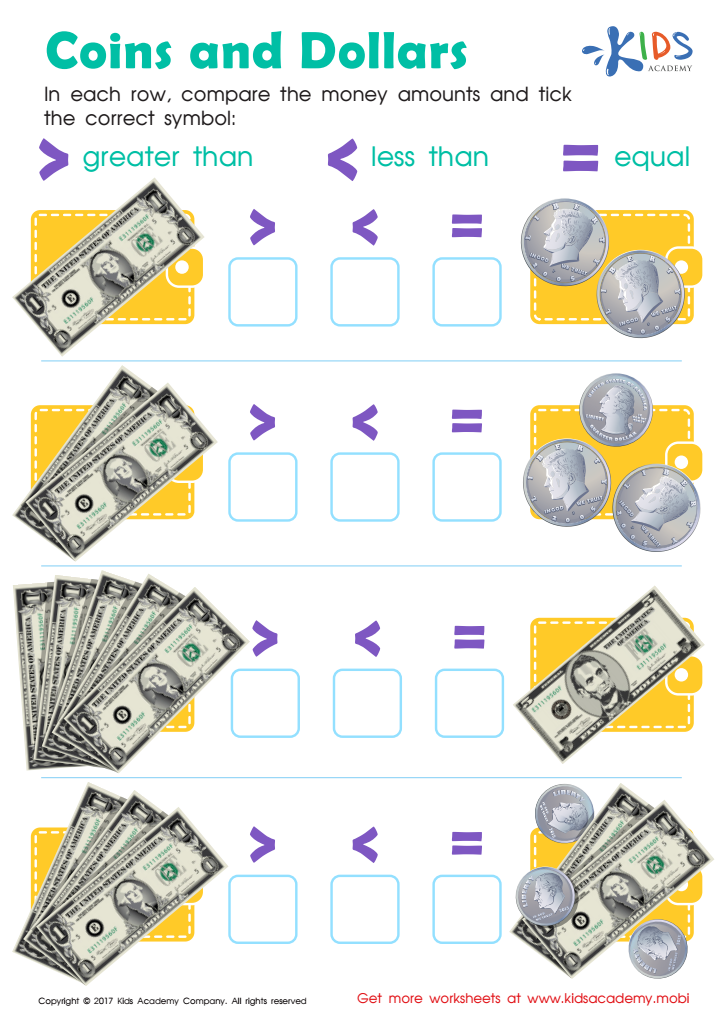
Money: Coins Dollars Printable
Motivate your kid to learn and practise essential math skills, like 'greater than' and 'less than', by introducing the importance of money! The money worksheet "Coins and Dollars" will give them a hands-on experience of counting coins and dollars, making math symbols more memorable.
 Assign to My Students
Money: Coins Dollars Printable
Worksheet
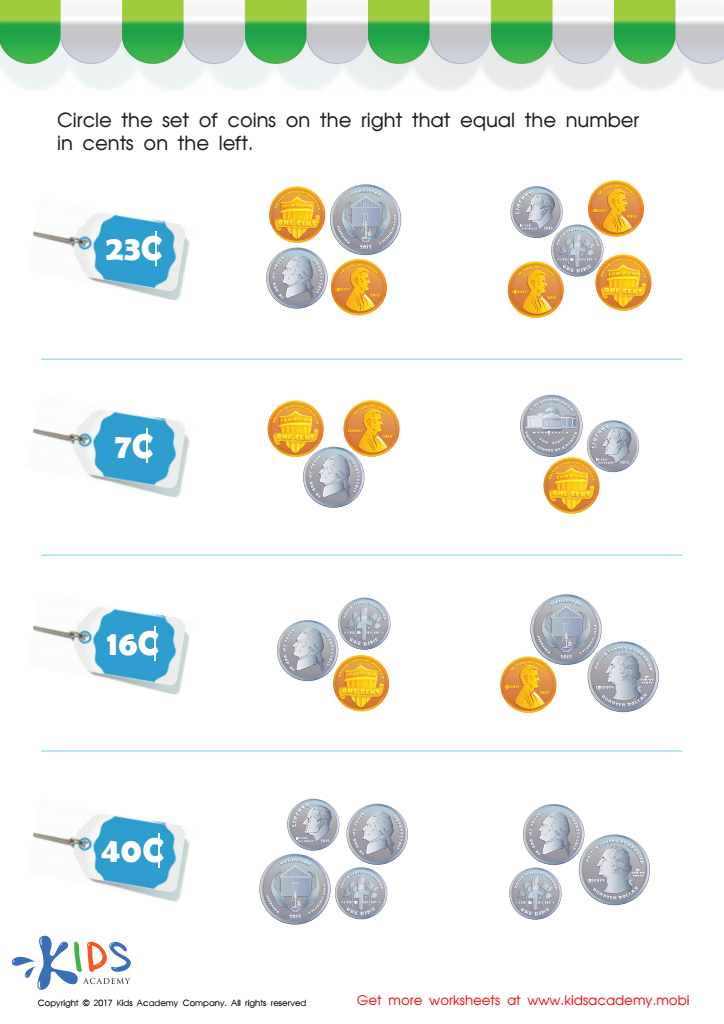
Picking the Coins You Need Money Worksheet
Let's learn to count money with Parents and Kids Academy! Investigate a real shop together: buy a globe, pencils, books, and a school bag using coins. Then, circle the coins you'll need. Visit our website for more free and fun money games for kids!
Picking the Coins You Need Money Worksheet
Worksheet
Join Kids Academy for Free
Who is primarily going to use this learning content?







Helping 4-year-olds identify money is an important foundational skill that offers numerous developmental benefits. Firstly, it nurtures early math skills. By understanding that different coins and bills have different values, children begin to grasp basic arithmetic concepts, such as counting, addition, and subtraction. These skills are fundamental for later academic success in math.
Moreover, money identification fosters cognitive development. It enhances memory, as children learn to recognize and remember various denominations. It also builds classification skills, as they sort and group different types of currency. This kind of sorting and cognitive differentiation is critical for overall brain development.
Another significant benefit is that it lays the groundwork for financial literacy. Early exposure to money helps children understand essential financial concepts and the value of money, which are crucial life skills. Recognizing money and its worth can instill a sense of responsibility and encourage early habits of saving and mindful spending.
Socially, money identification encourages interactions. Whether they play "store" at home or participate in classroom activities, they engage in collaborative learning, enhancing social skills like communication and cooperation.
In summary, teaching money identification helps young children build early math skills, cognitive abilities, beginning financial literacy, and social skills, laying a well-rounded foundation for future learning and responsible habits.








