
Enhance fine motor skills Worksheets for Ages 5-6
3 filtered results
Difficulty Level
Grade
Age
-
From - To
Subject
Activity
Standards
Boost your child’s fine motor skills with our engaging worksheets designed for ages 5-6. At Kids Academy, our expertly crafted activities focus on developing essential hand-eye coordination, pencil control, and precision through fun exercises like tracing, cutting, and drawing. These worksheets are perfect for preparing young learners for writing and other detailed tasks, ensuring they build a strong foundation for future academic success. Our collection provides a diverse range of tasks, keeping kids motivated and excited as they refine their motor skills in an enjoyable and educational way. Start today and watch your child’s abilities blossom!
Favorites
With answer key
Interactive
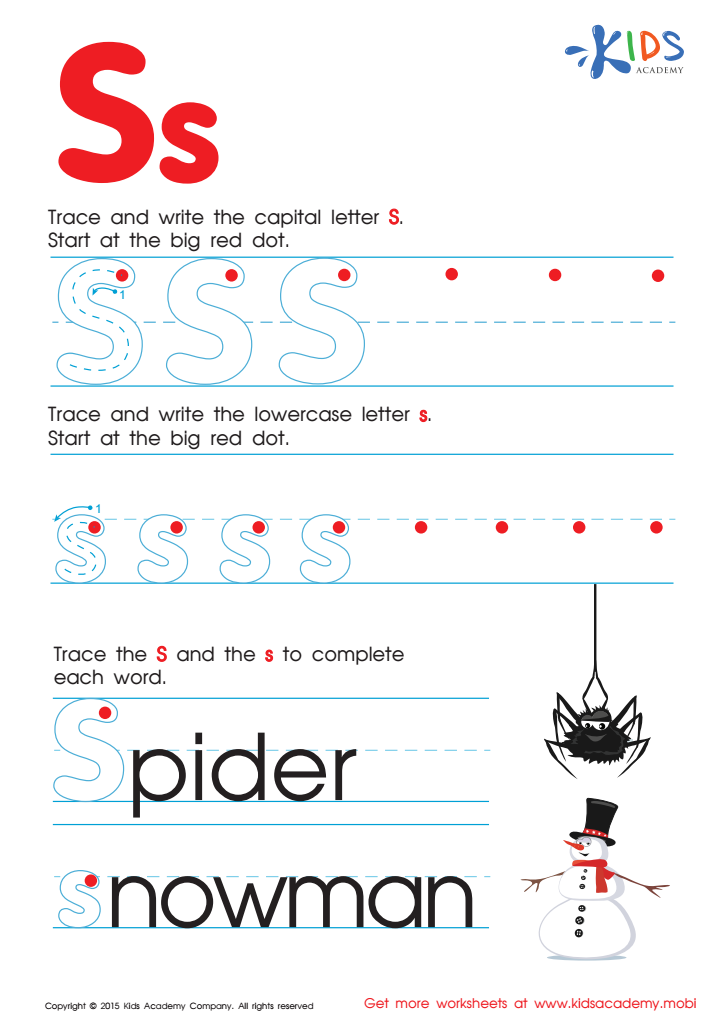
Letter S Tracing Page
Trace and write the capital and lowercase "S" on this ABC worksheet for kindergarten. Start with the big red dot and be careful. When you finish, help the spider and snowman in the pictures restore their words with the capital and lowercase letters. Continue learning the alphabet with Kids Academy.
 Assign to My Students
Letter S Tracing Page
Worksheet

Join Kids Academy for Free
Who is primarily going to use this learning content?








Fine motor skills involve the coordinated efforts of small muscles, such as those in the hands and fingers, to perform tasks such as writing, buttoning a shirt, or using scissors. For children ages 5-6, enhancing fine motor skills is crucial for several reasons. Firstly, these skills are foundational for academic success. Proficient pencil grip and control are essential for writing legibly and efficiently, which is a key part of early education. Activities like cutting, gluing, and drawing also support cognitive development by reinforcing concepts of shape, size, and spatial awareness.
Moreover, the development of fine motor skills contributes significantly to a child’s independence and self-esteem. Being able to dress themselves, tie their shoelaces, or prepare a simple snack without help fosters a sense of accomplishment and confidence. These skills also play a critical role in day-to-day activities, reducing reliance on adults for simple tasks.
In addition, enhancing fine motor skills lays the groundwork for more complex movements and coordination needed in sports, musical instruments, and other hobbies. Overall, prioritizing the development of fine motor skills prepares children for a successful transition into more structured school settings and daily life, making it a vital aspect of early childhood education and care.








