
Understanding forces Worksheets for Ages 5-6
3 filtered results
Difficulty Level
Grade
Age
-
From - To
Subject
Activity
Standards
Dive into the fascinating world of physics with our "Understanding Forces Worksheets for Ages 5-6"! These engaging printables introduce young learners to the concept of forces through fun and interactive activities. By exploring pushes, pulls, and the effects of different forces, children enhance their critical thinking and scientific curiosity. Perfect for both classroom settings and home learning, these worksheets align with early learning standards, ensuring your child builds a strong foundation in physical science. Encourage hands-on exploration and make learning enjoyable with our thoughtfully designed materials. The journey to understanding the basics of physics starts here!
Favorites
With answer key
Interactive
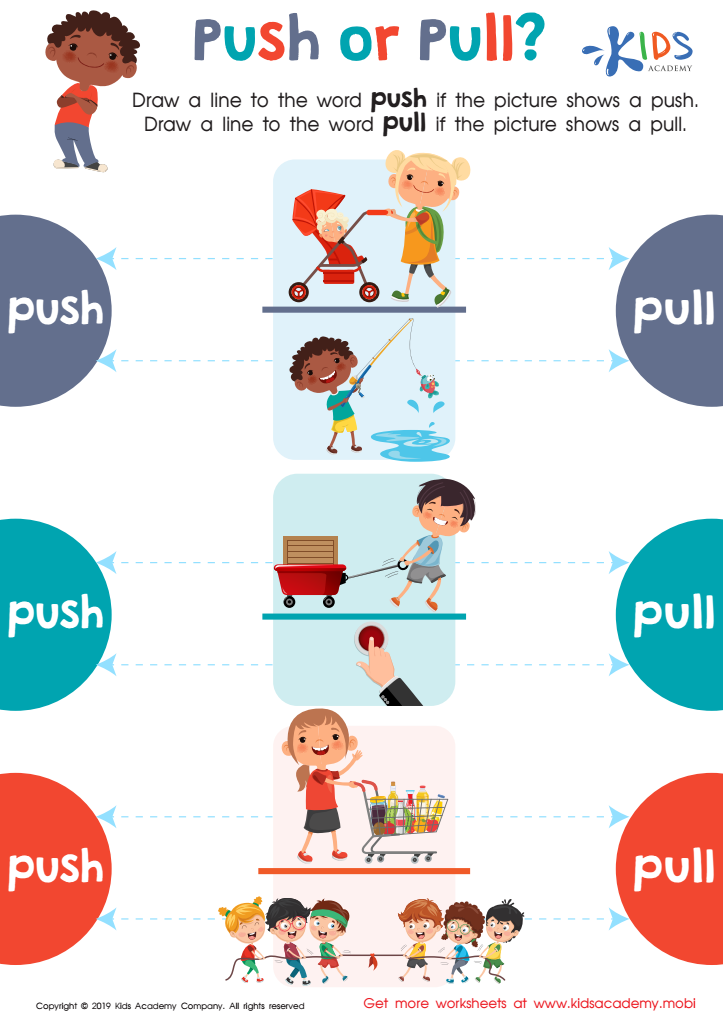
Push or Pull? Worksheet
Young kids may struggle to differentiate push and pull. When they start writing, they may use them interchangeably and wrongly. This worksheet clarifies the concepts: pushing means moving something away, pulling means bringing something closer. It provides pictures and traceable lines for kids to connect each image to the correct word. This helps them understand and remember the difference for future writing and reading.
 Assign to My Students
Push or Pull? Worksheet
Worksheet
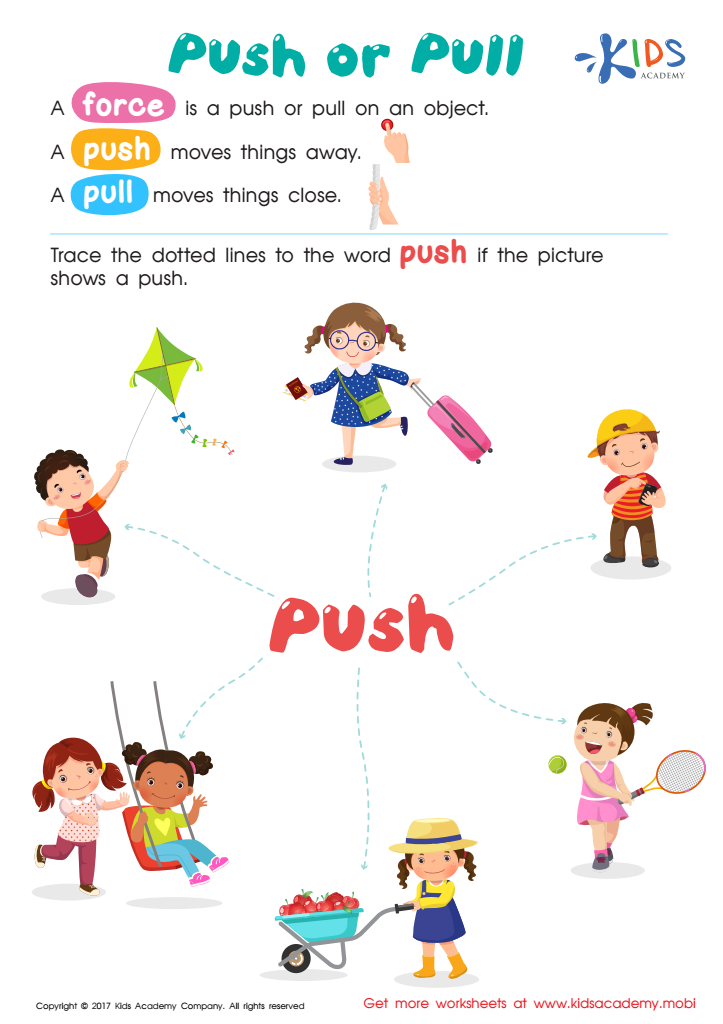
Push or Pull Worksheet
and which involve pulling! With this fun worksheet, your child will learn about force and its simple application in everyday activities. Get them started with Push or Pull! (80 words)
Push or Pull Worksheet
Worksheet
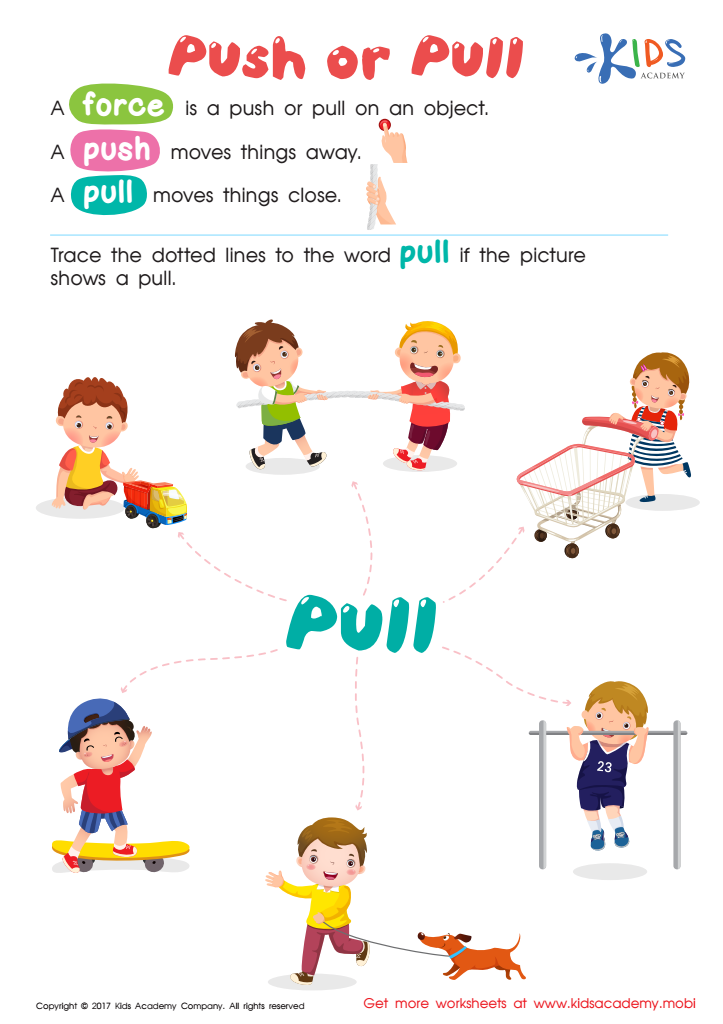
Pull or Push Worksheet
With this fun worksheet, they'll explore physics by sorting objects into categories according to their mode of motion. It's a great way to get them interested in science.
Pull or Push Worksheet
Worksheet
Join Kids Academy for Free
Who is primarily going to use this learning content?







Understanding forces for children aged 5-6 is crucial because it lays the foundation for scientific thinking and curiosity. Though the concept may seem advanced, young children naturally experience and question the forces acting around them, such as gravity when they drop a toy or push when they play on swings. By helping children recognize and categorize these forces, parents and teachers can foster critical thinking skills and encourage curiosity about the world.
Early exposure to the concept of forces supports cognitive development. For instance, when children are guided to understand why objects move or stop, they engage in problem-solving and reasoning, which are fundamental skills in both everyday life and later academic pursuits. Hands-on activities, such as simple experiments with magnets or observations of objects rolling down ramps, make learning interactive and enjoyable, solidifying these essential concepts in their young minds.
Furthermore, an early grasp of forces and motion standards prepares children for future academic success, as these principles recur in advanced subjects like physics and engineering. Hence, integrating the basics of forces into early childhood education leverages their natural curiosity and equips them with the building blocks for lifelong learning in the sciences. Prioritizing this knowledge helps create a more scientifically literate and inquisitive generation.








