Differentiating shapes Math Worksheets for Ages 5-6
3 filtered results
-
From - To
Unlock the world of geometry for your young learners with our "Differentiating Shapes Math Worksheets for Ages 5-6." These engaging worksheets are designed to help children easily identify and differentiate between various shapes. Through colorful illustrations and interactive activities, kids will enhance their recognition skills and build a strong foundation in geometry. Perfect for classroom or at-home learning, these worksheets cater to all learning styles, ensuring each child can progress at their own pace. Start your child's mathematical journey today and watch them confidently distinguish circles, squares, triangles, and more! Explore our collection now at Kids Academy.
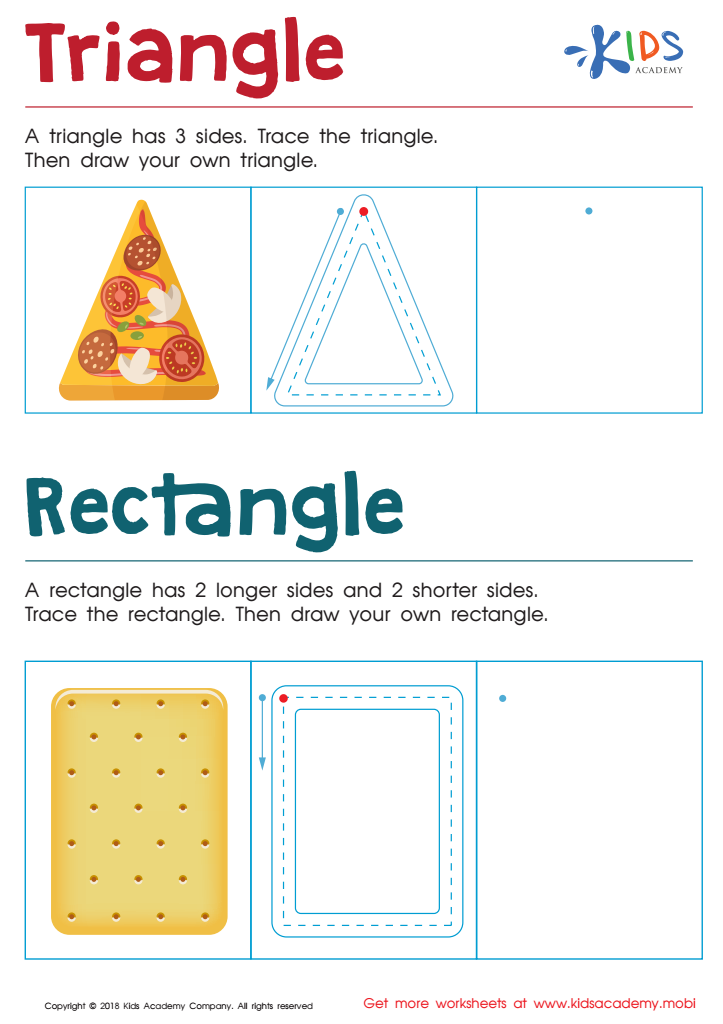
Triangle Rectangle Worksheet
 Assign to My Students
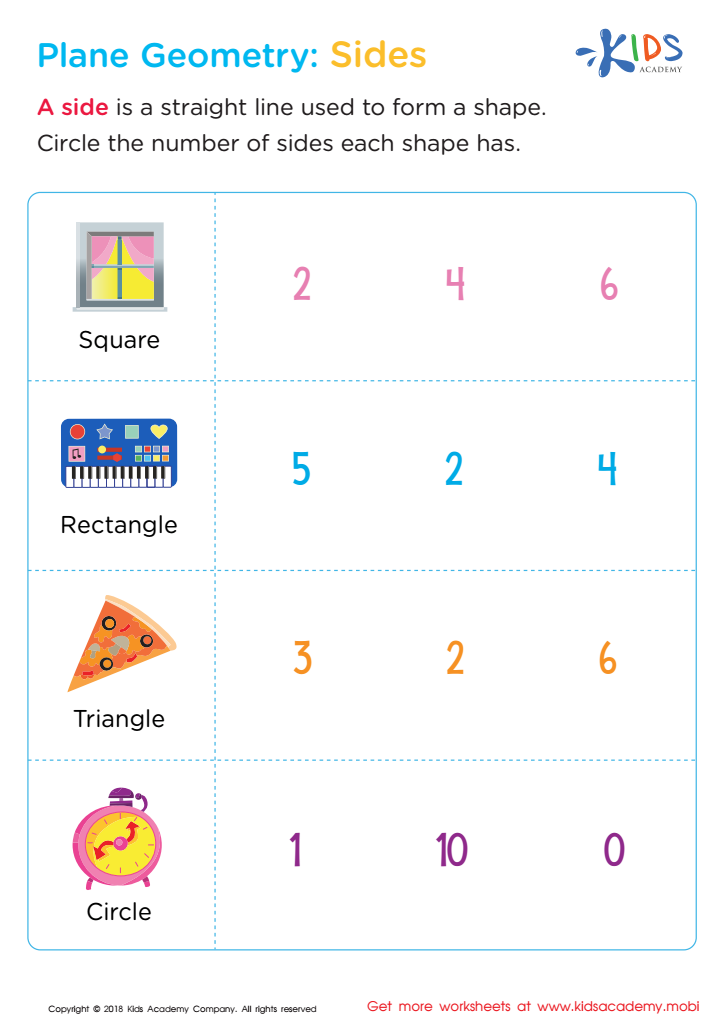
Plane Geometry: Sides Worksheet
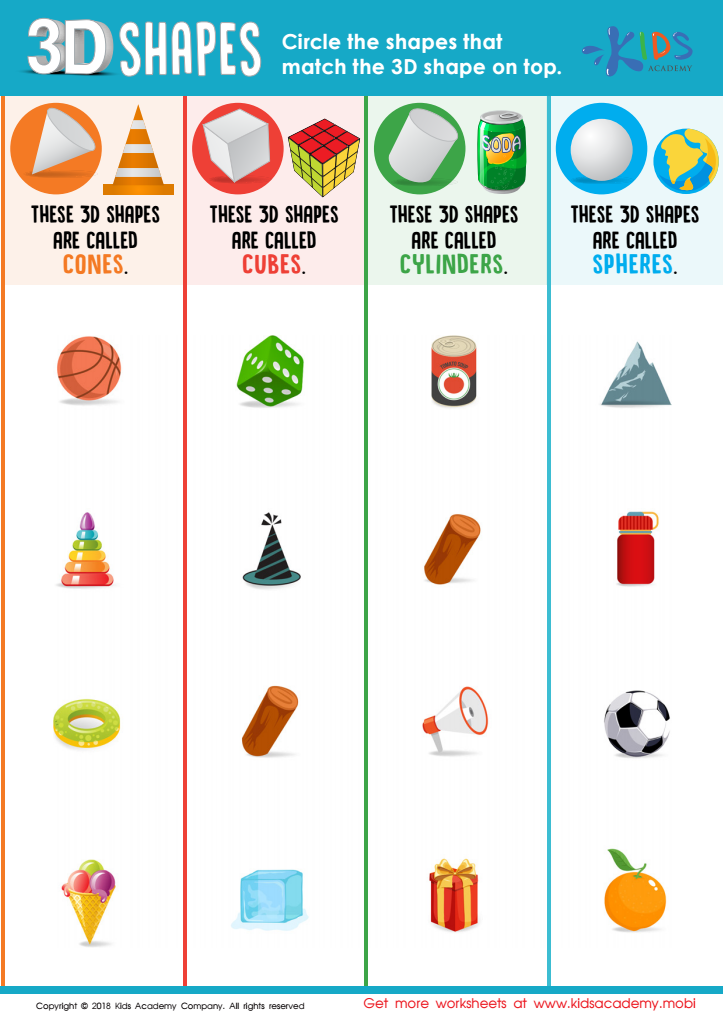
3D Shapes Worksheet








Differentiating shapes in math for children ages 5-6 is crucial for their early cognitive and spatial development. At this age, children are developing their ability to recognize and categorize visual information, which is a foundational skill for later mathematical learning, such as geometry. Engaging with shapes also enhances their problem-solving and critical thinking abilities. Understanding shapes helps children grasp other concepts such as size, symmetry, and spatial relationships, which are pivotal for understanding more complex concepts later.
For parents and teachers, introducing shape differentiation supports the development of vocabulary related to geometry. By naming shapes and their attributes—like sides, corners, and curves—children build language skills alongside mathematical understanding. Moreover, activities that involve sorting, comparing, and contrasting shapes can be highly engaging and motivating for young learners, fostering a positive attitude toward math.
Encouraging children to interact with shapes also has practical implications. It helps in honing motor skills as they trace, construct, and manipulate different shapes. This kind of fine motor development is essential for writing and daily activities. Finally, recognizing patterns formed by shapes helps in predictive reasoning and logic-building, which lays the groundwork for learning patterns in numbers and sequences. Hence, prioritizing shape differentiation enriches children's overall learning experiences and sets a strong foundation for future academic success.








