Fine motor skills (drawing lines) Math Worksheets for Ages 5-6
7 filtered results
-
From - To
Enhance your child’s fine motor skills with our engaging Math Worksheets for ages 5-6. These printable activities are designed to help young learners draw lines with precision, forming a foundation for handwriting and detailed work. By tracing and drawing lines, children improve their hand-eye coordination and control, while simultaneously exploring basic math concepts like patterns and shapes. Perfect for homeschooling or extra practice, our worksheets offer a fun, interactive way to boost motor skills and pave the way for academic success. Try Kids Academy’s specially crafted worksheets today and watch your child’s abilities flourish!

Count and Match Vegetables 1 – 7 Math Worksheet
 Assign to My Students

Counting Eggs Worksheet

Count and Match Vegetables 2 – 8 Math Worksheet
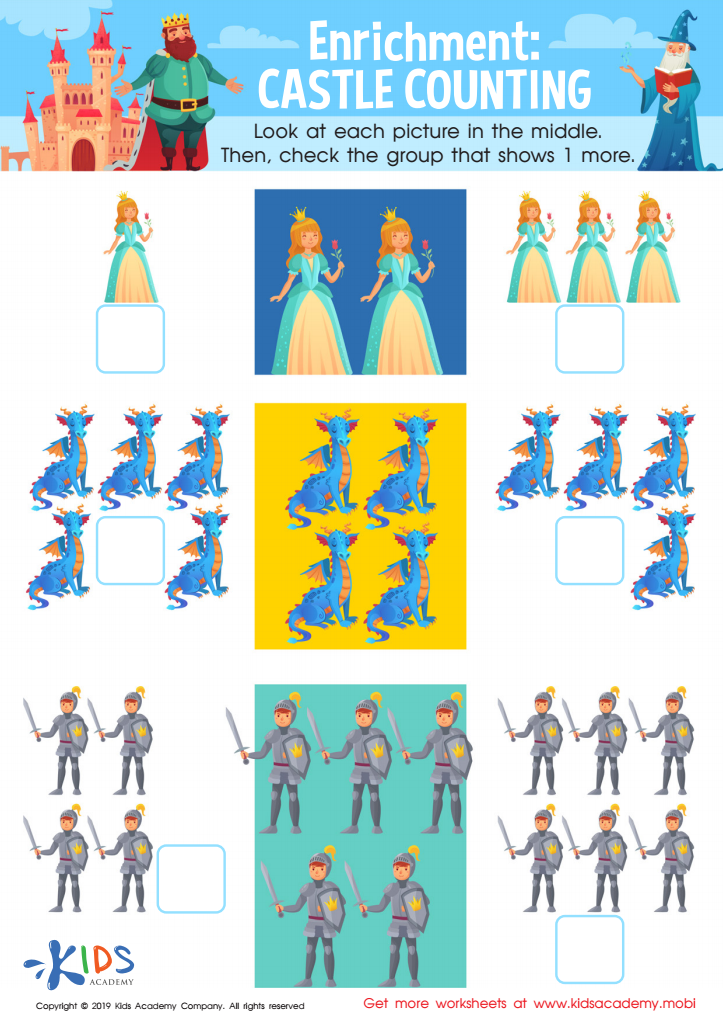
Enrichment: Castle Counting Worksheet







.jpg)
Fine motor skills are foundational for children aged 5-6 as they impact their ability to perform tasks that are crucial for both academic and daily life. Developing fine motor skills through activities like drawing lines is particularly important in understanding and executing math concepts. When children draw lines, they are not just improving hand-eye coordination and dexterity, but also reinforcing critical mathematical skills such as writing numbers, forming geometric shapes, and understanding spatial relationships.
Engaging in activities that enhance these skills prepares children for more complex math challenges they'll encounter later in their education. For instance, the act of drawing straight or curved lines supports recognizing and replicating shapes, which is essential for geometry. It also aids in grasping the basics of graphing, symmetry, and pattern recognition.
Moreover, developing these skills fosters independence and boosts self-esteem, making learning math a more enjoyable and engaging experience. For teachers and parents, paying attention to fine motor skills ensures that children don't encounter unnecessary learning obstacles rooted in physical dexterity issues. By integrating tasks that build these skills, like line drawing, into daily activities or curricula, educators lay a concrete foundation for mathematical competence and overall academic success.








