
Practice problem-solving Worksheets for Ages 5-7
5 filtered results
Difficulty Level
Grade
Age
-
From - To
Subject
Activity
Standards
Encourage critical thinking and enhance cognitive abilities with our "Practice Problem-Solving Worksheets for Ages 5-7." Designed to be engaging and educational, these worksheets help young learners develop essential skills in logic, reasoning, and decision-making. Whether for use at home or in the classroom, our collection offers a variety of fun exercises that challenge children to think independently and solve problems in creative ways. Perfect for building a strong foundation in early math and science, these worksheets integrate playful elements to make learning both effective and enjoyable. Download and print them today to support your child's academic journey.
Favorites
With answer key
Interactive
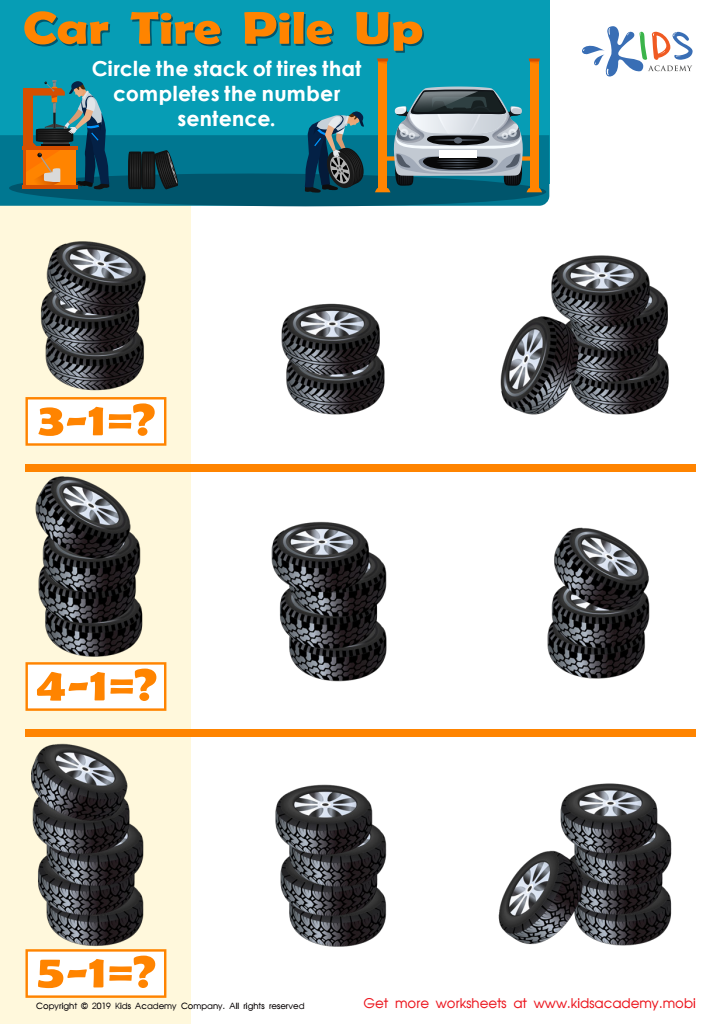
Car Tire Pile Up Worksheet
Examine the pic with your kids. Can they recognize the items piled up? The tires are organized in different quantities. Equations are on the left. Have your children work out the equations, counting the tire stacks to identify the correct answer.
 Assign to My Students
Car Tire Pile Up Worksheet
Worksheet
Join Kids Academy for Free
Who is primarily going to use this learning content?







Parents and teachers should prioritize practicing problem-solving skills for children aged 5-7 because it lays a crucial foundation for lifelong cognitive and social development. At this formative stage, children’s brains are highly receptive, and engaging them in problem-solving activities helps enhance their critical thinking, creativity, and resilience. By tackling problems, whether in math, play, or daily routines, kids learn to analyze situations, consider various solutions, and make decisions.
Fostering problem-solving abilities also strengthens children's independence and confidence. When young learners understand they can overcome obstacles, they gain a sense of achievement and are more inclined to face future challenges with a positive attitude. Furthermore, problem-solving exercises often involve cooperation and communication, vital interpersonal skills that children need to thrive socially and academically.
Additionally, engaging in problem-solving tasks can help develop patience and emotional regulation. Kids learn that perseverance is rewarded and that setbacks are opportunities for learning rather than reasons for discouragement. Ultimately, nurturing these skills at an early age supports balanced intellectual, emotional, and social development, providing children with enduring tools to succeed in their educational journey and beyond. Overall, integrating problem-solving practice into early learning environments is a worthwhile investment in a child's holistic growth.








