
Understanding greater/less than Worksheets for Ages 5-7
3 filtered results
Difficulty Level
Grade
Age
-
From - To
Subject
Activity
Standards
Welcome to our Understanding Greater/Less Than Worksheets for Ages 5-7! Designed to enhance early math skills, these engaging worksheets help young learners grasp the concepts of comparison using the greater than and less than symbols. With colorful illustrations and age-appropriate exercises, children will enjoy practicing their ability to compare numbers through interactive activities. Our worksheets not only reinforce foundational math concepts but also encourage critical thinking as students decide which values are greater or lesser. Perfect for both classroom and at-home learning, these resources are an excellent way to build confidence in mathematical reasoning. Start exploring today!
Favorites
With answer key
Interactive
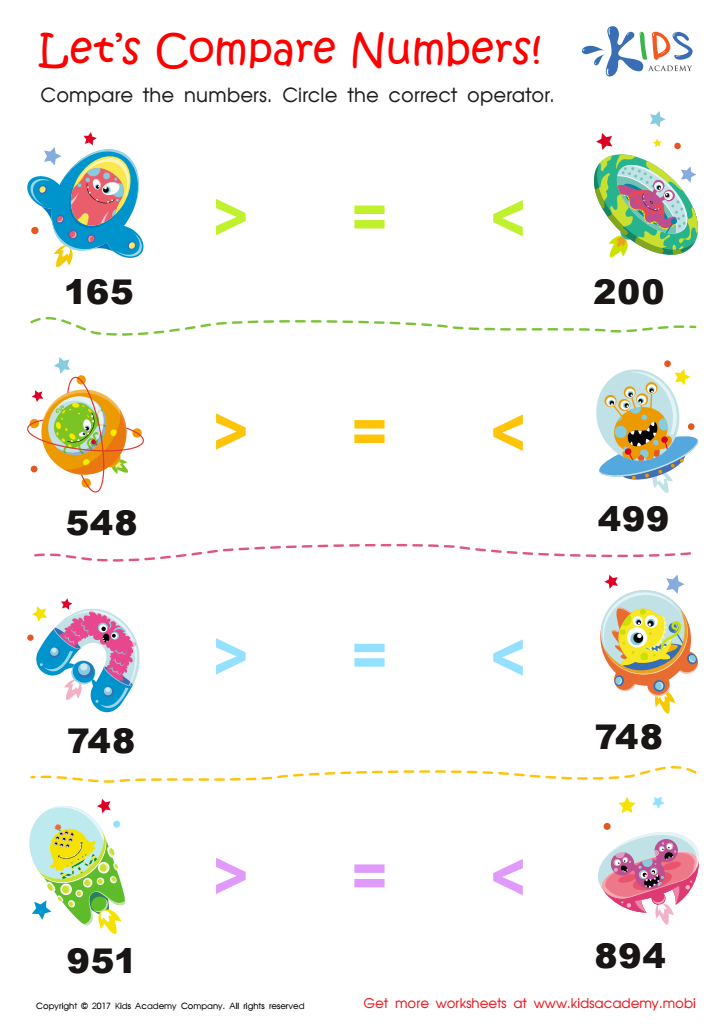
Comparing Numbers Worksheet for 2nd Grade
Alien friends are back to help your child learn to compare numbers using >, < and = symbols. This 2nd grade worksheet will challenge them with larger numbers!
 Assign to My Students
Comparing Numbers Worksheet for 2nd Grade
Worksheet
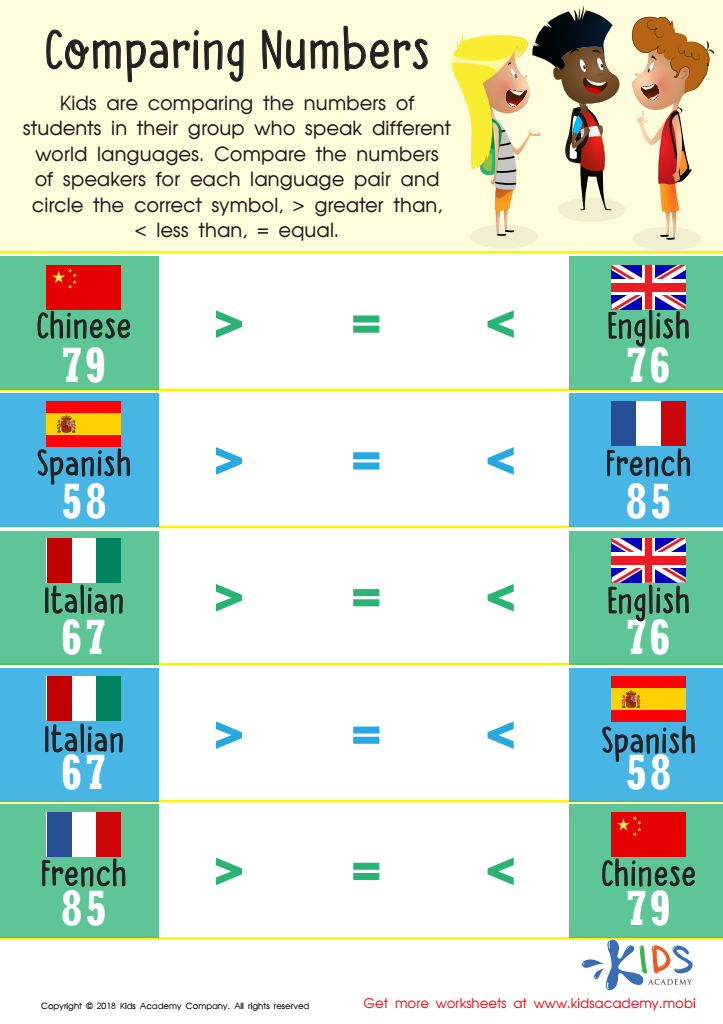
Comparing Numbers Worksheet for 1st Grade
Children can build number sense by exploring the relationship between numbers. This worksheet uses bright international flags to compare numerical groups. Kids will love the cheerful colors and flags from different countries. It encourages them to compare numbers and reinforces their number sense with tens and ones place values.
Comparing Numbers Worksheet for 1st Grade
Worksheet
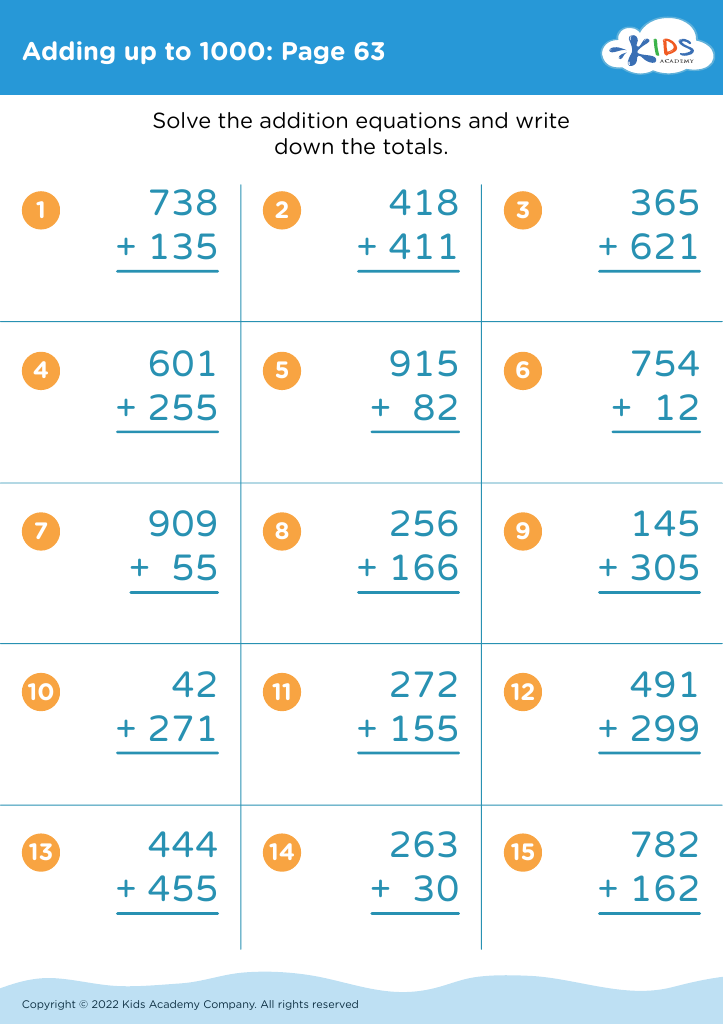
Join Kids Academy for Free
Who is primarily going to use this learning content?







Understanding the concepts of greater than and less than is fundamental for children aged 5-7 as it lays the groundwork for their mathematical development. During these crucial years, children are beginning to develop their numeracy skills, which are essential not only for math but for everyday problem-solving and reasoning. When parents and teachers prioritize these concepts, they encourage children to engage with numbers in a meaningful way.
Mastering the idea of greater than and less than helps children compare quantities, understand sequencing, and visualize how numbers relate to one another. Such skills foster critical thinking and aid in developing a positive relationship with math. This foundation supports future learning in mathematics, where concepts will grow increasingly complex.
Moreover, embracing these concepts early on can nurture confidence in children as they become more adept at tackling numerical problems. It encourages a playful exploration of numbers, making math feel more approachable and less intimidating. Ultimately, ensuring that children grasp the idea of greater and less than equips them with essential life skills that extend beyond the classroom, nurturing a mindset geared toward inquiry and logical reasoning that they will carry into adulthood.








