Understanding Quantities Worksheets for Ages 5-7 - Page 3
53 filtered results
-
From - To
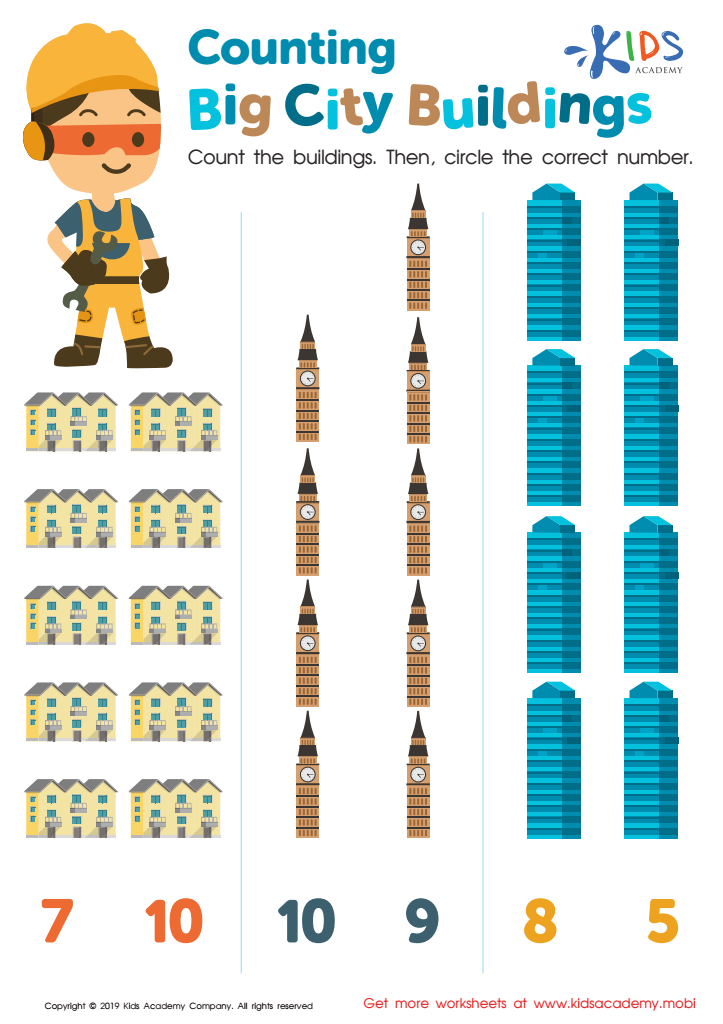
Counting Big City Buildings Worksheet
 Assign to My Students








Understanding quantities is fundamental for children aged 5-7 as it lays the groundwork for crucial mathematical skills. During this developmental phase, children begin to comprehend basic concepts of counting, measuring, and comparing numbers. A solid grasp of quantities enhances their ability to solve problems, reason logically, and develop critical thinking skills.
Parents and teachers should take note of this because early experiences with quantities influence children's confidence in mathematics. Engaging with quantities through hands-on activities and real-world applications fosters a deeper understanding and makes learning enjoyable. When children learn to visualize and manipulate numbers, they build connections that lead to more complex mathematical concepts later on.
Moreover, these skills translate to everyday life scenarios, such as shopping, cooking, and sharing, promoting practical math usage beyond the classroom. Supporting children’s understanding of quantities can also help reduce anxiety towards math, encouraging a positive attitude toward learning. In a diverse and fast-evolving world, strong foundational skills in mathematics are vital for future academic success and skill development. Therefore, parents and teachers must prioritize fostering a meaningful understanding of quantities in early education to prepare children for lifelong learning and problem-solving.








