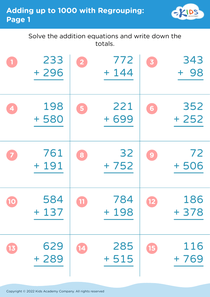
Recognize patterns Adding up to 1000 Without Regrouping Worksheets for Ages 5-7
3 filtered results
-
From - To
Boost your child's math skills with our "Recognize Patterns Adding up to 1000 Without Regrouping Worksheets" designed for ages 5-7. These engaging, printable resources help young learners understand addition patterns, making complex concepts simple and fun. Encouraging problem-solving and critical thinking, kids will confidently add large numbers without regrouping while recognizing numerical patterns. Perfect for both classroom and home practice, these worksheets cultivate a strong mathematical foundation, enhancing cognitive skills through enjoyable activities. Let Kids Academy support your child’s learning journey with these expertly crafted, easy-to-follow worksheets that turn math practice into an exciting adventure!
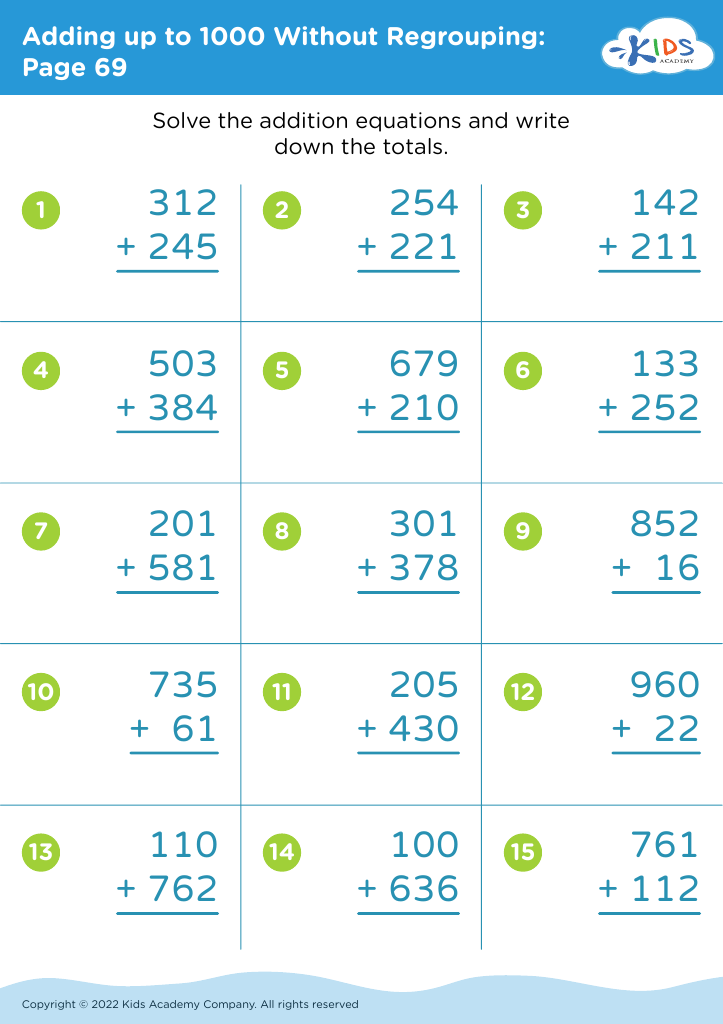
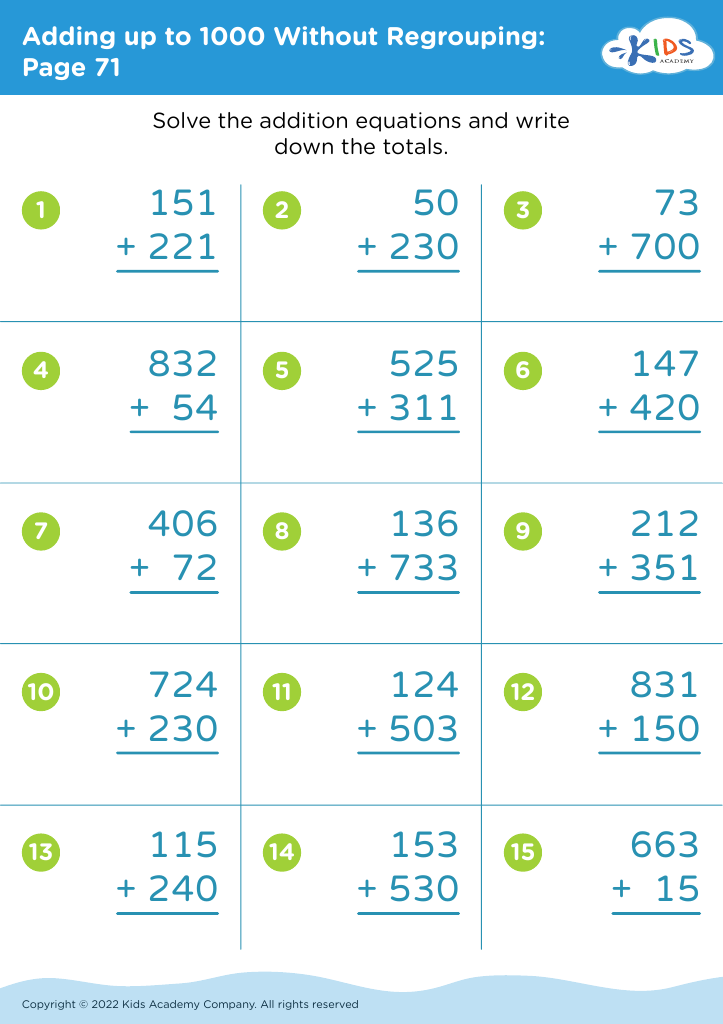
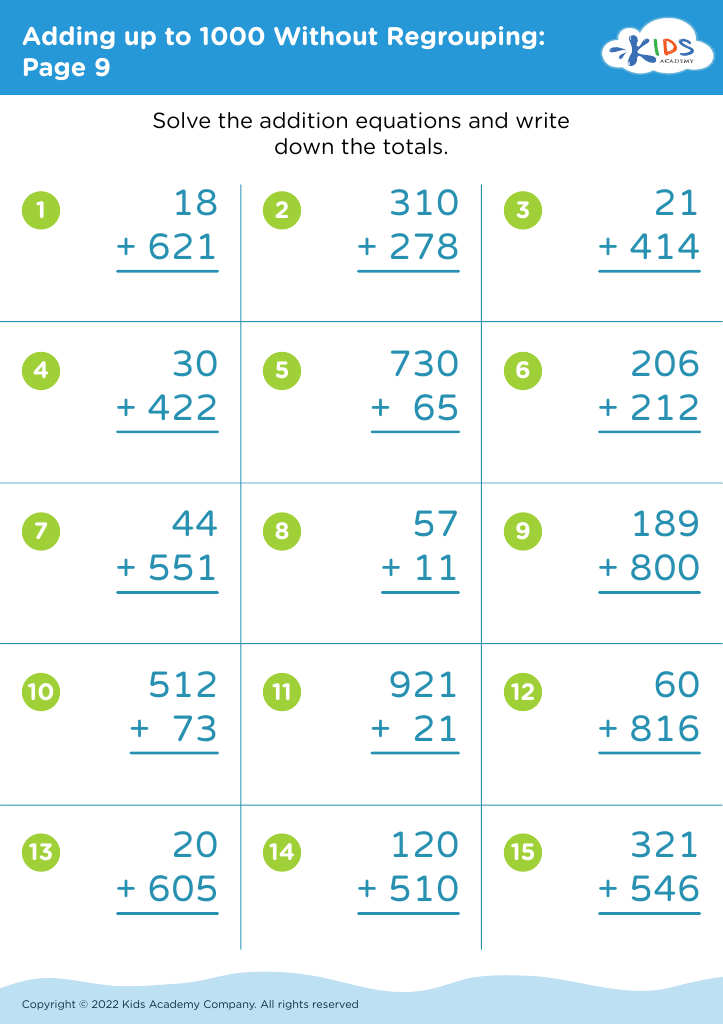


Introducing children aged 5-7 to the concept of recognizing patterns and adding numbers up to 1,000 without regrouping offers numerous cognitive and educational benefits. At this early stage in development, young minds are highly adaptable and eager to learn. Teaching these skills helps reinforce basic mathematical principles and establishes a strong foundation for more advanced arithmetic in the future.
Recognizing patterns in numbers aids in enhancing a child's problem-solving and critical-thinking abilities. It allows them to quickly identify relationships between numbers, which contributes to efficient and accurate calculations. This skill is crucial not only for mathematics but also for understanding patterns and sequences in other subjects, such as reading and science.
Learning to add numbers up to 1,000 without regrouping familiarizes children with the place value system, enhancing their understanding of units, tens, hundreds, and thousands. This grasp of place value is fundamental for progressing to more complex mathematical operations, such as regrouping (carrying) in addition or borrowing in subtraction.
In addition, mastering these skills can boost a child's confidence in their academic abilities, making them more likely to participate actively in class and tackle challenging problems with positivity. It prepares them for future success in academic subjects and everyday scenarios where quick mental math is useful. Therefore, this foundational knowledge is an invaluable part of early childhood education.