Recognizing shapes Adding up to 1000 Without Regrouping Worksheets for Ages 5-7
3 filtered results
-
From - To
Discover our engaging “Recognizing Shapes and Adding Up to 1000 Without Regrouping Worksheets” designed for children aged 5-7. These worksheets combine fun shape recognition exercises with foundational addition skills, helping young learners understand mathematical concepts through visual learning. As kids identify various shapes, they also practice adding numbers to reach sums up to 1000 without regrouping. This integrated approach enhances critical thinking and boosts cognitive abilities. Perfect for classrooms, homeschooling, or extra practice at home, these worksheets promote literacy in math while keeping learning fun and interactive. Give your child the tools they need to excel in math and shape recognition today!
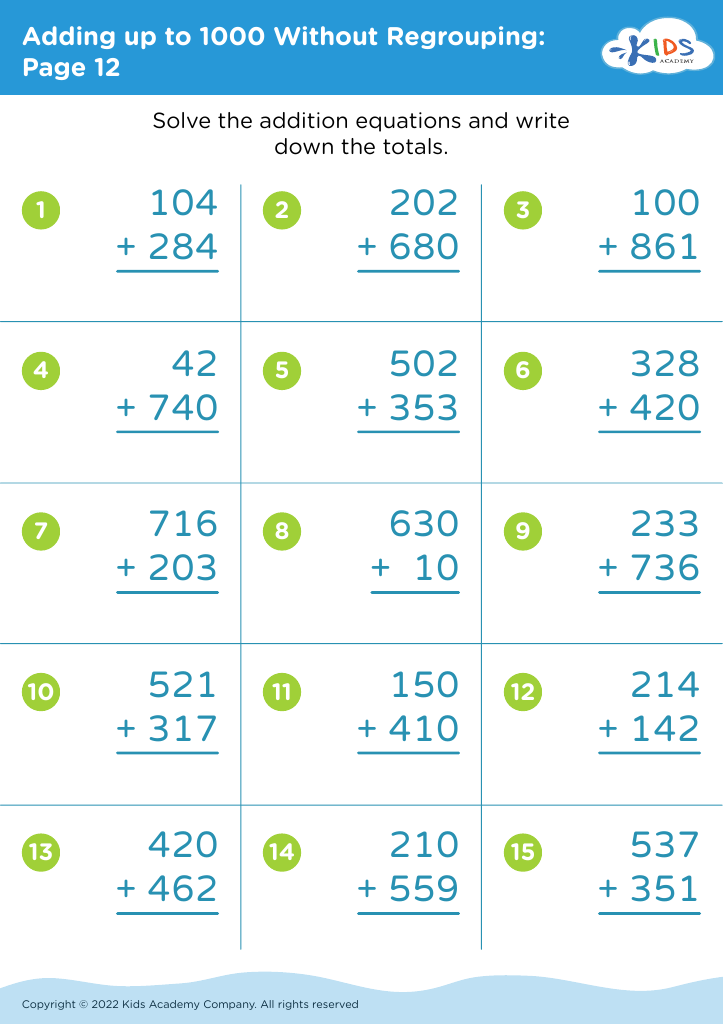
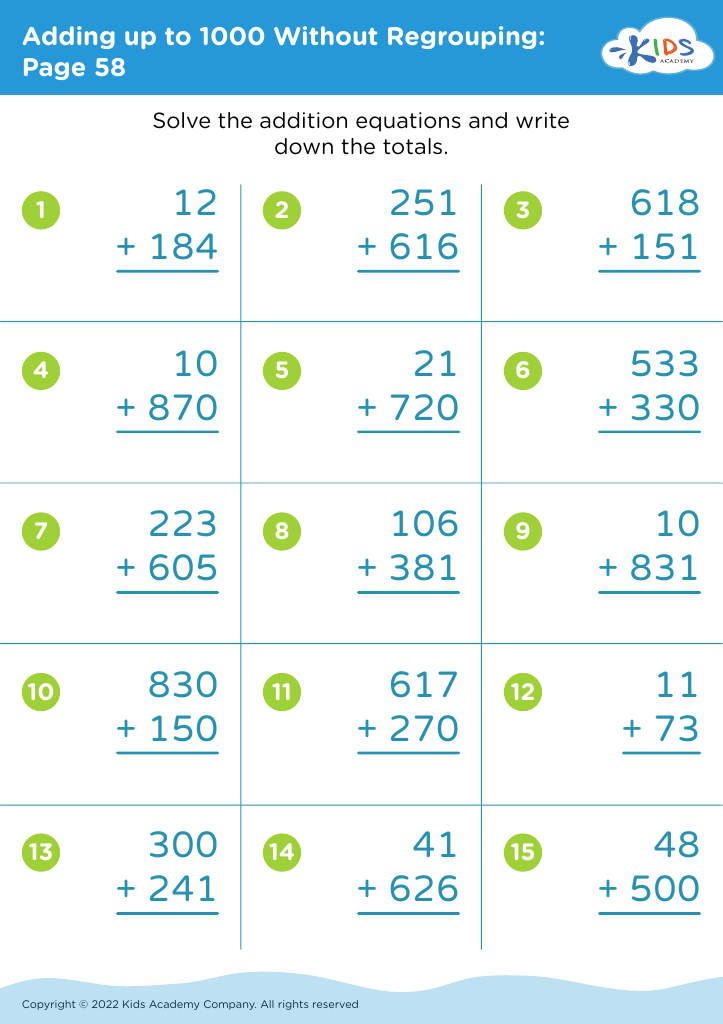
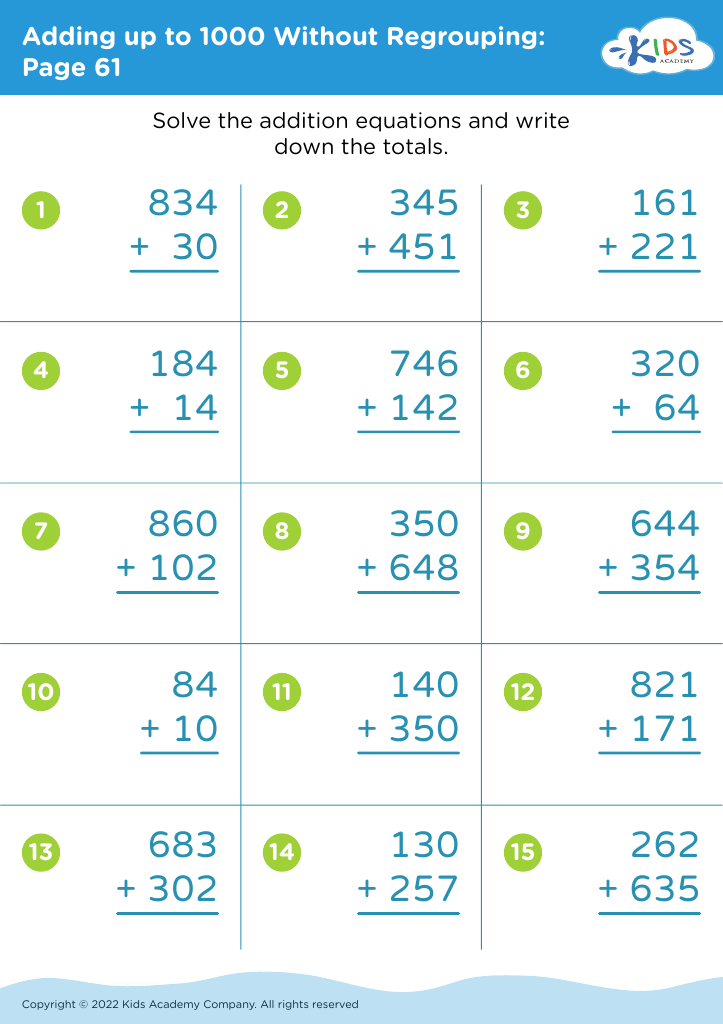


Recognizing shapes and mastering addition without regrouping are fundamental skills for children aged 5-7, forming the building blocks for future learning in mathematics and geometry. Parents and teachers should prioritize these skills for several reasons.
Firstly, recognizing shapes enhances visual and spatial awareness, which aids in problem-solving and creativity. Children encounter shapes in everyday life—from nature to architecture—which helps them relate mathematical concepts to real-world scenarios. This understanding promotes critical thinking and observation.
Secondly, learning to add up to 1000 without regrouping lays a strong arithmetic foundation. It reinforces number sense, instills confidence, and develops mental math abilities crucial for tackling more complex operations later. It prepares students for future curriculum challenges and avoids confusion that often arises with regrouping.
Furthermore, both skills promote cooperative learning and communication. Engaging in shape-related activities encourages teamwork, while addition games bolster social interaction and healthy competition among peers.
In essence, focusing on these skills ensures children are well-equipped for academic success and future problem-solving. By nurturing these foundational strengths, parents and teachers can inspire a love for learning and build confident, capable young mathematicians.