Pattern recognition Adding up to 1000 Worksheets for Ages 5-7
3 filtered results
-
From - To
Discover our engaging "Pattern Recognition Adding Up to 1000 Worksheets" tailored specifically for children ages 5-7. Our worksheets develop essential math skills by guiding kids through fun, interactive exercises that bolster their ability to recognize patterns in numbers and practice addition up to 1000. Designed by education experts, these activities enhance cognitive development, foster critical thinking, and build a strong mathematical foundation for young learners. Perfect for both classroom and at-home learning, our worksheets make mastering math enjoyable and accessible. Visit Kids Academy to download now and watch your child's confidence and skills soar!
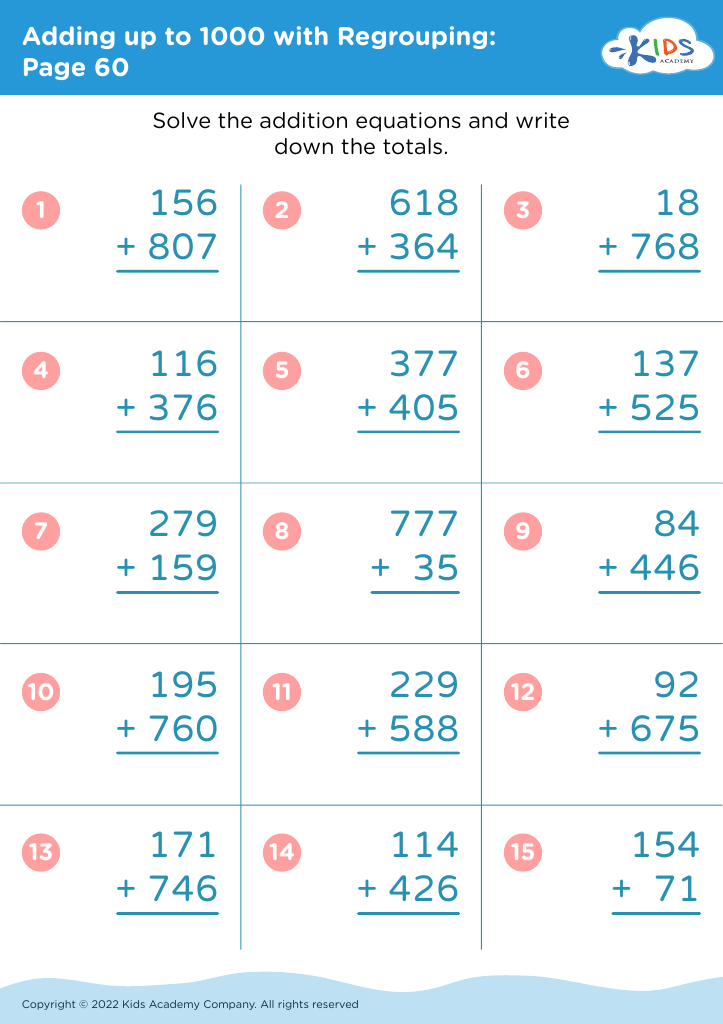
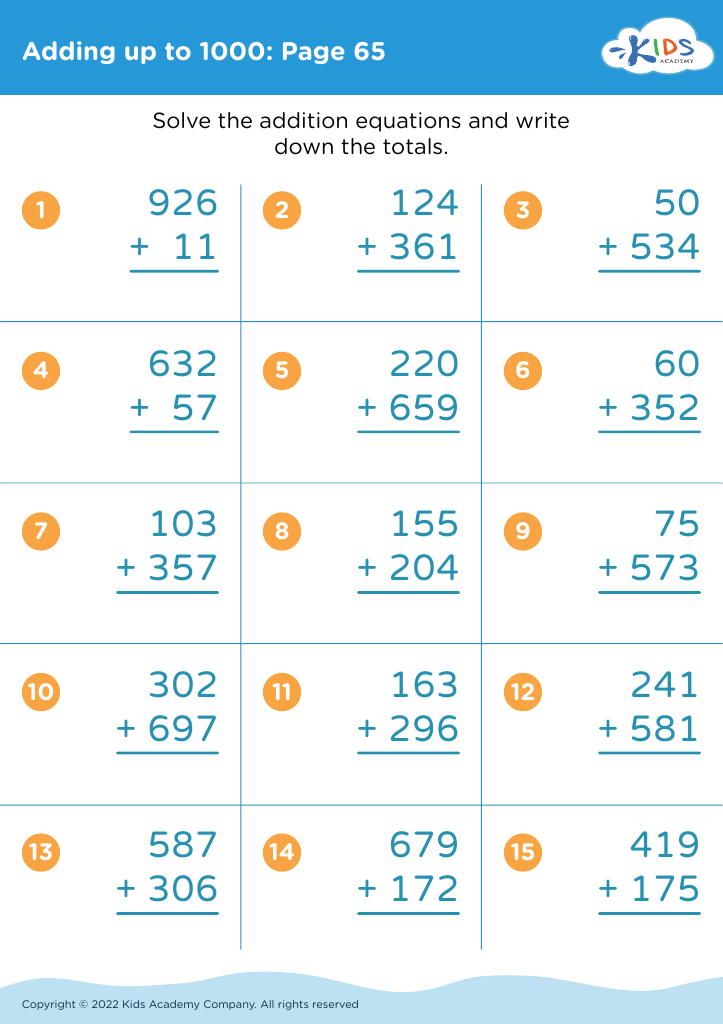
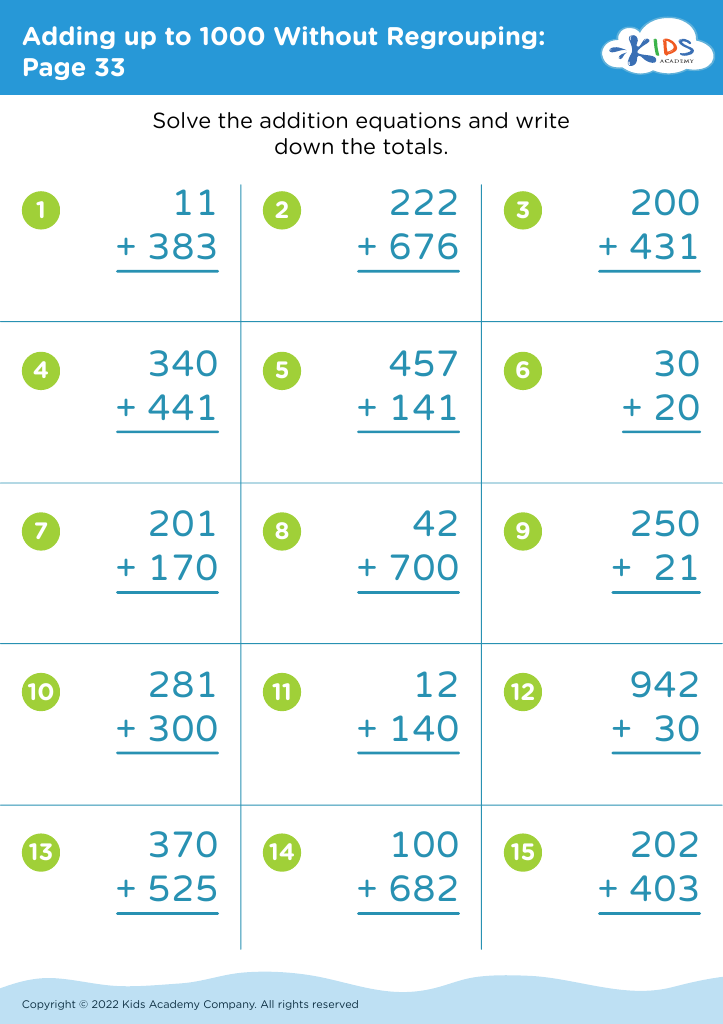



Pattern recognition and adding up to 1000 are foundational skills for young children aged 5-7 that should be emphasized both by parents and teachers. These skills play a significant role in cognitive development and prepare children for more advanced mathematical concepts.
First, pattern recognition helps children identify and predict sequences, which is a crucial aspect of problem-solving and logical thinking. Recognizing patterns enhances their ability to understand numeric relationships and symmetries, which are fundamental in various mathematical operations.
Second, learning to add up to 1000 introduces children to large numbers and acclimates them to the base-10 system, the foundation of our number system. It builds confidence in handling bigger quantities, promoting numeracy and a sense of scale. This foundational math skill is directly linked to real-life activities like shopping or measuring, making everyday experiences more comprehensible and manageable.
Combined, these skills foster critical thinking, attention to detail, and conceptual understanding. They form the bridge from simple counting to more complex mathematical tasks. By honing these skills early, parents and teachers equip children with the necessary tools to excel not only in mathematics but also in any discipline requiring analytical and critical thinking. Investing in these areas lays a solid groundwork for future academic success.








