Understand patterns Adding up to 1000 Worksheets for Ages 5-7
3 filtered results
-
From - To
Help your child grasp essential math skills with our "Understand Patterns Adding Up to 1000 Worksheets" designed for ages 5-7. These engaging worksheets focus on teaching children how to recognize and understand numerical patterns, a vital component in their mathematical development. By exploring addition problems that total up to 1000, your little one will gain confidence in their math abilities while enjoying interactive activities. Crafted for young learners, our worksheets promote critical thinking and enhance problem-solving skills. Foster your child's love for math today, and watch them become proficient with numbers through fun and educational experiences!
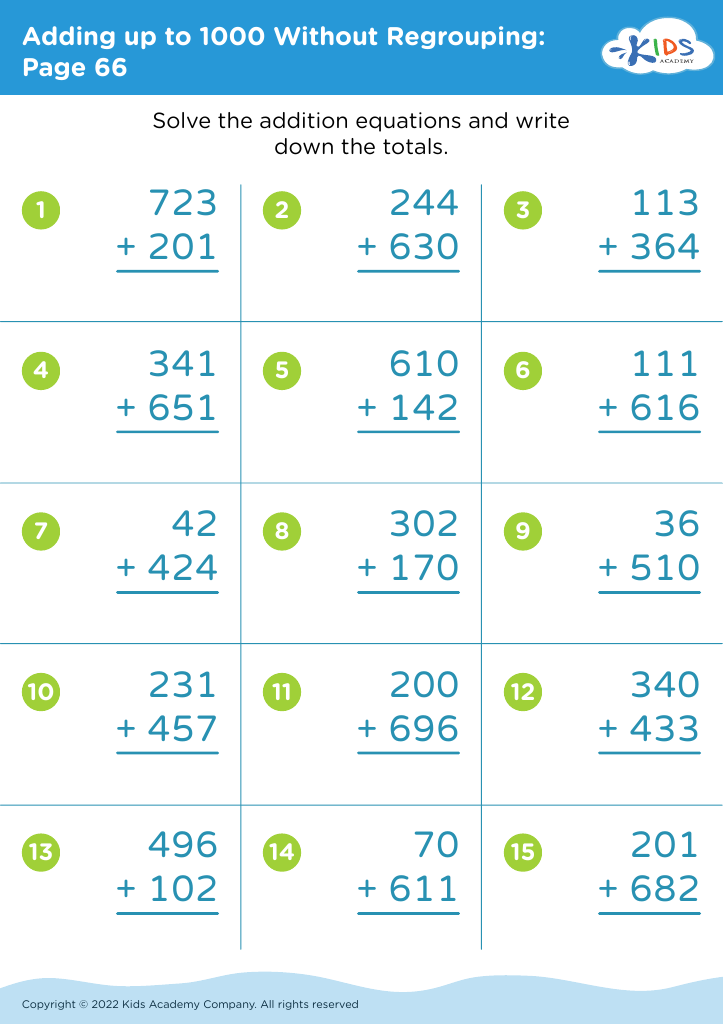
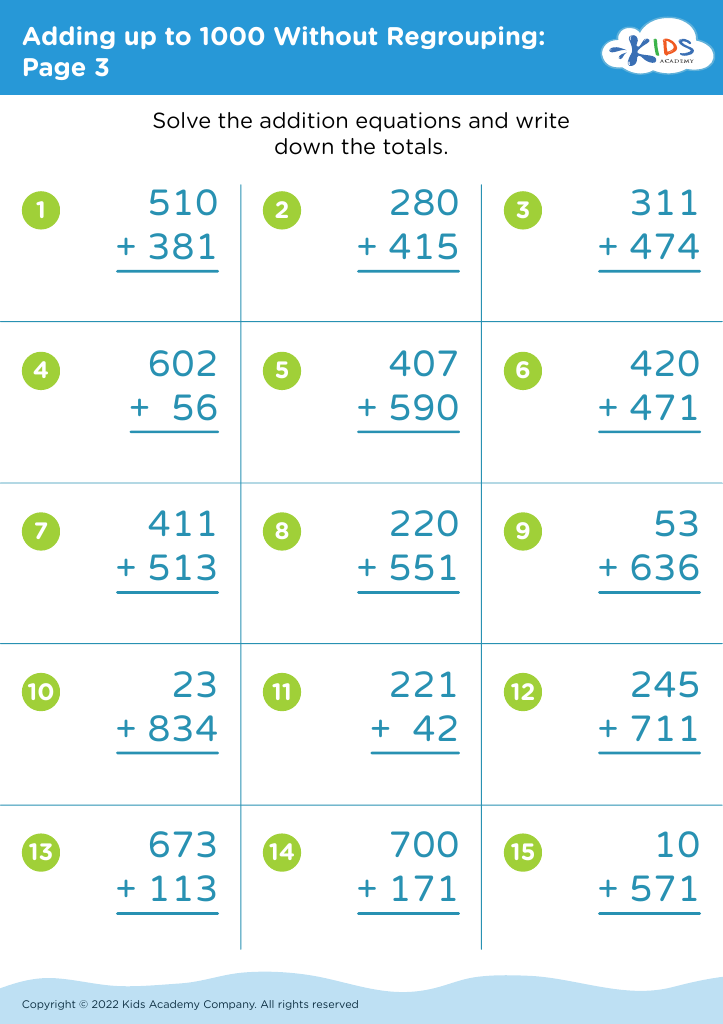
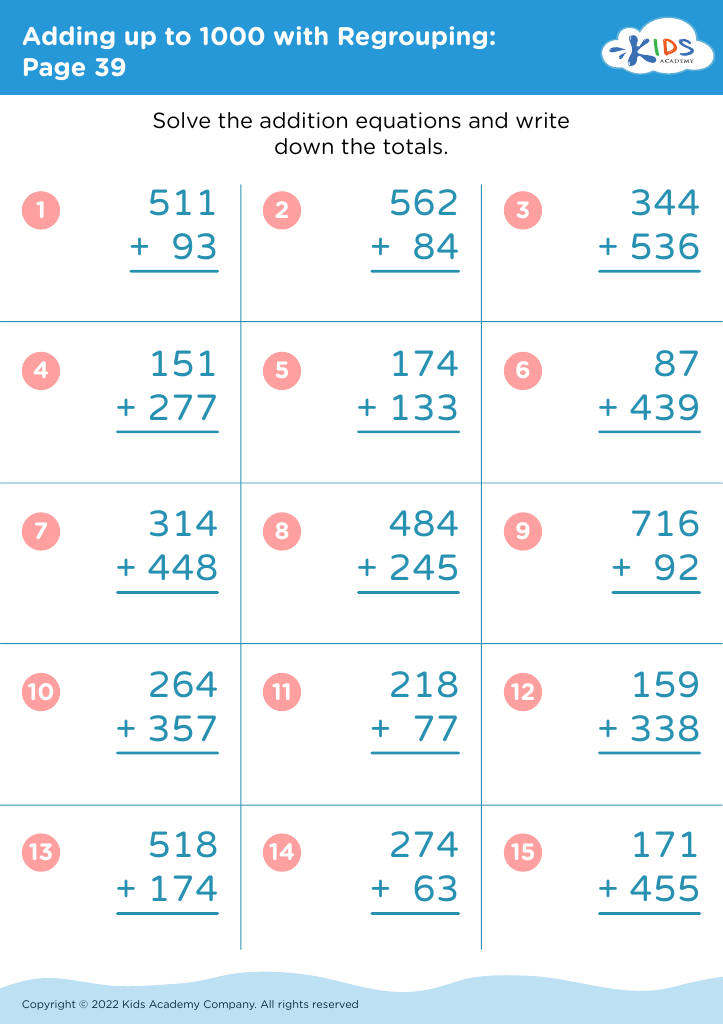



Understanding patterns, particularly in the context of adding up to 1000, is crucial for children aged 5-7 as it forms the foundation for their mathematical skills. When children grasp the concept of patterns, they begin to recognize relationships between numbers, which enhances their ability to add, subtract, and perform other calculations efficiently. Learning to add up to 1000 through patterns helps children develop important analytical skills, enabling them to identify and predict mathematical sequences.
Moreover, strong numeracy skills are essential not only for academic success but also for everyday life. Recognizing patterns fosters critical thinking, problem-solving, and logical reasoning—all necessary abilities as children progress in their education. For parents and teachers, emphasizing this concept helps nurture a child’s love for math and encourages them to engage more fully in learning activities.
Additionally, pattern recognition prepares students for more advanced concepts in mathematics. By establishing these essentials early on, parents and teachers provide children with a solid base, empowering them to tackle more complex subjects confidently in the future. This investment in early education can lead to greater success in school and beyond, equipping children with essential life skills that extend beyond the classroom.








