Fraction comparison Adding up to 50 with Regrouping Worksheets for Ages 5-7
3 filtered results
-
From - To
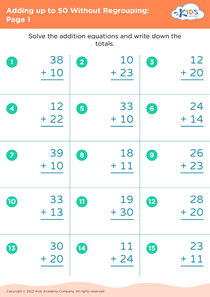
Introduce your young learners to the fundamentals of fractions and addition with our "Fraction Comparison: Adding up to 50 with Regrouping Worksheets for Ages 5-7." These engaging worksheets are specifically designed to enhance your child’s understanding of fractions, comparison skills, and regrouping concepts in a fun and interactive way. Kids will be tasked with solving problems that involve adding quantities up to 50, ensuring they grasp the essentials of borrowing and carrying over in the process. Ideal for early grade students, our printables offer a balanced mix of enjoyment and education, setting a strong foundation for future math success.
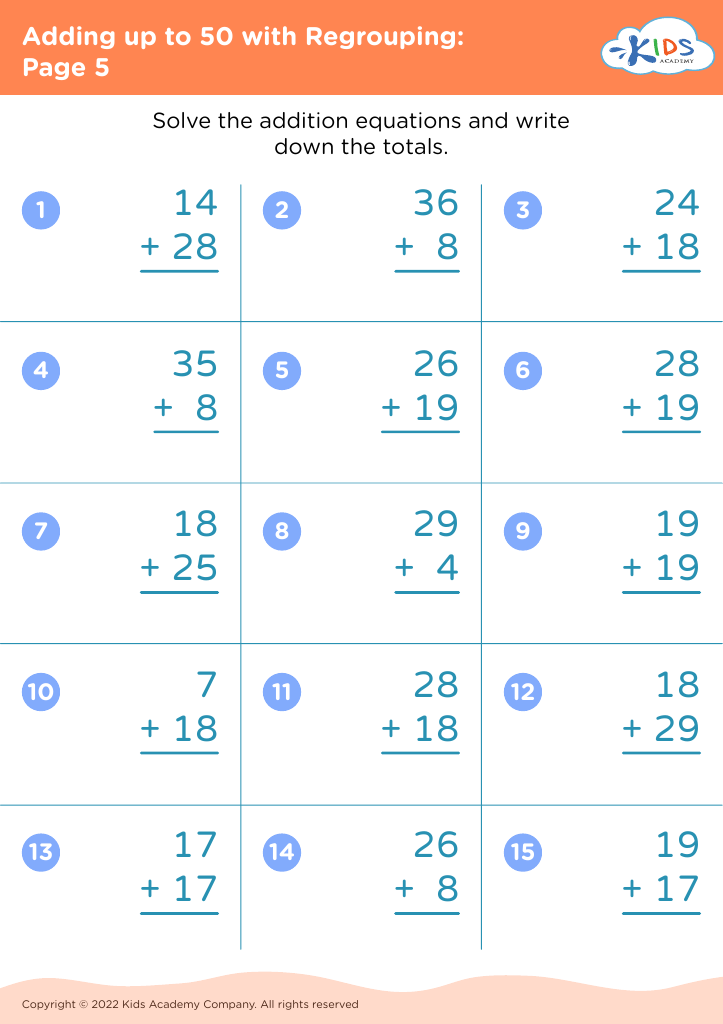
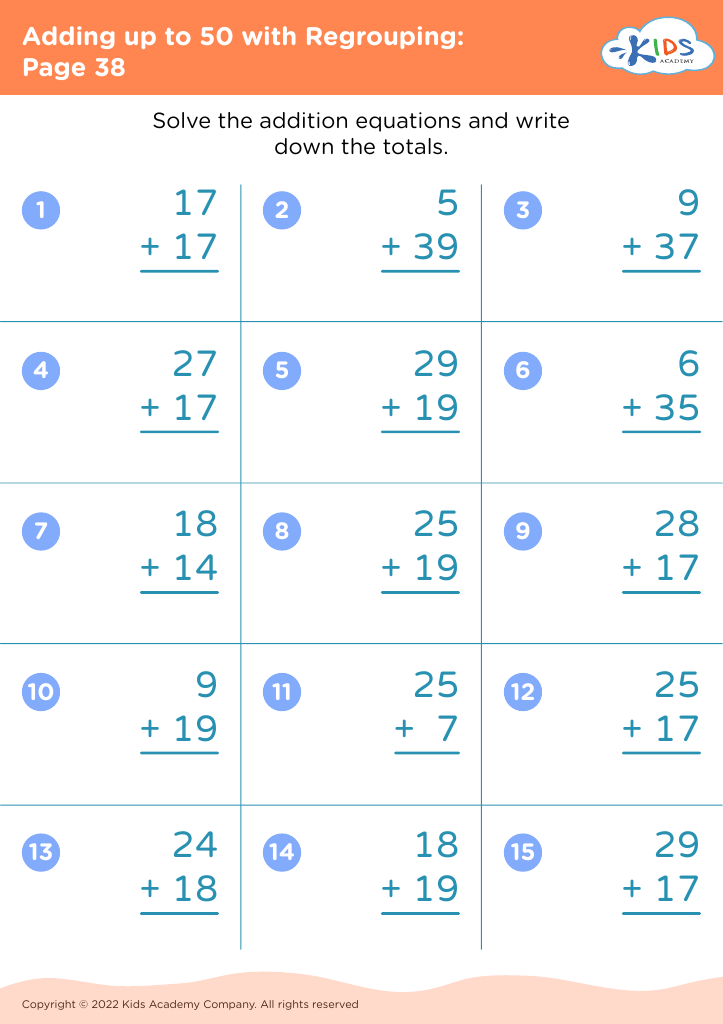
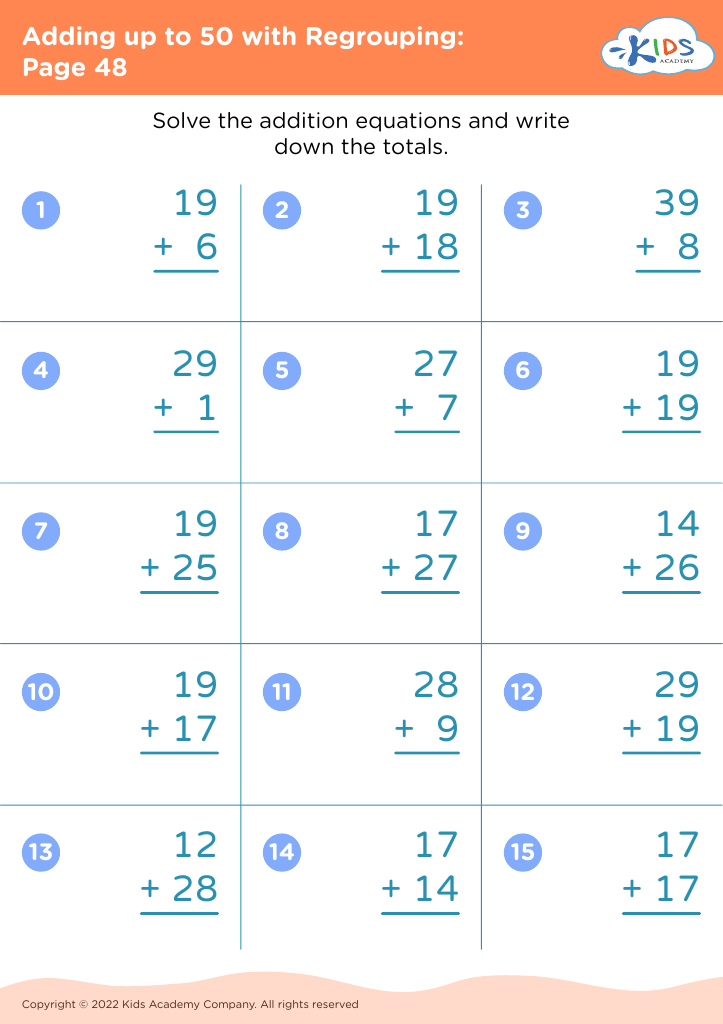


Parents and teachers should care about teaching fraction comparison and adding up to 50 with regrouping to children aged 5-7 because these foundational skills are crucial for their mathematical development. Early exposure to fractions helps kids understand the concept of parts of a whole, which is essential for more advanced math topics, such as algebra and geometry. Learning how to compare fractions fosters critical thinking and enhances their ability to evaluate and reason quantitatively.
Adding up to 50 with regrouping introduces children to the concept of place value, the cornerstone of our number system. It helps young learners grasp how numbers are structured and how they can be broken down and reassembled—skills that are vital for addition, subtraction, and even multiplication and division later on. Regrouping, also known as carrying or borrowing, is a strategy that ensures children understand the mechanics behind arithmetic operations, promoting accuracy and fluency in their calculations.
These skills collectively build a strong mathematical foundation, increasing children's confidence and setting them up for success in later stages of their education. Investing time in teaching these concepts early on will enable children to tackle more complex problems with ease, fostering a love and appreciation for mathematics that can last a lifetime.