Motor skills development Addition & Subtraction Worksheets for Ages 5-7
5 filtered results
-
From - To
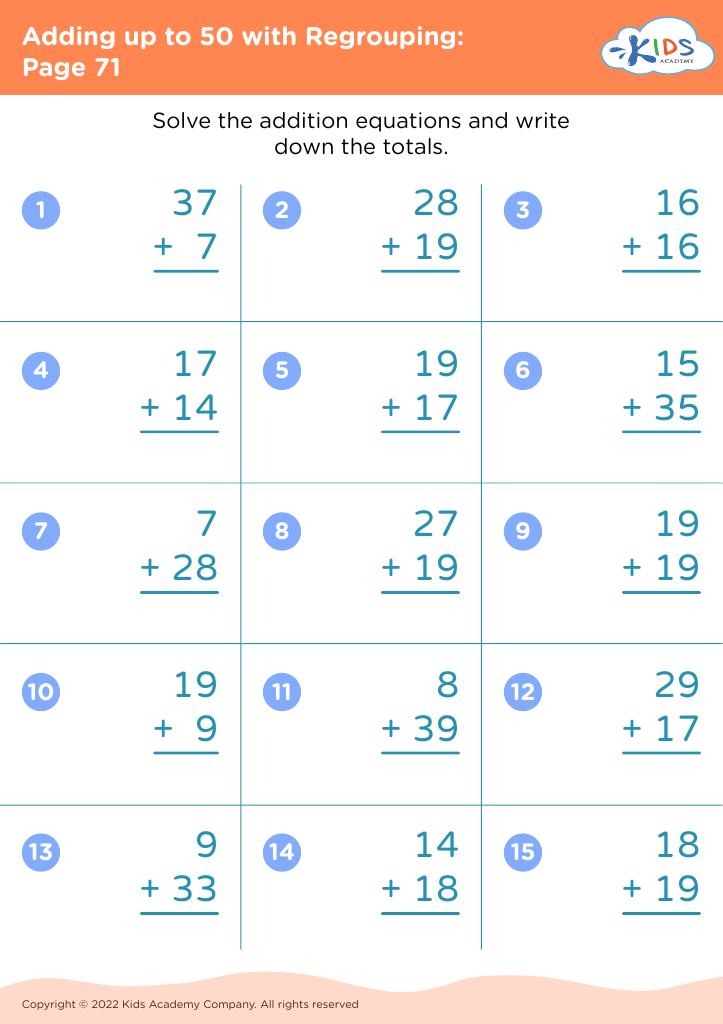
Enhance your child's motor skills while mastering essential math concepts with our Addition & Subtraction Worksheets designed for ages 5-7. These engaging, printable worksheets not only focus on fundamental arithmetic skills but also promote fine motor development. Each activity encourages kids to practice drawing, tracing, and writing numbers, helping them gain confidence in both math and their motor abilities. Our user-friendly layout and colorful designs make learning enjoyable, ensuring that your child stays motivated. Perfect for home or classroom use, these worksheets offer a fun way to combine education and skill-building. Start your child's learning journey today with our thoughtfully crafted resources!








Motor skills development, particularly during ages 5-7, plays a crucial role in enhancing children's learning capabilities, including their understanding of foundational math concepts such as addition and subtraction. During this stage, children are exceptionally receptive to new information, making it an ideal time to integrate physical activities that promote both fine and gross motor skills.
Fine motor skills, developed through activities like cutting, drawing, or manipulating small objects, enhance children's ability to engage with math tools such as counters, blocks, or even writing numerals comfortably. As they grasp these physical skills, tasks like counting or visualizing addition and subtraction become more manageable and engaging.
Gross motor skills, developed through larger movements like jumping or climbing, can be used in interactive math games, allowing children to enact mathematical principles physically. This kinesthetic approach helps children grasp abstract concepts visually and physically, reinforcing their understanding and retention.
Moreover, when parents and teachers actively promote motor skills along with math practice, they foster overall cognitive development, confidence, and a positive attitude towards learning. By emphasizing the link between physical movement and mathematical thinking, caregivers can cultivate a comprehensive, engaging experience that prepares children for future academic success.








