
Understanding money Addition & Subtraction Worksheets for Ages 5-7
4 filtered results
Difficulty Level
Grade
Age
-
From - To
Subject
Activity
Standards
Discover the "Understanding Money Addition & Subtraction Worksheets for Ages 5-7" designed to make learning engaging and fun! These worksheets introduce young learners to essential math skills while incorporating real-life money concepts. Through colorful illustrations and interactive exercises, children will practice adding and subtracting using coins and bills. Each worksheet aims to enhance financial literacy and reinforce addition and subtraction skills in an age-appropriate manner. Perfect for home or classroom use, these resources cater to diverse learning styles, ensuring that children grasp money math fundamentals effectively while building confidence in their abilities. Start your child's money math journey today!
Favorites
With answer key
Interactive
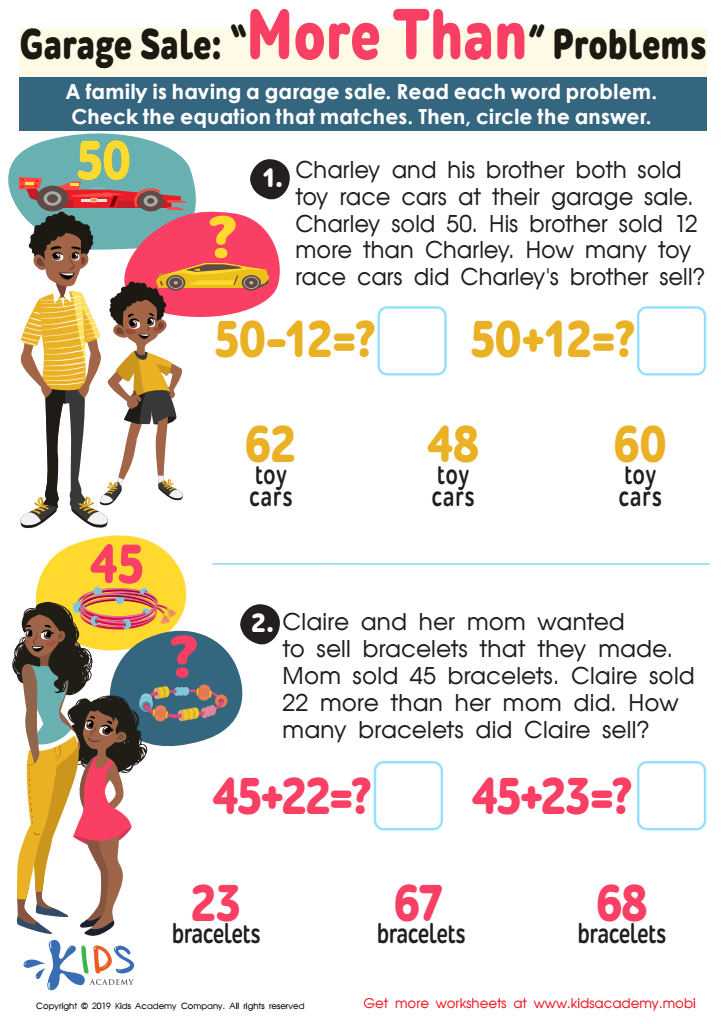
Garage Sale - More yhan Worksheet
The whole family can join in on the fun with this free worksheet! It helps kids practice math word problems while assisting their friends with a garage sale. Kids learn to identify "More Than" key words and pick the right equation, improving their order of operations skills. Download the PDF and get started!
 Assign to My Students
Garage Sale - More yhan Worksheet
Worksheet
Join Kids Academy for Free
Who is primarily going to use this learning content?








Understanding money, along with addition and subtraction, is a fundamental skill for children aged 5-7, which is crucial for their overall development. At this age, kids are naturally curious about the world around them and are often exposed to money through daily activities like shopping. Teaching them about money helps connect math concepts to real-life situations, making learning more engaging and relevant.
When children learn to identify coins, understand their values, and practice addition and subtraction with money, they are developing essential numeracy skills. These skills lay the foundation for future mathematical concepts, fostering confident problem-solving abilities. Moreover, this knowledge promotes financial literacy from an early age, equipping children with the skills necessary to make informed decisions about money as they grow.
Parents and teachers should care about this topic because it encourages critical thinking, strengthens mental math abilities, and instills a sense of responsibility in kids. Empowering children to understand money management boosts their independence, preparing them for everyday tasks in the future, such as shopping, budgeting, and saving. By integrating these concepts into learning, adults play a pivotal role in cultivating financially savvy and mathematically capable individuals.








